The National Green Tribunal (Western Zone Bench, Pune) has upheld the joint Coastal Regulation Zone (CRZ) and environmental clearance granted to Jawaharlal Nehru Port Authority (JNPT) for widening of the existing container berth. The Tribunal rejected the appeal filed by Paramprik Machimmar Bachav Samajik Kruti Samittee, finding that the clearance was granted after due process and compliance with statutory safeguards.
Background & Facts
The Dispute
The appellant, a social organization representing fishing communities in Uran Taluka, Raigad, challenged the grant of joint CRZ and environmental clearance by the Ministry of Environment, Forests and Climate Change (MoEF&CC) on 15.03.2024 for the widening of the existing container berth at JNPT. The project involves increasing the crane rail span, widening the deck, and upgrading the berth structure within the port limits.
Key Facts
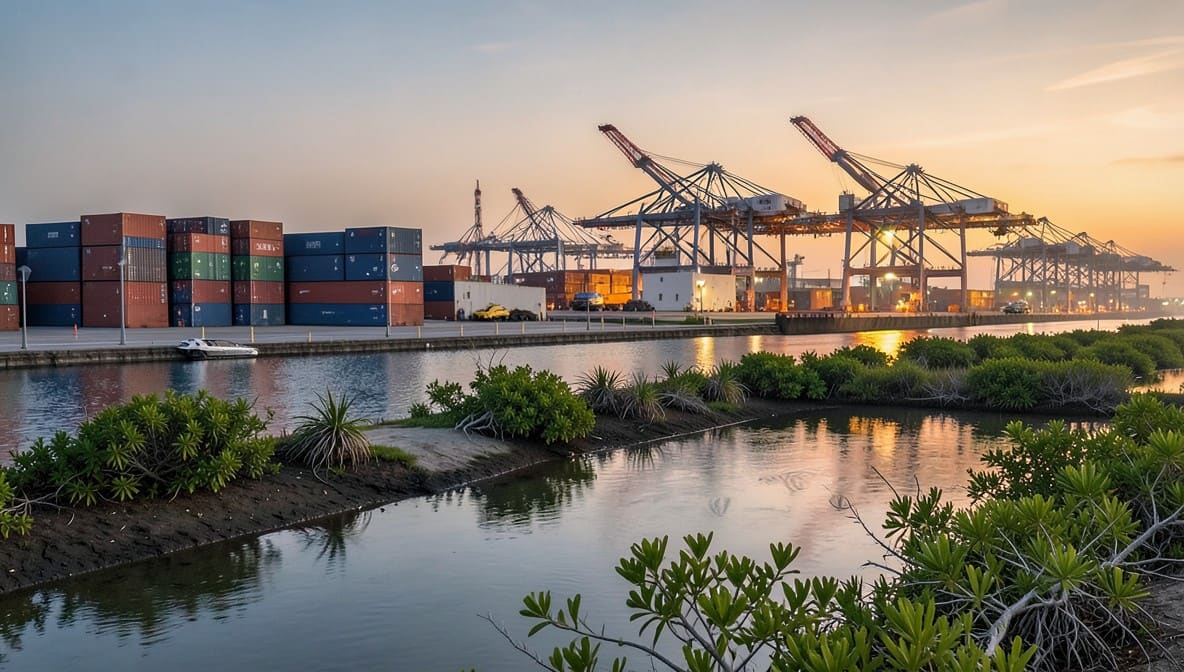
- JNPT operates from Nhava Sheva, Uran Taluka, Raigad, since 1989. The port was established on land reclaimed from the Arabian Sea’s creek system, including estuaries such as Sheva, Nhava, Gavhan, Belpada, Sonari, Uran, Dongari, Bokadvira, Funde, and Jaskhar.
- The creek system covers approximately 100 sq.km and supports mangroves, mudflats, and rich fishing grounds. The livelihoods of local communities, including fishermen, salt pan workers, and agriculture laborers, depend on these ecosystems.
- The project proposes to widen the existing container berth by increasing the crane rail span from 20 meters to 30.15 meters and deck width by 15 meters, within the port’s operational area. No seaward extension or dredging is envisaged.
- The appellant contended that the project would destroy wetlands, mangroves, and fishing grounds, and that the Environmental Impact Assessment (EIA) report contained false and misleading information regarding the impact on fisheries.
Procedural History
- 01.09.2023: Terms of Reference (ToR) issued by MoEF&CC for EIA/EMP preparation.
- 01.12.2023: Public hearing conducted by Maharashtra Pollution Control Board (MPCB) at JNPT Colony, Uran.
- 11.01.2024: Minutes of public hearing submitted to MoEF&CC.
- 06.02.2024 & 07.02.2024: Expert Appraisal Committee (EAC) of MoEF&CC considered the proposal in its 356th meeting and recommended grant of environmental and CRZ clearance.
- 15.03.2024: MoEF&CC granted composite environmental and CRZ clearance to JNPT, subject to conditions.
- 01.12.2023: Appellant addressed a letter to District Collector, Raigad, highlighting non-compliance with previous clearances and impact on fishing communities.
- 08.04.2024: Appellant reiterated objections and sought revocation of clearance.
- 27.04.2026: Arguments heard by NGT; further submissions made on 18.06.2026.
- 22.07.2026: Judgment reserved and pronounced.
Relief Sought
The appellant sought quashing of the CRZ and environmental clearance dated 15.03.2024, and restoration of the pre-project status quo. The relief included a direction to revoke the clearance and conduct fresh environmental impact studies.
The Legal Issue
The central question was whether the MoEF&CC and Maharashtra Coastal Zone Management Authority (MCZMA) complied with the Environment Impact Assessment Notification, 2006 and CRZ Notification, 2011 in granting joint environmental and CRZ clearance for the widening of the container berth at JNPT. Specifically, whether the EIA report adequately assessed the impact on marine ecology, fisheries, and livelihoods of local communities, and whether the procedural safeguards were followed.
Arguments Presented
For the Appellant
Ms. Meenaz Kakalia, counsel for the appellant, argued:
- The EIA report contained false and misleading information, particularly regarding the impact on fisheries. It relied on outdated and secondary data, and sections were copied from unrelated reports.
- The project would adversely affect mangroves, mudflats, and fishing grounds, and no adequate mitigation measures were proposed.
- The public hearing did not reflect genuine participation, as objections raised by fishing communities were not addressed.
- The clearance was granted without critical analysis of the EIA report or independent verification of claims.
For the Respondents
Counsel for JNPT, MoEF&CC, MCZMA, and MPCB argued:
- The project falls within CRZ-IVA and does not involve seaward extension or large-scale construction. It is limited to widening the berth landward.
- Fresh EIA studies were conducted, including marine biodiversity assessments by CSIR-NIO, and mitigation measures were prescribed.
- The ToR required studies on fishing activity and marine ecology, which were completed and submitted.
- The clearance was granted after due process, including public hearing and EAC deliberations, and compliance with statutory conditions.
The Court's Analysis
The Tribunal examined the procedural compliance and substantive adequacy of the clearance process.
The Tribunal noted that the project falls within CRZ-IVA and does not involve dredging or seaward extension. The EIA report included studies by CSIR-NIO on marine ecology and fisheries, which identified 117 species in Thane Creek, including finfish and shellfish. The report acknowledged potential impacts of turbidity on fish populations but proposed mitigation measures, including:
- Restrictions on dredging during fish breeding seasons.
- Confined dredging to minimize environmental impact.
- Independent monitoring by government agencies.
- Preparation of a Marine Biodiversity Management Plan (MBMP) by NIO or a reputed institute.
- Regular monitoring of marine ecology and fisheries.
The Tribunal rejected the appellant’s contention that the EIA report was a copy-paste of unrelated studies. It found that the report cited secondary sources but also included primary data collection and site-specific studies. The Tribunal observed:
"The source has been duly quoted in the current study that they have taken assistance from the detailed Project Report of Nhava Sheva Port. So, there is no concealment in this regard that secondary study material was taken from that report but it does not mean that no original study was conducted in the case in hand with the present project in site."
The Tribunal also noted that the clearance was granted subject to 20 specific conditions, including:
- Maintenance of free flow of tidal water and prevention of creek blockage.
- Use of stilt curtains during dredging to contain sediment spread.
- Preparation and implementation of a Marine Biodiversity Management Plan.
- Regular monitoring and submission of six-monthly compliance reports.
- Restrictions on dredging during fish breeding and spawning seasons.
The Tribunal held that the clearance was granted after due process and compliance with statutory safeguards. It found no infirmity in the clearance and upheld the same.
The Verdict
The National Green Tribunal dismissed the appeal with no order as to costs. The joint CRZ and environmental clearance dated 15.03.2024 granted to Jawaharlal Nehru Port Authority for widening of the existing container berth was upheld. The Tribunal found that the clearance was granted after due process, compliance with statutory safeguards, and adequate mitigation measures.
What This Means For Similar Cases
Procedural Compliance Is Non-Negotiable
- Authorities must strictly comply with the Environment Impact Assessment Notification, 2006 and CRZ Notification, 2011 in granting clearances.
- Public hearings must reflect genuine participation, and objections must be addressed in the decision-making process.
- The Tribunal emphasized that the ToR must be followed, and studies must be site-specific and not rely solely on secondary data.
Mitigation Measures Must Be Specific and Enforceable
- Clearances must include specific, enforceable conditions to mitigate environmental impact.
- Conditions must address cumulative impacts, particularly on marine ecology and fisheries.
- Independent monitoring and regular reporting are essential to ensure compliance.
Marine Ecology Assessments Must Be Comprehensive
- EIA reports must include primary data collection and site-specific studies.
- Marine biodiversity management plans must be prepared by reputed institutes and implemented.
- Regular monitoring of marine ecology, including fisheries, mangroves, and mudflats, is necessary.
Transparency and Accountability Are Key
- Authorities must ensure transparency in decision-making and provide reasoned justifications for their decisions.
- The Tribunal’s scrutiny reinforces the need for authorities to critically analyze EIA reports and not rely solely on the project proponent’s submissions.