The Meghalaya High Court has affirmed that the absence of a formal order of disengagement from public service, even where service has been effectively terminated, entitles the affected employee to equitable compensatory relief. This judgment reinforces the principle that procedural fairness and substantive justice must prevail over technicalities in service matters involving long-serving personnel.
Background & Facts
The Dispute
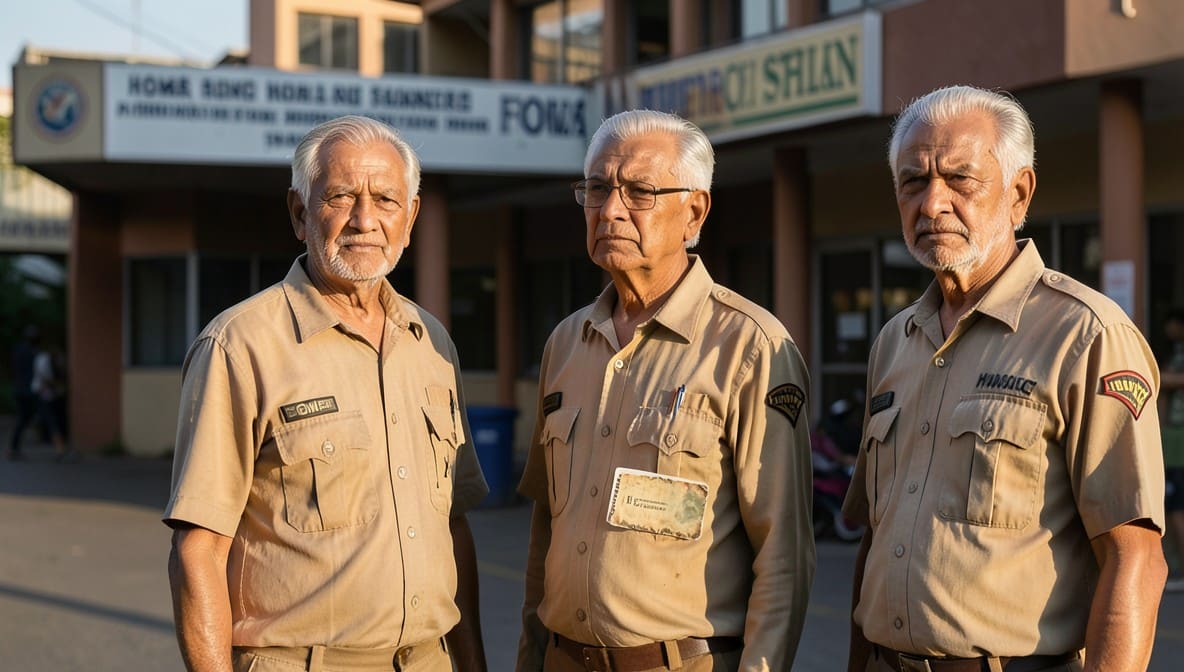
The petitioners, Shri Emanuel Lamare, Imjing Mut Sten, and Shri Ram Dkhar, were employed as Home Guards in the West Jaintia Hills district of Meghalaya. They were engaged on a contractual or temporary basis under the State’s Home Guards Scheme and had rendered continuous service for approximately 36 years. Despite their long tenure, they were never formally appointed to permanent posts or issued regular service orders. On 1st December 2022, they were informed via letter from the Chief Engineer, PHE, that their services were being discontinued. A subsequent letter dated 19th June 2023 from the District Home Guards Commandant reiterated the discontinuance without any formal order of termination, retirement, or discharge.
Key Facts
- The petitioners began service in the early 1980s and continued without interruption until June 2023
- No formal order of termination, retirement, or discharge was ever issued to any of the petitioners
- They were not provided with a notice period, reasons for discontinuance, or opportunity of hearing
- The petitioners were informed of discontinuance through informal letters only
- The petitioners were eligible for retirement between February and April 2025 under normal service norms
- They had not been paid any salary or allowances from the date of discontinuance until their actual retirement
- The petitioners retired on superannuation in early 2025, after the discontinuance notice
Procedural History
- 19th June 2023: District Home Guards Commandant issued letter discontinuing services
- 2023: Writ Petition (WP(C) No. 220 of 2023) filed before the Single Judge of the High Court
- 18th July 2025: Single Judge directed payment of ₹1 lakh each as compensatory relief
- 2026: Appeal filed by the State challenging the compensation order
- 24th March 2026: Division Bench heard the appeal and delivered judgment
Relief Sought
The petitioners sought:
- Declaration that their service was not lawfully terminated
- Direction to continue service till retirement age
- Payment of back wages and allowances for the period from discontinuance to retirement
- Regularization of service
The Parties' Positions
The petitioners contended that their 36 years of continuous service created a legitimate expectation of service continuity, and that the absence of a formal order rendered the discontinuance illegal and void. The State argued that the petitioners were never regular employees, were engaged on ad hoc basis, and had no legal right to claim service beyond the term of their engagement.
Relief Sought
The petitioners sought reinstatement or, alternatively, payment of back wages and benefits for the period from discontinuance to retirement. The Single Judge, while declining reinstatement, awarded ₹1 lakh each as compensatory relief.
The Legal Issue
The central question was whether the failure to issue a formal order of disengagement, despite termination of service through informal communication, entitles long-serving temporary employees to compensatory relief under principles of equity and natural justice.
Arguments Presented
For the Appellant/Petitioner
Learned counsel argued that the petitioners had rendered 36 years of uninterrupted service under the State’s scheme, creating a legitimate expectation of service continuity. The absence of any formal order of termination violated the principles of natural justice under Article 14 and Article 21 of the Constitution. Reliance was placed on State of Haryana v. Bhajan Lal and Union of India v. Rameshwar Prasad to assert that even temporary employees are entitled to procedural fairness. The Court was urged to recognize that the State cannot terminate service without due process, especially after decades of service.
For the Respondent/State
The State contended that the petitioners were never regular employees and were engaged under temporary or contractual arrangements governed by administrative orders, not statutory rules. The State argued that no formal appointment or confirmation had ever been made, and therefore, no legal right to continued service arose. It further submitted that the petitioners had not suffered any financial loss as they had not rendered service during the disputed period and had already retired.
The Court's Analysis
The Division Bench, while acknowledging the State’s position on the temporary nature of the petitioners’ engagement, emphasized that the absence of a formal order of disengagement rendered the termination procedurally defective. The Court noted that the petitioners had served for over three decades, during which they performed duties assigned by the State, received remuneration, and were subject to departmental control. The Court held that such long-term service, even if not regularized, created a moral and equitable claim.
"In the circumstances therefore, considering the fact that, had the petitioners continued in service from the date of disengagement till retirement, the amount of salary payable would be over Rs.7 Lakhs each, and considering the fact that they were never served with formal orders of disengagement, and also that they have not rendered any service for this period, this Court deems it fit and proper in the interest of justice and equity to direct the respondents to pay the petitioners a sum of Rs.1 Lakh each, as a compensatory amount to bring a quietus to the matter."
The Court found no error in the Single Judge’s reasoning that while reinstatement was not feasible - given that the petitioners had already retired - the denial of a formal order of termination was a procedural violation warranting equitable redress. The Court rejected the State’s argument that no loss had occurred, observing that the deprivation of service continuity and the lack of procedural fairness constituted a distinct injury. The award of ₹1 lakh was deemed proportionate, given the duration of service and the absence of any formal process.
The Verdict
The appeal was dismissed. The Division Bench upheld the Single Judge’s order dated 18th July 2025, directing the State to pay each petitioner a compensatory amount of ₹1 lakh. The Court mandated that the payment be made within three weeks from 24th March 2026, and directed the matter to be listed on 21st April 2026 to confirm compliance. The petitioners, having already retired, were not reinstated, but were granted monetary relief as a measure of equity.
What This Means For Similar Cases
Formal Orders Are Non-Negotiable in Service Termination
- Practitioners must now argue that even for temporary or contractual employees, termination without a formal order violates Article 14 and Article 21
- Administrative letters or oral communications cannot substitute for statutory or procedural termination orders
- Courts may award compensatory relief even where reinstatement is not possible, especially after long service
Long-Term Service Creates Equitable Claims
- Continuous service exceeding 15 - 20 years, even without regularization, may trigger equitable entitlements
- Courts are increasingly willing to recognize moral obligations arising from decades of public service
- Compensation, not reinstatement, is emerging as the preferred remedy where service has ended but procedural fairness was denied
State Cannot Benefit from Its Own Procedural Lapses
- The State cannot invoke the temporary nature of employment to avoid liability when it has failed to follow its own procedures
- The burden shifts to the State to prove that termination was lawful and procedurally sound
- Failure to issue orders after decades of service will be viewed as an abuse of power, inviting judicial intervention