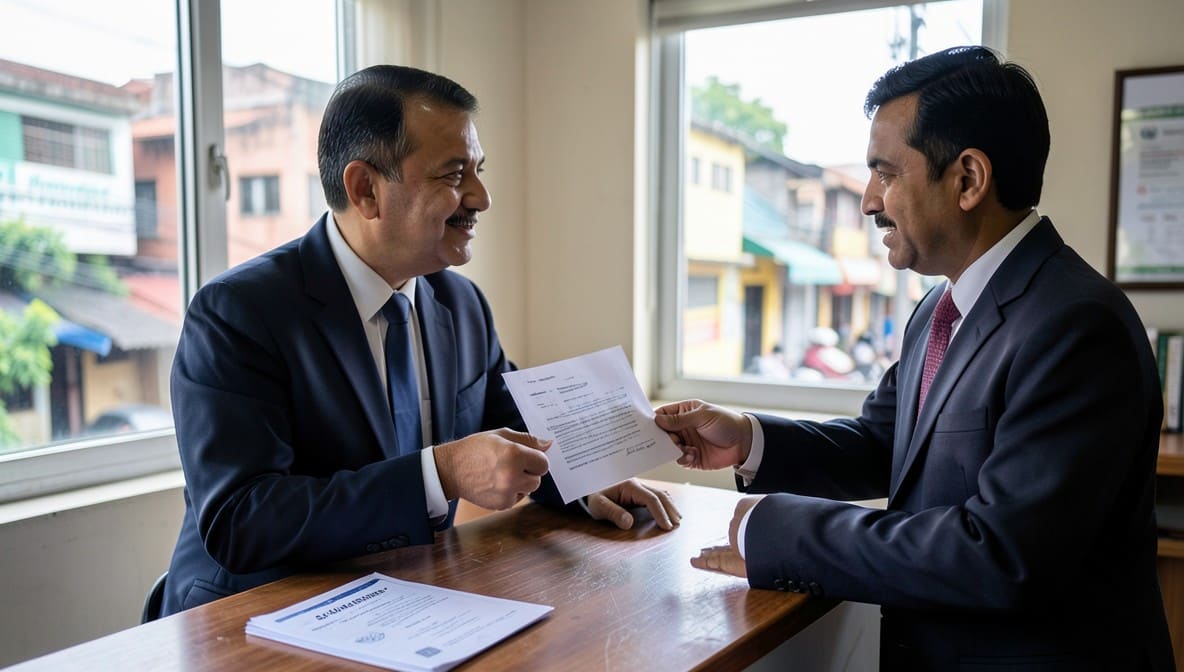
The Madras High Court has reaffirmed that administrative decisions affecting property rights cannot be made without affording a fair hearing. In a decisive ruling, the Court quashed a refusal check slip issued by a Sub Registrar on the grounds that it was a non-speaking order, devoid of any reasoning or consideration of the petitioner’s submissions. This judgment reinforces the foundational principle that procedural fairness is not optional - it is mandatory under Article 21 of the Constitution.
Background & Facts
The Dispute
The petitioner sought to register a sale deed covering three survey numbers in Vilankurichi, Coimbatore, executed through a power of attorney. The Sub Registrar issued a refusal check slip dated 09.12.2025, rejecting the deed solely on the ground that the power of attorney did not contain the schedule of the property. No opportunity for hearing was granted, and no analysis was provided of the petitioner’s supporting documents or legal arguments.
Procedural History
- 09.12.2025: Sub Registrar issued refusal check slip without hearing or reasoning
- 01.01.2026: Petitioner filed Writ Petition under Article 226 challenging the refusal
- 09.03.2026: Madras High Court heard arguments and delivered judgment
Relief Sought
The petitioner sought quashing of the refusal check slip and a direction to the Sub Registrar to register the sale deed. Alternatively, the petitioner requested that the matter be remanded for fresh consideration with compliance to natural justice.
The Legal Issue
The central question was whether an administrative authority, such as a Sub Registrar, may refuse to register a document based on a technical ground without providing a speaking order or affording the party an opportunity to be heard, thereby violating the principles of natural justice.
Arguments Presented
For the Petitioner
The petitioner contended that the refusal check slip was a non-speaking order, violating the principles of natural justice as enshrined in Maneka Gandhi v. Union of India. It was argued that the power of attorney was legally valid and that the omission of the property schedule was a curable irregularity, not a ground for outright refusal. The petitioner relied on State of U.P. v. Mohammad Noor to assert that administrative decisions must be reasoned and fair.
For the Respondent
The Special Government Pleader accepted notice but did not file a detailed counter-affidavit. He conceded that the order lacked reasoning but argued that the technical defect in the power of attorney justified the refusal under the Registration Act, 1908. No substantive defense of the procedural lapse was offered.
The Court's Analysis
The Court examined the nature of the Sub Registrar’s function under the Registration Act, 1908, and emphasized that while the authority has the power to refuse registration on valid grounds, such refusal must be reasoned and procedurally fair. The Court held that the refusal check slip was a classic example of an arbitrary administrative action.
"Being a non-speaking order with regard to the petitioner’s contentions and the supporting documents produced by him, and an order passed in violation of the principles of natural justice, this Court is of the considered view that the impugned refusal check slip... has to be quashed."
The Court distinguished between substantive defects (which may justify refusal) and procedural failures (which invalidate the decision itself). It noted that even if the power of attorney had a technical flaw, the petitioner was entitled to an opportunity to explain, rectify, or supplement the document. The absence of any such opportunity rendered the order legally unsustainable.
The Court further held that the duty to act fairly is not contingent on the nature of the document or the technicality invoked. The principles of natural justice apply with equal force in registration matters as in any other administrative decision affecting rights.
The Verdict
The petitioner succeeded. The Madras High Court quashed the refusal check slip and remanded the matter to the Sub Registrar for fresh consideration. The Court mandated that any future refusal must be accompanied by a speaking order that addresses the petitioner’s submissions and documents.
What This Means For Similar Cases
Speaking Orders Are Mandatory
- Practitioners must now challenge non-speaking refusal orders in property registration as violations of natural justice
- Sub Registrars must record reasons for refusal, even for technical grounds like missing schedules
- A mere checklist-based refusal without analysis is legally void
Opportunity to Be Heard Is Non-Negotiable
- Petitioners can now demand a hearing before any refusal is issued
- Written submissions must be considered and addressed in the final order
- Failure to do so invites writ jurisdiction under Article 226
Curable Irregularities Cannot Justify Summary Rejection
- Minor omissions in documents (e.g., missing property schedule in power of attorney) do not automatically invalidate registration
- Authorities must permit rectification or clarification before outright refusal
- This aligns with the Supreme Court’s directive in S. R. Batra v. Tarun Batra that technicalities must not defeat substantive rights