In a significant order addressing academic fairness, the Andhra Pradesh High Court has directed Dr. NTR University of Health Sciences to re-examine the answer sheets of two MBBS students who challenged the correctness of a question in their final answer key. The judgment underscores the importance of adhering to prescribed textbooks and provides relief when authoritative academic sources conflict with examination keys.
Background & Facts
The Dispute
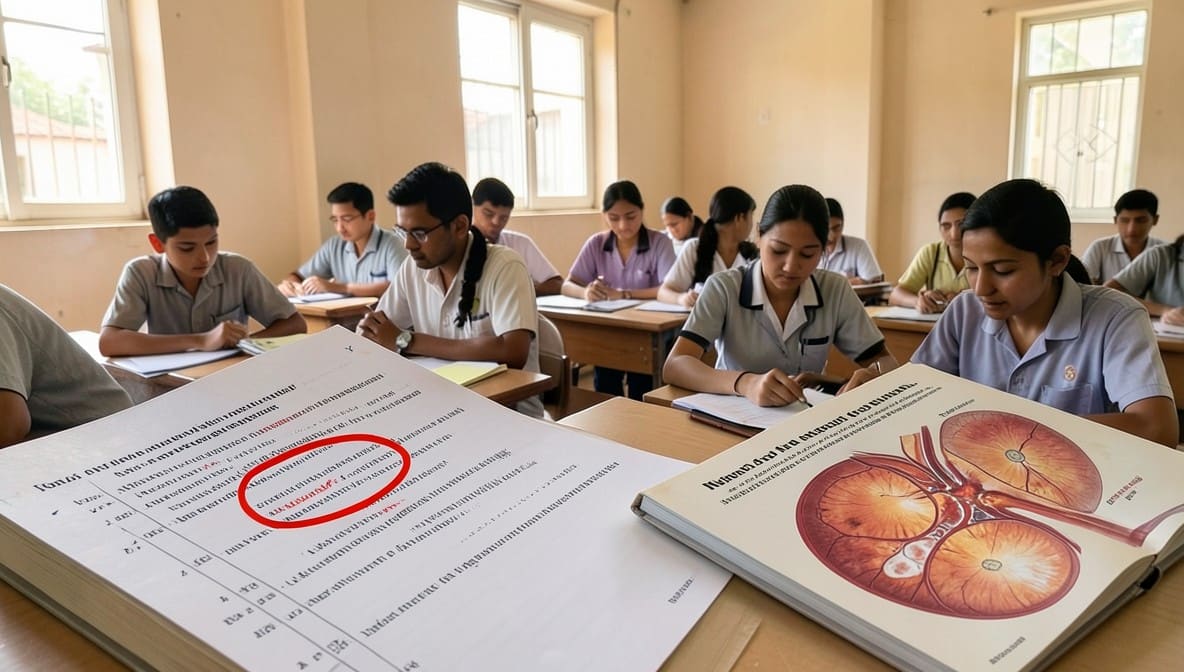
The petitioners, Butreddy Mahidhar Reddy and V. Deekshith Reddy, both MBBS students, challenged the final answer key released by Dr. NTR University of Health Sciences for their professional examination. The dispute centered on Question No. 17 (Set A) / Question No. 19 (Set D), which asked about the number of layers in the neurosensory retina. The petitioners marked 9 layers, while the university's answer key suggested 10 layers based on certain textbooks.
Key Facts
- The petitioners are MBBS students who appeared for their professional examination conducted by Dr. NTR University of Health Sciences
- The disputed question pertained to the number of layers in the neurosensory retina
- The petitioners relied on prescribed textbooks that recognize 9 layers
- The university's answer key was based on alternative textbooks recognizing 10 layers
- The petitioners' hall ticket numbers were 21M102003030 (Set A) and 21M102003206 (Set D) respectively
Procedural History
- Prior Litigation: A Division Bench of the Andhra Pradesh High Court in W.P.No.1811 of 2026 had previously directed the university to examine representations regarding disputed questions and to verify papers through a different set of examiners
- 18.06.2026: The present writ petition (W.P.No.15431/2026) was filed by the two petitioners seeking similar relief
Relief Sought
The petitioners sought a direction to the university to:
- Re-examine their answer sheets for the disputed question
- Award marks based on the correct answer as per prescribed textbooks
- Complete the re-evaluation process within a specified timeframe
The Legal Issue
The central question before the court was whether a university can enforce an answer key that conflicts with prescribed textbooks, and if so, what remedial measures should be available to students who rely on authoritative academic sources.
Arguments Presented
For the Petitioners
- The petitioners contended that the university's answer key was incorrect as it contradicted the prescribed textbooks for their course
- They relied on the Division Bench order in W.P.No.1811 of 2026, which had directed re-evaluation in similar circumstances
- The petitioners argued that academic fairness required the university to re-examine their papers through an independent set of examiners
For the Respondents
- The university, represented by the Government Pleader for Medical Health, submitted that some textbooks recognize 10 layers in the neurosensory retina
- This argument implied that the university's answer key was not necessarily incorrect, but based on alternative academic sources
The Court's Analysis
The court observed that:
- There was a dispute regarding the correct answer to the question on neurosensory retina layers
- The petitioners had relied on prescribed textbooks, which recognized 9 layers
- The Division Bench in W.P.No.1811 of 2026 had already set a precedent by directing re-evaluation in similar cases
The court emphasized the need for academic fairness and held that when there is a conflict between the answer key and prescribed textbooks, the university must re-examine the papers through an independent set of examiners to ensure justice.
"Having regard to the facts and circumstances of the case, there shall be a direction to the respondents to send the subject exam papers of the petitioners to different set of examiners for awarding marks for the answers submitted by the petitioners and for reconsideration of the correct answer marked by the petitioners insofar the question referred to above."
The Verdict
The court disposed of the writ petition with the following directions:
- The university must re-examine the petitioners' answer sheets for the disputed question
- The re-evaluation must be conducted by a different set of examiners
- The process must be completed within one week from the date of receipt of the order
- No order as to costs was passed
- All pending miscellaneous petitions were closed
What This Means For Similar Cases
Academic Fairness Requires Adherence to Prescribed Textbooks
- Universities must ensure that answer keys align with prescribed textbooks to avoid disputes
- When conflicts arise, re-evaluation by independent examiners is a viable remedy
- Students can challenge answer keys if they contradict authoritative academic sources
Precedent for Re-evaluation in Disputed Questions
- The judgment reinforces the principle that academic institutions cannot arbitrarily enforce answer keys that conflict with prescribed study materials
- Courts may direct re-evaluation when students demonstrate reliance on authoritative sources
- The timeline for compliance (one week in this case) sets a benchmark for prompt resolution
Limitations on Relief
- The relief is restricted to the petitioners in this case, as only two students filed the writ petition
- The court did not strike down the answer key but merely directed re-examination of the petitioners' papers
- Future cases may require similar Division Bench directions to ensure consistent application of this principle