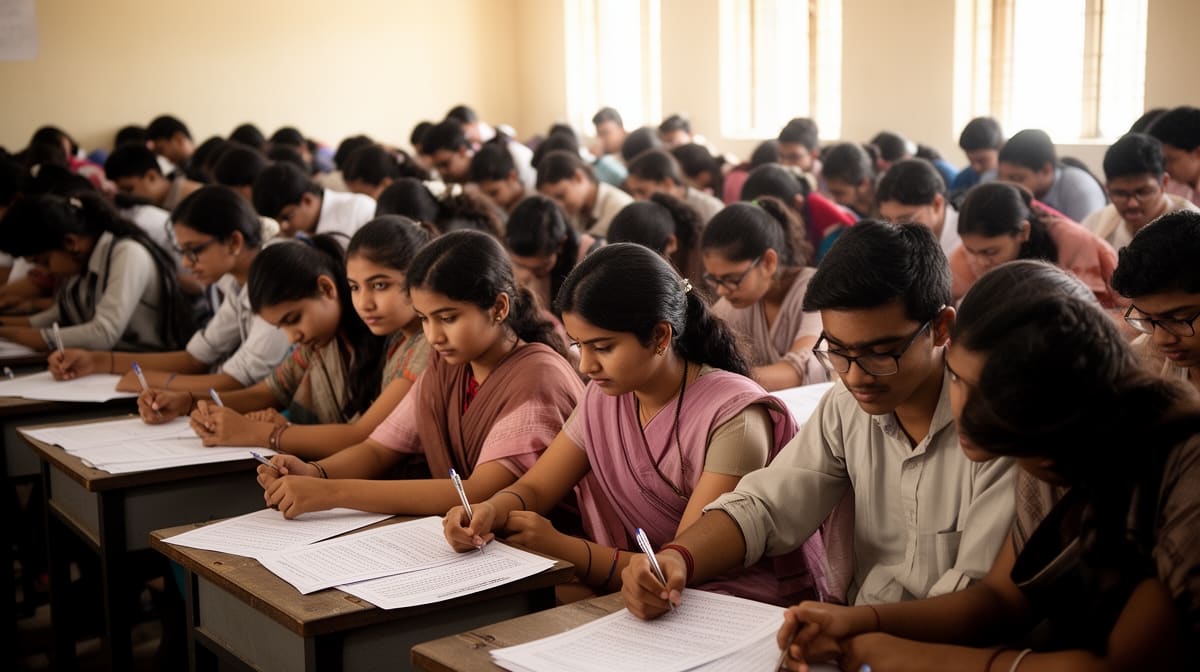
The Central Administrative Tribunal, Ahmedabad, has delivered a significant ruling affirming that arbitrary or incorrect assessment of subjective examination answers violates the principles of natural justice and equal opportunity in public employment. When candidates raise specific, documented objections to answer key interpretations, the state cannot rely solely on its own evaluators to adjudicate the dispute.
Background & Facts
The Dispute
The applicants, all serving Loco Pilots (Mail) with the Centralised Training and Control Centre (CTCC), Ahmedabad, applied for promotion to the post of Loco Inspector (Electrical) through a competitive examination conducted by Western Railway. The recruitment notification was issued on 04.03.2014 for six vacancies: four unreserved, one SC, and one ST. Written examinations were held on 02.04.2016, 09.04.2016, 23.04.2016, and 07.05.2016. The result, declared on 22.09.2016 through Memorandum No. E/CONF/1025/02/MECH/16, listed only one candidate - Shri Manoj Kumarsinh - as qualified.
Key Facts
- The applicants contested the evaluation of multiple questions in both Part A (objective) and Part B (descriptive) of the examination.
- Specific objections were raised regarding:
- Question No. 5 (Part B): Incorrect assessment of the answer regarding switches on the SB-1 panel of 3-phase locos.
- Fill-in-the-blank questions in Part A: Nos. 4, 6, 15, and 16 (Question No. 2) were marked wrong despite correct responses.
- Abbreviations in Question No. 1: Marks deducted for abbreviations Nos. 7, 8, and 9 despite alignment with ZETC BRCY study material.
- The applicants obtained the model answer key via RTI on 10.04.2017 and found discrepancies with the official evaluation.
- Representations were submitted on 20.03.2017, 21.03.2017, 26.04.2017, and 17.04.2017.
- The respondents referred the objections to the original paper setter, who upheld the original assessment without independent review.
- The applicants cited K. Nirmal v. The Chairman (Madras HC) and Abhishek Kumar v. State of Bihar (SC) to support their claim for re-evaluation.
Procedural History
- 04.03.2014: Recruitment notification issued for Loco Inspector (Electrical) posts.
- 02.04.2016 to 07.05.2016: Written examinations conducted across four dates.
- 22.09.2016: Result declared; only one candidate qualified.
- 17.04.2017: First formal representation submitted by applicants.
- 20.03.2017, 21.03.2017, 26.04.2017: Additional representations filed.
- 26.07.2017: Respondents replied via Office Letter No. E/conf/1025/02/MECH/16 (Temp), rejecting all objections.
- 18.03.2026: Original Application No. 462/2017 reserved.
- 21.04.2026: Judgment pronounced by CAT Ahmedabad.
The Parties' Positions
Applicants: Argued that the evaluation was based on an incorrect model answer key, ignored ZETC BRCY guidelines, and lacked impartiality. They contended that the respondents acted as judge in their own cause by having the original paper setter review objections.
Respondents: Maintained that the evaluation was conducted as per rules, the notification dated 04.03.2014 governed the process, and no provision existed for revaluation. They claimed the paper setter’s opinion was final and no malafide intent existed.
Relief Sought
The applicants sought:
- Quashing of the result dated 22.09.2016.
- Declaration that the model answer key was invalid.
- Re-evaluation of answer sheets by an independent expert committee.
- Inclusion in a fresh merit list if eligible.
- Costs of litigation.
The Legal Issue
Can a public employer rely on its own examiners to adjudicate claims of erroneous answer key assessment, when candidates provide credible evidence that their responses align with official study material, and no independent review mechanism exists?
Arguments Presented
For the Appellant
The applicants relied on K. Nirmal v. The Chairman (Madras HC), where the court held that while no legal right to revaluation exists, equity demands intervention when there is a demonstrable divergence in key answers and the candidate’s response is supported by authoritative material. They also cited Abhishek Kumar v. State of Bihar (SC), where the Apex Court ordered a two-member expert committee to re-assess answer sheets and redraw the merit list. The applicants emphasized that the evaluation was not merely subjective but based on an incorrect, non-official key, violating Article 14 and Article 16 of the Constitution.
For the Respondent
The respondents argued that the evaluation process was conducted in accordance with the Railway Recruitment Rules and IRME Vol-I, para 310. They contended that the paper setter’s opinion was final and that the applicants had no vested right to revaluation. They also asserted that the 2014 notification governed the 2016 examination and no fresh notification was required.
The Court's Analysis
The Tribunal acknowledged that while candidates do not possess a legal right to revaluation under the rules, the principle of natural justice and the constitutional guarantee of equal opportunity compel intervention where the assessment appears arbitrary or based on an erroneous foundation. The Court observed that the respondents had entrusted the review of objections to the very person who set the answer key - a clear conflict of interest.
"It is contrary to the principle that one cannot be judge of his own cause."
The Tribunal further noted that the applicants had not merely complained about subjective marking but pointed to specific questions where their answers matched the ZETC BRCY syllabus, yet were marked incorrect. This raised a legitimate concern about the integrity of the evaluation process. The Court distinguished the respondents’ reliance on IRME provisions, noting that procedural fairness cannot be subordinated to bureaucratic finality when fundamental rights are at stake.
The Tribunal declined to adjudicate the correctness of the answer key itself, but emphasized that the process of resolving disputes must be impartial. Drawing from K. Nirmal, it held that equity, fairness, and good conscience require an independent expert review when the stakes involve career advancement and the candidate’s claim is substantiated by official training material.
The Verdict
The applicants succeeded. The Tribunal set aside the result dated 22.09.2016 and directed the respondents to constitute a two-member expert committee, independent of the original paper setters, to re-evaluate the disputed questions: Part B Question No. 5, Part A Fill-in-the-blank Nos. 4, 6, 15, 16, and abbreviations Nos. 7, 8, 9. The committee must submit its report within three months of receipt of the order. The already qualified candidate, Shri Manoj Kumarsinh, shall not be affected. A fresh merit list shall be prepared based on the committee’s findings, subject to eligibility criteria. No costs were awarded.
What This Means For Similar Cases
Independent Review Is Mandatory When Answer Keys Are Disputed
- Practitioners must now argue that when candidates cite official syllabi or training manuals to challenge answer key interpretations, the employer cannot rely on internal evaluators to resolve the dispute.
- Any review mechanism must involve external subject experts with no prior involvement in setting or evaluating the paper.
Equity Overrides Procedural Absence
- Even in the absence of a formal revaluation rule, courts and tribunals may intervene under Article 14 and 16 if the evaluation process is demonstrably flawed.
- The burden shifts to the employer to prove the answer key’s correctness when credible evidence of deviation from official material is presented.
Timing of Notifications Does Not Preclude Fairness
- The date of the recruitment notification does not immunize the process from procedural fairness. If the examination is conducted years later, the evaluation must still be accurate and impartial.
- Candidates may challenge assessments based on outdated or incorrect keys, even if the notification remains unchanged.
Actionable Takeaways for Practitioners
- Always request the model answer key via RTI immediately after results are declared.
- Document objections with reference to official study material (syllabi, manuals, training notes).
- Cite K. Nirmal and Abhishek Kumar to establish the legal basis for expert re-evaluation.
- File OA before CAT within 30 days of rejection of representations to avoid limitation issues.