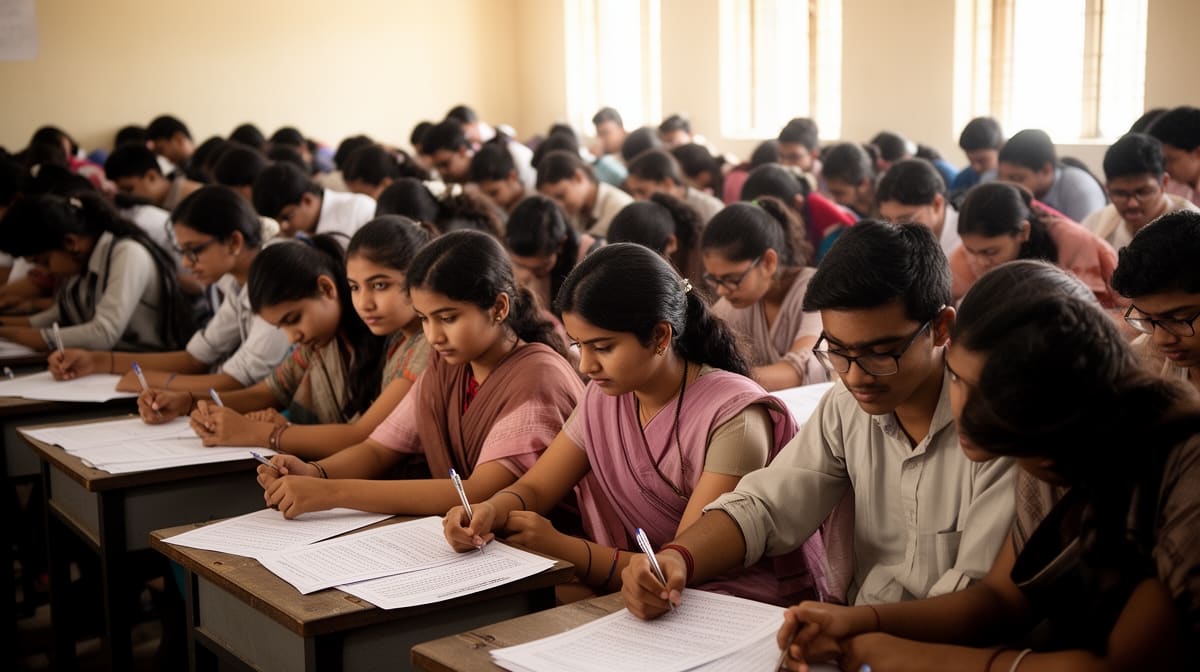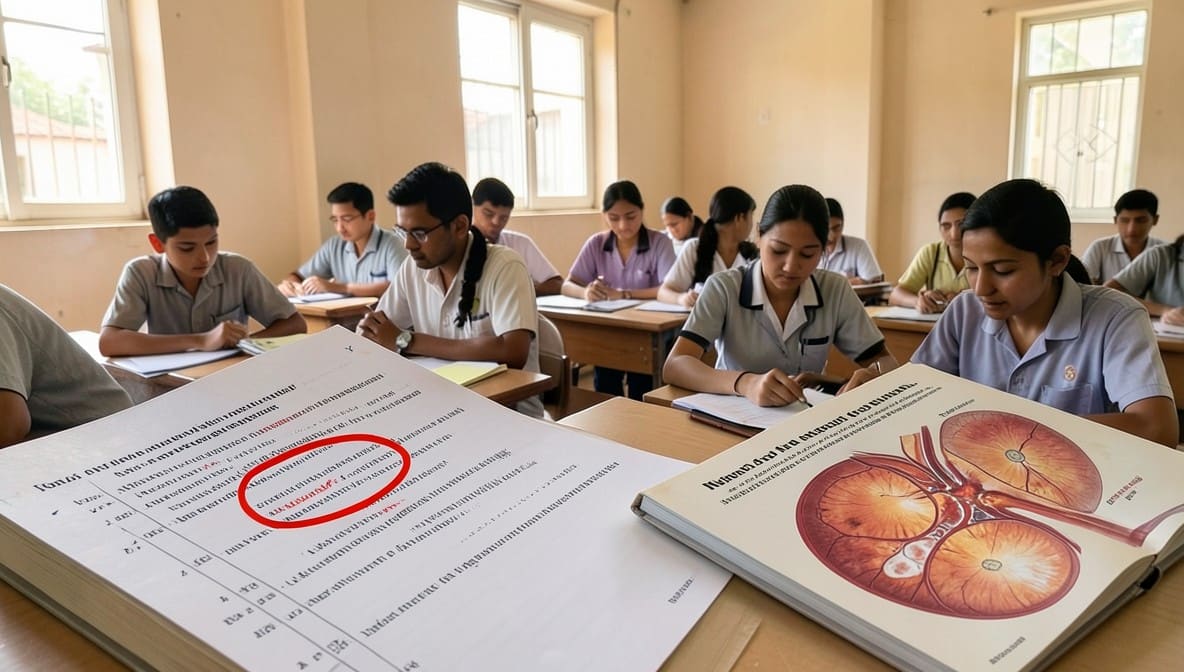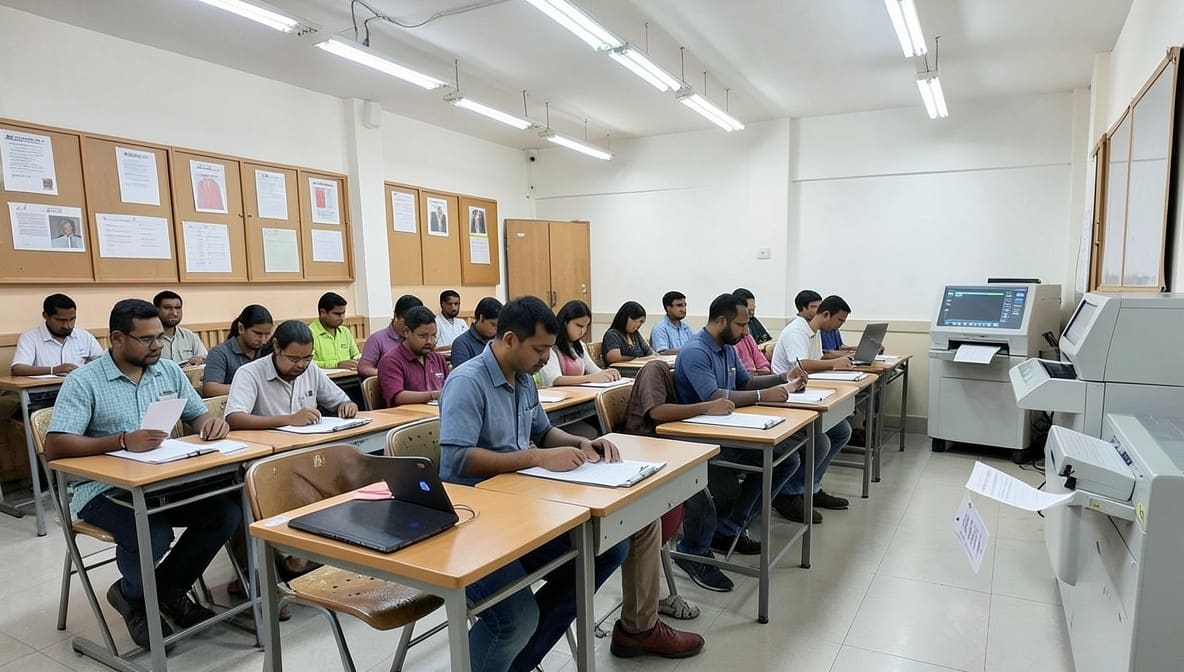
The Punjab and Haryana High Court has dismissed challenges to the NEET (UG) 2026 answer keys, affirming that expert-determined 'most appropriate answers' are binding and not subject to judicial review under Article 226. The Division Bench held that courts lack subject-matter expertise to evaluate answer keys and must defer to specialist panels, while OMR marking instructions preclude challenges to partial or unintended markings.
Background & Facts
The Dispute
Two writ petitions were filed before the High Court of Punjab and Haryana challenging the answer keys published by the National Testing Agency (NTA) for the National Eligibility Entrance Test (NEET) Undergraduate 2026, conducted on 21.06.2026. The petitioners, both NEET aspirants, alleged errors in specific questions and sought judicial intervention to correct the answer keys and recalculate their scores.
Key Facts
- CWPO 23206/2026: Petitioner Harshul Garg challenged Question No. 77 of Booklet No. 70, contending that two options (Nos. 2 and 3) were correct, whereas NTA's final answer key recognized only Option No. 3 as correct.
- CWPO 23306/2026: Petitioner Harshita Agarwal (through her father Dr. Ajay Agarwal) challenged three questions of Booklet No. 70:
- Question No. 152: Alleged two correct options (Nos. 2 and 4)
- Question No. 167: Contended that none of the given options were correct
- Question No. 22: Claimed partial and unintended marking against one option, which the OMR scanner read as a marked answer resulting in negative marking
- The provisional answer keys were uploaded on the NTA website on 25.06.2026, and both petitioners raised objections within the prescribed window.
- The petitioners' specific case was that their objections had not been considered by the panel of experts constituted by NTA.
- Note No. 3 of the Information Bulletin (Annexure P-3) stipulates the marking criteria: "Correct answer or the most appropriate answer: Four marks (+4)"; "Any incorrect option marked will be given minus one mark (-1)"; "Unanswered: No mark (0)."
- OMR answer sheet instructions explicitly state: "Darken ONLY ONE CIRCLE for each Question", "Answer once marked cannot be changed", and "Please do not make any stray marks on the Answer Sheet. Stray spot marks/Stray marks may be read erroneously by the OMR Scanner."
- Clause 15.2 of the Information Bulletin provides that the decision of NTA on challenges shall be final and result will be declared on the basis of revised answer key. Clause 15.4 states there is no provision for re-checking or re-evaluation of answer sheets.
Procedural History
- 21.06.2026: NEET (UG) 2026 examination conducted
- 25.06.2026: Provisional answer keys uploaded on NTA website; petitioners raise objections
- 16.07.2026: NTA declares result by press release after applying final answer keys based on expert panel opinion
- 28.07.2026: High Court passes interim order directing NTA to produce complete expert report in sealed cover and file affidavit on how objections were dealt with; petitioner in CWPO 23206/2026 confines challenge to Question No. 77 only
- 10.08.2026: Expert report produced in sealed cover, opened and perused by Court; Mr. Harshit Aggarwal, JD, NTA, explains contents in chambers
- 17.08.2026: Judgment pronounced
- 18.08.2026: Judgment uploaded
Relief Sought
The petitioners sought quashing of the impugned answer keys to the extent of the challenged questions, direction to NTA to revise the answer keys as per their contentions, consequential recalculation of their scores and ranks, and such other reliefs as the Court deemed fit.
The Legal Issue
The central questions were: (1) Whether the High Court, in exercise of its writ jurisdiction under Article 226, can interfere with answer keys finalized by a duly constituted panel of subject experts for a national-level entrance examination; (2) Whether the standard of "most appropriate answer" as opposed to "correct answer" insulates the expert opinion from judicial scrutiny; (3) Whether a candidate can challenge OMR evaluation based on partial or unintended marking when instructions explicitly prohibit stray marks and state that answers once marked cannot be changed.
Arguments Presented
For the Petitioners
Counsel for the petitioners (Mr. Vikas Mohan Gupta and Ms. Tanvi Aggarwal in CWPO 23206/2026; Mr. Sukesh Kumar Jindal, Ms. Sonia Bohat, and Mr. Lalit Goel in CWPO 23306/2026) submitted that:
- The provisional answer keys contained demonstrable errors where multiple options were factually correct or no option was correct.
- Objections raised by the petitioners were not genuinely considered by the expert panel, violating principles of natural justice.
- In CWPO 23306/2026, the marking on Question No. 22 was partial and unintended, and the OMR scanner erroneously captured it, causing unfair negative marking.
- The Court should exercise its constitutional jurisdiction to correct manifest errors affecting the petitioners' careers.
For the Respondents
Senior Panel Counsel Ms. Promila Nain (for Union of India and NTA), assisted by Mr. Ishkaran Singh Chhabra, and Mr. Arun Gosain and Mr. Ramandeep Singh Sandhu (for NTA) contended that:
- Challenges from all candidates were placed before a panel of eminent subject experts drawn from premier institutions including IITs and Central Universities.
- The expert panel reviewed each challenge carefully and certified the final answer keys as correct.
- The Information Bulletin's Clause 15.2 makes NTA's decision on challenges final, and Clause 15.4 bars re-checking or re-evaluation.
- Note No. 3 establishes the "most appropriate answer" standard, vesting evaluative discretion in experts.
- OMR instructions are unambiguous: stray marks are prohibited, answers once marked cannot be changed, and the scanner's reading is final.
- Supreme Court precedents (Himachal Pradesh Public Service Commission v. Mukesh Thakur, Ran Vijay Singh v. State of Uttar Pradesh, U.P. Public Service Commission v. Sunil Kumar Singh) establish that academic evaluation is the domain of experts and courts should not act as "expert of experts."
The Court's Analysis
The Division Bench, comprising Justice Suvir Sehgal and Justice Deepinder Singh Nalwa, began by examining the expert report produced in sealed cover. The report contained a certification that the experts had "verified all the answer keys of the question paper and have ensured that the answer keys are correct" and had "gone through all the challenges of the candidates on each question raised and reviewed them carefully and submitted the final answer keys."
The Court emphasized its institutional limitation: "This Court is not an expert in respective subjects. It is not permissible for High Court to examine the question paper and the answer keys." Relying on Ran Vijay Singh v. State of Uttar Pradesh (2018) 2 SCC 357, the Court noted that the Apex Court has observed that "academic matters are best left to academicians." The judgment in U.P. Public Service Commission v. Sunil Kumar Singh (Law Finder Doc ID #2959487) was cited for the proposition that the manner of examination of so-called dubious questions by a High Court "as if it was an expert of experts" is "clearly indefensible."
On the interpretive question of "correct answer" versus "most appropriate answer," the Court turned to Note No. 3 of the Information Bulletin. The note states: "To answer a question, the candidate needs to choose one option corresponding to the correct answer or the most appropriate answer." The Court held:
"This note puts the entire controversy at rest. It is not the correct answer alone, but the most appropriate answer in the opinion of the evaluators/experts, which has to be treated as the correct answer and has to be awarded four marks. As has been noticed in the judgments reproduced above, it is the opinion of the experts, which has to prevail and once they find a particular answer to be correct, the same is not to be interfered with by the Court in the exercise of extraordinary writ jurisdiction under Article 226 of the Constitution of India."
Regarding the partial marking claim on Question No. 22, the Court reproduced the OMR instructions in full, noting they "unambiguously show that candidates have been advised not to make any stray marks on answer sheet and answer, once marked, cannot be changed." The Court concluded: "In view of these instructions, this Court cannot examine as to whether the marking on the answer sheet was deliberate, partial or unintended."
The Court also referenced Himachal Pradesh Public Service Commission v. Mukesh Thakur (2010) 6 SCC 759, where the Supreme Court held that if there is any discrepancy in framing of questions or evaluation, "it is for all the candidates appearing in the examination and not for just one candidate alone." The Court found no reason to doubt the opinion of the experts.
The Verdict
Both writ petitions were dismissed, though with no order as to costs. The Court declined to interfere with the answer keys finalized by the expert panel or the result declared by NTA on 16.07.2026. The expert report was ordered to be re-sealed and returned to Mr. Arun Gosain, Advocate for NTA, under his signatures. No monetary relief, interest, or compliance deadlines were awarded; the dismissal operates as a final affirmation of the NEET (UG) 2026 results as declared.
What This Means For Similar Cases
Expert Opinion on Answer Keys Is Final and Binding
The judgment reinforces that once a duly constituted panel of subject experts - drawn from premier institutions - has reviewed challenges and certified answer keys, the Court will not substitute its own judgment. The "most appropriate answer" standard in the Information Bulletin expressly vests evaluative discretion in experts. Practitioners must advise clients that judicial review under Article 226 does not extend to re-evaluating academic answer keys, absent mala fide, arbitrariness, or procedural violation in the constitution of the expert panel itself.
OMR Instructions Create an Absolute Bar on Marking Challenges
The OMR sheet instructions - "Answer once marked cannot be changed" and "Stray marks may be read erroneously" - create a contractual and procedural framework that binds candidates. A candidate cannot later claim a marking was "partial," "unintended," or "stray" to escape negative marking. The scanner's reading is final. This principle applies squarely to all OMR-based examinations (NEET, JEE, CUET, state PSCs, etc.).
No Individual Relief for Systemic Discrepancies
Following Himachal Pradesh PSC v. Mukesh Thakur, if a question is genuinely flawed, the remedy (if any) must be uniform for all candidates - such as grace marks or deletion of the question - not individualized relief for petitioners alone. Lawyers should frame challenges accordingly: either seek a global remedy affecting all examinees, or demonstrate a procedural defect in the expert review process itself.
- Drafting tip: In answer key challenges, plead specific procedural failures (e.g., expert panel not constituted, challenges not placed before panel, mala fide) rather than substantive disagreement with the expert's academic judgment.
- Evidence tip: Obtain the Information Bulletin and OMR instructions early; they are the contractual terms governing evaluation.
- Forum tip: High Courts will dismiss Article 226 petitions challenging answer keys on merits; the Supreme Court has consistently discouraged such interference.