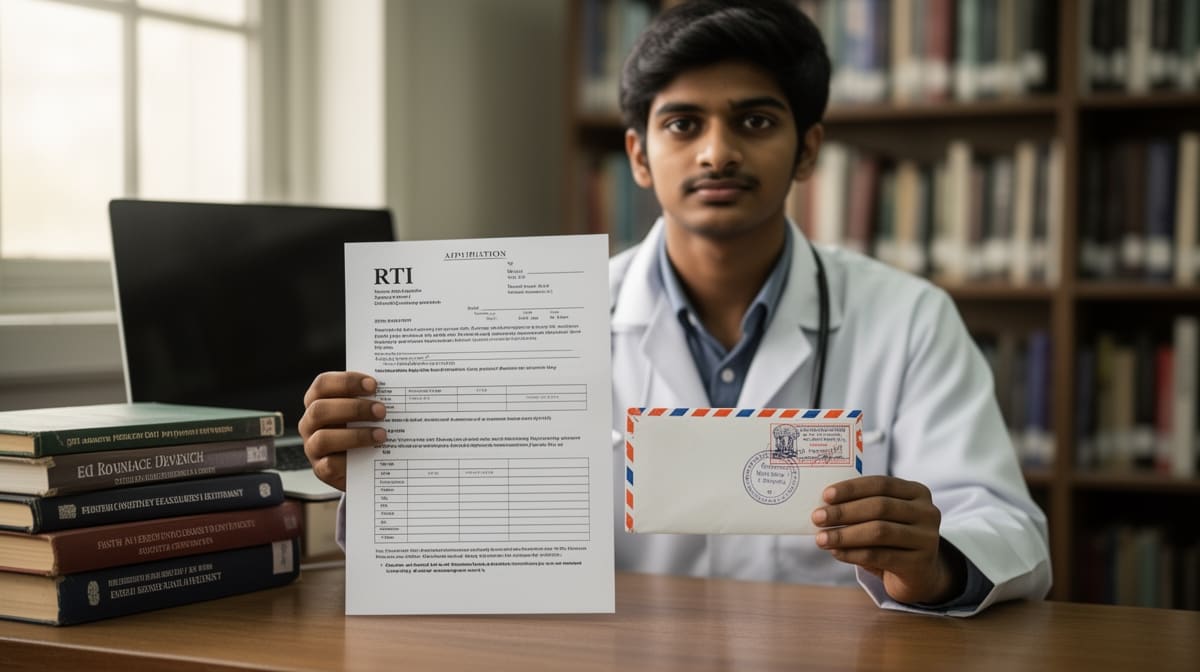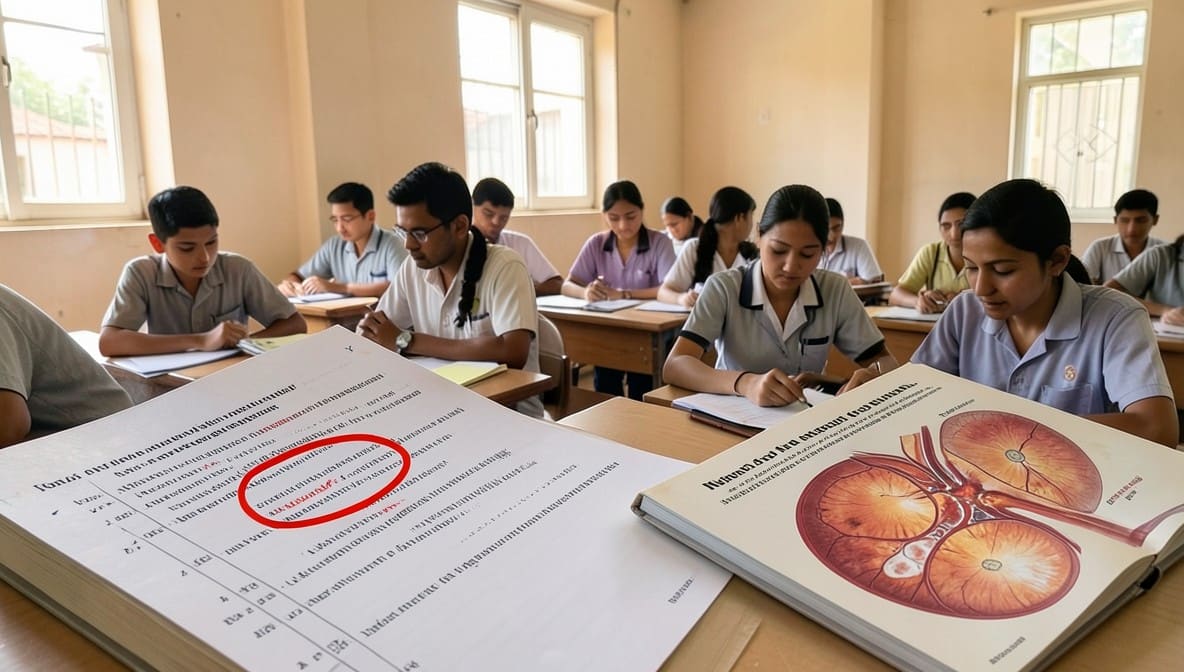
The Telangana High Court has affirmed that the right to personally verify answer scripts in professional examinations is a fundamental aspect of natural justice, even where statutory rules do not explicitly provide for revaluation. This ruling reinforces procedural fairness in academic assessments, particularly in high-stakes medical education.
Background & Facts
The Dispute
The petitioner, Damera Vaishnavi, a 23-year-old MBBS second-year student, appeared for the theory examinations in Pharmacology, Pathology, and Microbiology conducted by Kaloji Narayana Rao University of Health Sciences (KNRUHS). Despite believing she performed adequately, she was declared unsuccessful in all three subjects. She challenged the result on grounds of arbitrary evaluation and lack of transparency.
Key Facts
- The petitioner appeared for the MBBS Second Year theory examinations in January 2026.
- Results were declared in February 2026, showing failing marks in Pharmacology, Pathology, and Microbiology.
- On 10.02.2026, she applied for recounting of marks in all three subjects, as permitted under KNRUHS regulations.
- Recounting was conducted on 15.02.2026, but no change in marks was observed.
- On 18.02.2026, she submitted a formal request for revaluation of answer scripts, which was rejected by KNRUHS on the ground that revaluation is not permitted under university regulations.
- On 20.03.2026, she filed a fresh application for revaluation, which remained unaddressed at the time of filing the writ petition.
- She also requested personal verification of her answer scripts, which was denied by the university on the grounds that such verification is not allowed under any rule.
- The petitioner had no access to her evaluated answer scripts and could not ascertain whether errors in marking, omission, or misreading had occurred.
Procedural History
- 10.02.2026: Application for recounting submitted to KNRUHS.
- 15.02.2026: Recounting completed; marks unchanged.
- 18.02.2026: First application for revaluation submitted and rejected.
- 20.03.2026: Second application for revaluation submitted; no response received.
- 24.03.2026: Writ Petition No. 8636 of 2026 filed before the Telangana High Court.
- 24.03.2026: Interim Application No. 1 of 2026 filed under Section 151 CPC seeking immediate verification and revaluation.
- 24.03.2026: Court heard arguments and delivered judgment on the same day.
The Parties' Positions
Petitioner’s Position: The denial of revaluation and personal verification violates Articles 14, 19, and 21 of the Constitution and the principles of natural justice. The petitioner has a legitimate expectation of fair evaluation and transparency. Without access to answer scripts, she cannot challenge errors or seek redressal.
Respondent’s Position: KNRUHS regulations do not provide for revaluation of answer scripts. Only recounting is permitted. The university has already conducted recounting, which yielded no change. The petitioner may approach the Grievance Committee if dissatisfied, but personal verification is not permitted under any rule.
Relief Sought
The petitioner sought:
- A declaration that the refusal to revaluate and deny verification violates constitutional rights and natural justice.
- A writ of mandamus directing KNRUHS to re-evaluate the answer scripts.
- Permission for the petitioner to personally verify her answer scripts in Pharmacology, Pathology, and Microbiology.
The Legal Issue
The central question was whether the refusal to permit a student to personally verify her answer scripts in a professional medical examination, even after recounting has failed to alter results, violates the principles of natural justice under Article 21 of the Constitution.
Arguments Presented
For the Petitioner
Learned counsel argued that the right to know the basis of one’s evaluation is intrinsic to fair procedure. Citing State of U.P. v. Mohd. Noor and P. K. Srinivasan v. University of Madras, he contended that denial of access to answer scripts amounts to denial of opportunity to be heard. He emphasized that revaluation may not be mandatory, but verification is a minimal procedural safeguard. He further argued that the university’s blanket prohibition on verification is arbitrary and violates the petitioner’s right to equality under Article 14.
For the Respondent
The Standing Counsel conceded that while revaluation is not mandated by KNRUHS regulations, there is no statutory bar to personal verification. He acknowledged that the university has no objection to allowing the petitioner to verify her answer scripts, provided the requisite fee is paid as per existing rules. He submitted that the university’s policy is uniformly applied and that the Grievance Committee remains an available remedy.
The Court's Analysis
The Court observed that while the university is not obligated to provide revaluation, the denial of access to answer scripts for personal verification raises serious concerns under the doctrine of natural justice. The principle of audi alteram partem requires that a person be given a fair opportunity to know the case against them and to respond.
"The right to examine one’s own answer script is not a privilege but a procedural necessity in high-stakes examinations, particularly in medical education where the consequences are career-defining."
The Court noted that the petitioner had already undergone recounting, which confirmed the original marks. However, recounting does not address potential errors in evaluation, such as misreading of answers, omission of partial marks, or inconsistent marking across scripts. Without access to the scripts, the petitioner is effectively barred from identifying such errors or making a meaningful representation.
The Court further held that the university’s policy of denying verification, even after recounting, is not only unreasonable but also inconsistent with the constitutional guarantee of fair procedure under Article 21. The absence of a specific rule permitting verification cannot be used to justify a complete denial of transparency.
The Court emphasized that the state, as a provider of public education, owes a duty of fairness to students. The petitioner’s request was modest: to view her own answer scripts under supervision, upon payment of the prescribed fee. This does not interfere with the integrity of the evaluation process but enhances its legitimacy.
The Verdict
The writ petition was disposed of with directions. The Court directed Kaloji Narayana Rao University of Health Sciences to permit the petitioner to personally verify her answer sheets for MBBS Second Year Pharmacology, Pathology, and Microbiology within seven days of the order, subject to payment of the requisite fee for each subject as per existing rules. The university was further directed to re-verify the answer scripts in the presence of a designated official to ensure accuracy. There shall be no order as to costs.
What This Means For Similar Cases
Verification Is a Minimum Standard of Fairness
- Practitioners representing students in professional exams must now argue that denial of answer script verification violates natural justice, even if revaluation is not mandated.
- Educational institutions cannot rely on silence in regulations to deny transparency; the Constitution imposes a baseline duty of fairness.
Institutional Policies Must Align with Constitutional Norms
- Universities must review their examination policies to ensure they include provisions for personal verification upon request.
- Blanket prohibitions on verification are now legally untenable in light of this judgment.
- Institutions should establish clear, accessible procedures for verification, including fee structure, timing, and supervision protocols.
Precedent for Medical and Professional Exams
- This ruling applies equally to dental, nursing, pharmacy, and other health science examinations conducted by state universities.
- Students in competitive entrance or licensing exams may now invoke this judgment to demand access to evaluated answer sheets.
- Legal challenges against opaque evaluation systems in medical education are now strengthened by a binding High Court precedent.