The Madhya Pradesh High Court has clarified that appointment to the post of Aanganwadi Worker cannot be based on documents not explicitly prescribed by government circulars, reinforcing the principle that administrative discretion must conform strictly to notified eligibility criteria.
Background & Facts
The Dispute
The petitioner, Smt. Meera Bai, was ranked Sr. No. 1 in the provisional list of candidates for appointment as an Aanganwadi Worker in Gram Panchayat Nandchand, District Panna, Madhya Pradesh. Despite her top ranking, the appointment was granted to respondent No. 5, who was ranked lower on the list. The petitioner challenged the order dated 13.11.2024 passed by the appellate authority (Respondent No. 2), which upheld the appointment of respondent No. 5 on the ground that she was a local resident of the village.
Key Facts
The petitioner was ranked Sr. No. 1 in the provisional list prepared for Aanganwadi Worker posts in Gram Panchayat Nandchand
Respondent No. 5 was ranked lower than the petitioner on the same list
The appointment of respondent No. 5 was approved by the appellate authority on 13.11.2024
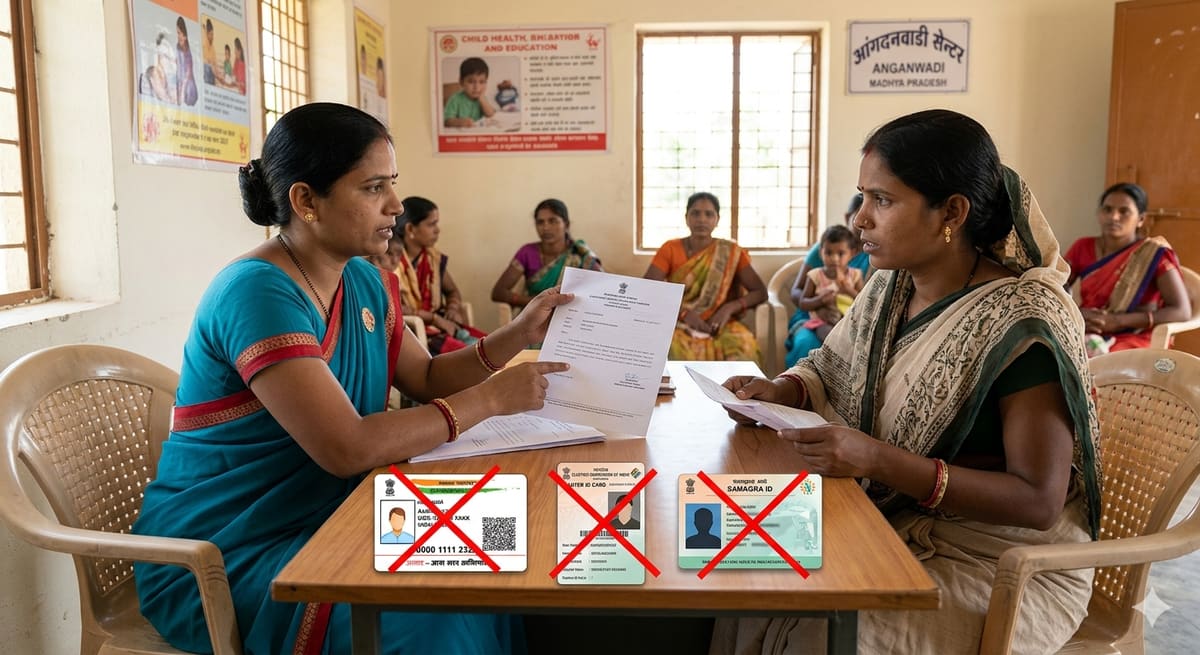
Respondent No. 5 submitted an Aadhaar Card, Samagra ID, and Voter ID as proof of local residence
The Government of Madhya Pradesh, through the Women and Child Development Department, issued a circular dated 10.07.2007 prescribing the exact documents required to establish local residence
The 2007 circular mandates that candidates must submit one of the following: Ration Card, Voter List of the concerned Gram Panchayat, or current BPL list
None of the documents submitted by respondent No. 5 were among those prescribed in the 2007 circular
The petitioner had not been appointed despite her top ranking, while respondent No. 5 was appointed despite non-compliance with the circular
Procedural History
10.07.2007: Government of Madhya Pradesh issues circular prescribing documents for proving local residence for Aanganwadi Worker appointments
Date unspecified (prior to 13.11.2024): Provisional list prepared; petitioner ranked Sr. No. 1
13.11.2024: Appellate authority (Respondent No. 2) passes order appointing respondent No. 5 based on Aadhaar, Samagra ID, and Voter ID
23.06.2024: Writ Petition No. 37452 of 2024 filed before the High Court of Madhya Pradesh at Jabalpur
23.06.2026: Hearing concluded before Hon’ble Justice Vishal Dhagat
The Parties' Positions
For the Petitioner
The petitioner contended that the appellate authority acted illegally and arbitrarily by relying on documents not prescribed under the 2007 circular. She argued that the circular was issued under statutory authority and had the force of law. Deviation from its terms violated the principle of equality under Article 14 and amounted to arbitrary administrative action.
For Respondent No. 5
Respondent No. 5 submitted that her Aadhaar Card, Samagra ID, and Voter ID were sufficient to prove her residence in Village Nandchand. She argued that these documents were widely accepted and that the circular’s requirements were outdated or overly technical.
For the State
The State, through the Government Advocate, did not contest the legal position that the 2007 circular was binding. However, it sought to justify the appointment on grounds of administrative convenience and the respondent’s actual residence.
Relief Sought
The petitioner sought:
Setting aside of the impugned order dated 13.11.2024
Directing the respondents to appoint her to the post of Aanganwadi Worker as she was Sr. No. 1 in the provisional list
Costs of litigation
The Legal Issue
The central question was whether documents not prescribed under a statutory circular can be accepted to establish eligibility for a public appointment, particularly when the circular explicitly lists the only acceptable proofs of local residence.
Arguments Presented
For the Petitioner
The petitioner relied on the binding nature of the 2007 circular issued by the Women and Child Development Department. She cited State of U.P. v. Raj Narain Singh to argue that administrative authorities cannot substitute prescribed documents with others, even if they appear to serve the same purpose. She emphasized that the circular was issued to ensure transparency, prevent favoritism, and maintain uniformity in appointments. Accepting Aadhaar or Voter ID as substitutes would open the door to arbitrary decisions and undermine the rule of law.
For the Respondent/State
Respondent No. 5 argued that her Aadhaar Card and Voter ID were reliable proof of residence and that the circular’s requirements were rigid and outdated. The State did not dispute the legal validity of the circular but suggested that strict adherence should not override substantive facts of residence. However, no legal precedent or statutory provision was cited to justify deviation from the circular.
The Court's Analysis
The Court examined the 2007 circular in detail and found that it was issued under the authority of the Department of Women and Child Development and clearly specified the documents required to establish local residence. The circular did not contain any provision allowing for substitution or discretion in document acceptance.
"The circular dated 10/07/2007 is not a mere guideline but a mandatory prescription issued by the competent authority for ensuring uniformity and fairness in appointments. The documents listed therein are exhaustive and no other document can be accepted in lieu of those prescribed."
The Court held that the appellate authority committed a clear error of law by relying on Aadhaar Card, Samagra ID, and Voter ID, none of which were enumerated in the circular. The Court distinguished this case from situations where courts allow flexibility in procedural compliance, noting that eligibility criteria for public appointments are not mere formalities but substantive conditions designed to prevent nepotism and ensure equitable access.
The Court further observed that the petitioner, being ranked first, had a legitimate expectation of appointment. Denying her the post while appointing a lower-ranked candidate on the basis of non-compliant documents violated the principles of natural justice and equality.
The Verdict
The writ petition is allowed. The impugned order dated 13.11.2024 is set aside. The respondents are directed to appoint the petitioner, Smt. Meera Bai, to the post of Aanganwadi Worker in Gram Panchayat Nandchand, District Panna, as she was ranked Sr. No. 1 in the provisional list. The appointment shall be made within four weeks from the date of this order. Costs of Rs. 10,000 are awarded to the petitioner.
What This Means For Similar Cases
Prescribed Documents Are Non-Negotiable
Practitioners must insist that public appointments strictly adhere to notified eligibility criteria
Any deviation from prescribed documents, even if the candidate is genuinely local, renders the appointment legally vulnerable
Administrative authorities cannot invoke "substantial compliance" to bypass mandatory document requirements
Local Residency Criteria Are Substantive, Not Formal
The requirement of local residence in rural public posts is not a technicality - it is a policy tool to ensure community representation
Courts will not entertain arguments that "the end justifies the means" when statutory norms are violated
Candidates must be evaluated strictly on the basis of documents listed in the circular, not on subjective assessments of residency
Procedural Rigor Protects Merit
Ranking in provisional lists must be honored unless the higher-ranked candidate is disqualified under the prescribed criteria
Appellate authorities must not substitute their own judgment for statutory rules
This judgment reinforces that merit-based appointments in public service require procedural integrity, not administrative convenience