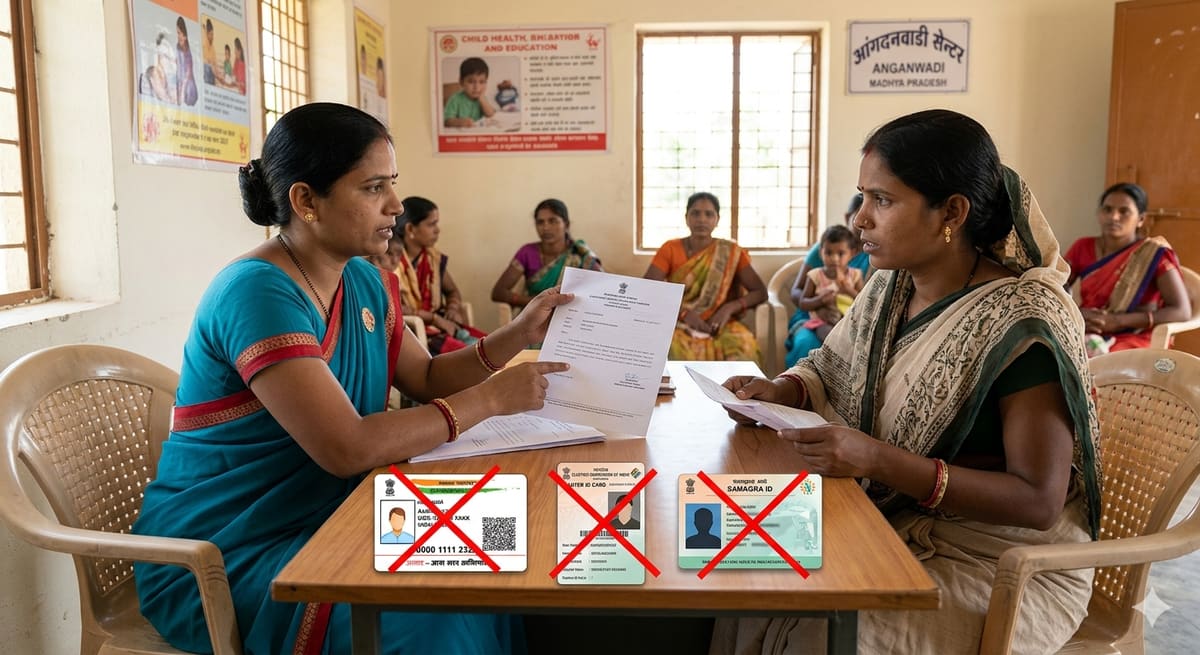
The Bombay High Court has reaffirmed that documentary evidence of residence - such as ration cards, Aadhaar cards, and EPIC cards - cannot be disregarded on the basis of unsubstantiated hearsay or vague allegations in the context of Anganwadi Sevika appointments under the Integrated Child Development Services Scheme. This ruling provides critical clarity for thousands of rural women appointed on honorarium basis, reinforcing the primacy of verifiable documents over speculative inquiries.
Background & Facts
The Dispute
The petitioner, Jyoti w/o Ravindra Sable, applied for the post of Anganwadi Sevika at Padoshi village, Taluka Akole, District Ahmednagar, under the Integrated Child Development Services Scheme (ICDS). The appointment is governed by Government Resolution dated 13.08.2014, which mandates that candidates must be residents of the village where the Anganwadi center is located. The petitioner, who ranked first in the merit list, was initially appointed but later removed following a complaint by Respondent No. 4, who alleged she was not a genuine resident of Padoshi.
Key Facts
- The petitioner submitted three documents to establish residence: (i) a certificate from the Gram Sevak, (ii) a self-declaration, and (iii) copies of her Ration Card, Aadhaar Card (issued 17.01.2014), and EPIC Card - all showing her address as Padoshi, Taluka Akole, District Ahmednagar.
- The Ration Card was issued prior to the advertisement date (27.07.2022) and remained valid.
- Respondent No. 4 filed a complaint on 05.11.2022 alleging the petitioner resided in Sherewadi, not Padoshi.
- The Child Development Project Officer (CDPO), Ms. Bharati Satalkar, conducted an inquiry and submitted a report on 06.02.2023, relying on:
- A purported Panchanama dated 09.11.2022 (undated in original file)
- Hearsay that the petitioner was residing in Padoshi on rental basis since after the advertisement
- The fact that the petitioner’s son studied at the Anganwadi in Sherewadi
- The Chief Executive Officer, Zilla Parishad Ahmednagar, passed an order on 06.02.2023 disqualifying the petitioner.
- The petitioner was discharged from service on 15.09.2023.
- The Divisional Commissioner, Nashik, upheld the disqualification in Appeal No. 3 of 2023 on 24.11.2023.
- The petitioner filed this writ petition on 15.01.2024.
Procedural History
- 27.07.2022: Advertisement published for Anganwadi Sevika post at Padoshi
- 05.11.2022: Complaint filed by Respondent No. 4
- 06.02.2023: CDPO’s report recommending disqualification
- 06.02.2023: Order issued by Chief Executive Officer, Zilla Parishad, disqualifying petitioner
- 15.09.2023: Petitioner discharged from service
- 24.11.2023: Divisional Commissioner, Nashik, upheld disqualification in Appeal No. 3 of 2023
- 15.01.2024: Writ Petition No. 1422 of 2024 filed before Bombay High Court, Aurangabad Bench
- 01.04.2026: Oral judgment delivered
The Parties' Positions
Petitioner: Argued that all documents submitted were valid, issued prior to the advertisement, and unchallenged for authenticity. Contended that hearsay, uncorroborated Panchanama, and the location of her son’s schooling cannot override statutory documentary proof.
Respondents 1, 2 & 3 (Zilla Parishad & CDPO): Relied on the CDPO’s report, particularly the Panchanama and hearsay, to justify disqualification. Claimed the petitioner’s residence was not genuine.
Respondent No. 4 (Complainant): Supported the disqualification, asserting that the petitioner’s use of Sherewadi Anganwadi for her son proved her actual residence.
Relief Sought
The petitioner sought:
- Quashing of the orders dated 06.02.2023 and 24.11.2023
- Reinstatement to the post of Anganwadi Sevika at Padoshi
- Direction to the authorities to reinstate her within a stipulated time
- Declaration that her appointment was lawful and based on valid documents
The Legal Issue
The central question was whether documentary proof of residence - such as a ration card, Aadhaar card, and EPIC card issued prior to the advertisement - can be set aside on the basis of unverified hearsay and an undated, unsigned Panchanama without independent corroboration.
Arguments Presented
For the Petitioner
Learned Counsel for the petitioner submitted that:
- The petitioner fulfilled all conditions stipulated in the advertisement and Government Resolution.
- The documents submitted were issued well before the advertisement and were not disputed for authenticity.
- The Panchanama relied upon was undated, lacked originality, and was not signed by the petitioner in the presence of witnesses.
- The CDPO’s report was based on vague, unattributed hearsay and failed to record any statement from landlords or neighbors.
- The fact that the petitioner’s son studied in Sherewadi does not negate her residence in Padoshi.
- The authorities failed to apply independent judgment and acted mechanically on the CDPO’s report.
For the Respondent/State
The respondents argued that:
- The Panchanama dated 09.11.2022, signed by the petitioner and her husband, proved she resided in Sherewadi.
- The CDPO’s personal visit and findings were credible and sufficient to override documentary evidence.
- The petitioner’s use of Sherewadi Anganwadi for her son indicated her actual residence.
- The Gram Sevak’s certificate was merely a formality and could be overridden by on-ground verification.
The Court's Analysis
The Court undertook a rigorous examination of the documentary evidence and the procedural irregularities in the inquiry. It emphasized that the ICDS scheme, being a welfare initiative, must be implemented with fairness and adherence to established norms.
"The petitioner was sufficiently holding all the requisite documents for filing nomination on the subject matter/post. Those documents in my opinion sufficiently proved that the petitioner was resident of village Padoshi..."
The Court observed that the Ration Card, Aadhaar Card, and EPIC Card were not merely formalities but official records issued by state authorities, predating the advertisement and consistently reflecting Padoshi as the petitioner’s address. The authorities did not dispute their authenticity.
The Court rejected the Panchanama as unreliable, noting it was undated, lacked an original copy, and was inconsistent with the petitioner’s long-standing official records. The Court remarked:
"By no stretch of imagination a prudent mind will accept that a person will sign against herself."
It further held that the CDPO’s reliance on hearsay - without recording statements from landlords, neighbors, or village elders - was legally unsustainable. The observation that the petitioner resided in Padoshi on a rental basis since the advertisement was speculative and did not establish that she was not a resident at the time of application.
The Court also dismissed the argument that the son’s schooling in Sherewadi implied the mother’s residence there, stating:
"Mere here-se information that the Petitioner is not resident of Padoshi village and that her son is prosecuting studies at Sherewadi Anganwadi, in my opinion must not stand fatal to the petitioner’s appointment..."
The Court emphasized that the burden to disprove documentary evidence lies squarely on the objector and the investigating authority, which was not discharged.
The Verdict
The writ petition was allowed. The Court:
- Quashed the order dated 06.02.2023 of the Chief Executive Officer, Zilla Parishad Ahmednagar
- Quashed the order dated 24.11.2023 of the Divisional Commissioner, Nashik Division
- Directed the Chief Executive Officer and CDPO to reinstate the petitioner as Anganwadi Sevika at Padoshi Anganwadi Center within four weeks from the date of judgment
- Directed immediate communication of the order to concerned authorities
- Noted that the appointment of Respondent No. 4 was contingent upon the petitioner’s removal and would stand subject to this order
What This Means For Similar Cases
Documentary Evidence Prevails Over Hearsay
- Practitioners must insist that authorities cannot override statutory documents like ration cards, Aadhaar, or EPIC cards based on uncorroborated oral complaints or vague Panchanamas
- Any inquiry must be structured, documented, and corroborated with witness statements or physical evidence
- Blanket reliance on CDPO reports without independent verification violates principles of natural justice
Son’s Schooling Cannot Determine Mother’s Residence
- The location of a child’s education is not a valid proxy for determining parental residence
- This principle applies across all welfare schemes with residence-based eligibility criteria
- Authorities must avoid drawing inferences that lack logical or legal foundation
Procedural Compliance Is Non-Negotiable
-
All documents submitted at the time of application must be accepted unless proven fraudulent
-
The burden of proof to disqualify lies with the authority, not the applicant
-
Failure to preserve original records or produce originals in court renders evidence inadmissible
-
Always verify the date of issuance of residence documents against the advertisement date
-
Challenge any inquiry report that lacks witness statements, signatures, or original documentation
-
Seek reinstatement, not just compensation, where wrongful termination occurs in welfare appointments