
The Supreme Court has set aside the Commercial Court's dismissal of an appeal challenging a 10% security-deposit clause in an arbitration agreement, and ordered a reference to a larger bench to resolve constitutional and statutory questions concerning the clause's validity.
Background & Facts
The Dispute
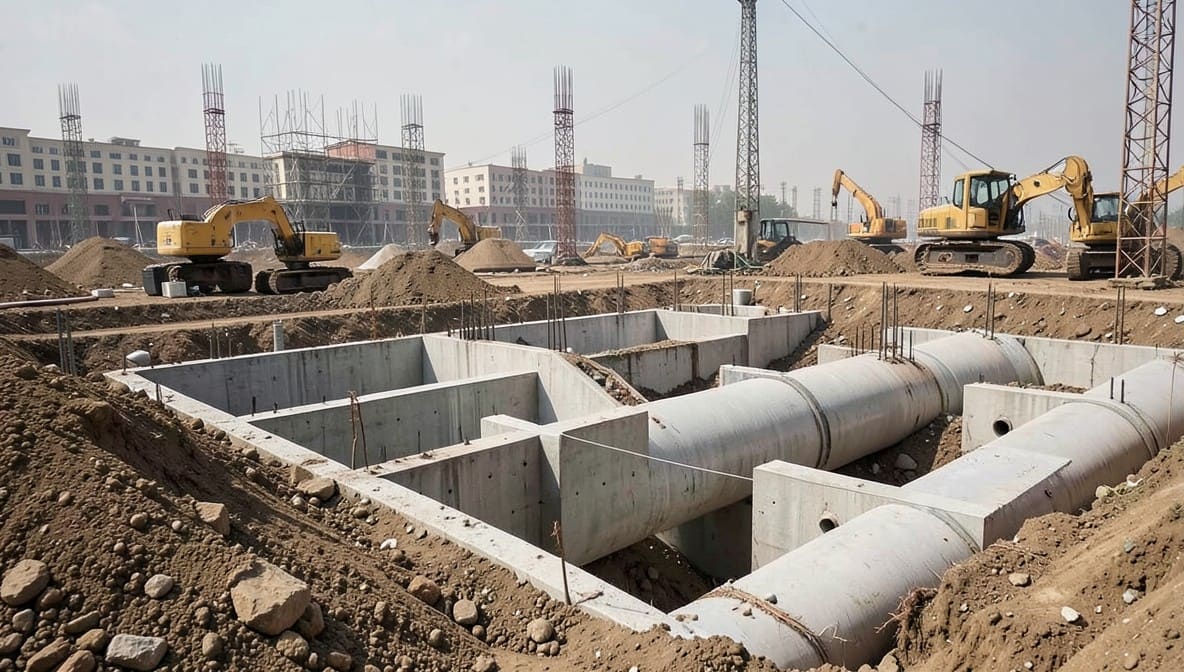
The appellant, M/S Santosh Associate Private Limited, entered into a contract with the respondent, Haryana State Industrial and Infrastructure Development Corporation Ltd., for storm-water drainage works at Sector-35, Udyog Vihar, Phase-VII, Gurugram.
Key Facts
- 07-11-2016: Respondent issued e-tenders for the project.
- 17-05-2017: Appellant was awarded the contract for a total consideration of ₹5,14,11,635.
- The contract contained Clause 25-A(vii) requiring a 10% security deposit of the claim amount for any claim exceeding ₹1,00,000 before arbitration could be referred.
- 19-01-2021: Scope reduced; contract value revised to ₹2,40,93,059.
- 08-08-2024: Sole Arbitrator Justice (Retd.) Surender Gupta appointed under Section 11(6) of the Arbitration Act.
- Respondent filed an application under Section 16, contending the reference was not maintainable because the appellant had not furnished the mandatory 10% deposit.
- The Sole Arbitrator ordered the appellant to deposit the amount within 15 days; upon refusal, the appellant’s claim was dismissed in entirety.
- 01-08-2025: Sole Arbitrator’s order passed.
- 12-09-2025: Commercial Court, Gurugram dismissed the appellant’s appeal under Section 37(2), relying on S.K. Jain v. State of Haryana.
- 17-08-2026: Supreme Court delivered the present judgment.
Procedural History
- 07-11-2016: E-tender issued.
- 17-05-2017: Contract awarded.
- 19-01-2021: Contract value revised.
- 08-08-2024: Sole Arbitrator appointed.
- 01-08-2025: Sole Arbitrator dismissed appellant’s claim for non-deposit.
- 12-09-2025: Commercial Court dismissed appeal.
- 17-08-2026: Supreme Court order.
Parties' Positions
- Appellant: Argues Clause 25-A(vii) violates Article 14 of the Constitution, is discriminatory, lacks rational nexus to curbing frivolous claims, and contravenes Section 18 of the Arbitration Act.
- Respondent: Relies on S.K. Jain as binding precedent upholding refundable pre-deposit clauses, contends the clause is reasonable and serves a legitimate purpose.
Relief Sought
The appellant seeks a declaration that the 10% pre-deposit clause is unconstitutional and an order referring the matter to a larger Bench for authoritative determination of the issues enumerated.
The Legal Issue
What is the constitutional validity of a contractual clause that obliges only the contractor to furnish a pre-deposit of ten per cent of the claim amount prior to arbitration, and does S.K. Jain v. State of Haryana remain a binding precedent on such clauses under the Arbitration & Conciliation Act, 1996?
Arguments Presented
For the Appellant
- Clause 25-A(vii) is arbitrary and discriminatory under Article 14, as it imposes a burden solely on contractors while the State is exempt.
- The deposit requirement lacks a rational nexus to the objective of deterring frivolous claims; frivolousness can be addressed through costs under Section 31(8) of the Act.
- Cites ICOMM Tele Ltd. v. Punjab State Water Supply (2019) 4 SCC 401 and Lombardi Engineering Ltd. v. Uttarakhand Jal Vidyut Nigam Ltd. (2024) 4 SCC 341, where similar clauses were struck down as violative of Article 14.
- Argues that S.K. Jain did not consider Article 14 and therefore cannot be a binding authority on the present issue.
For the Respondent
- Relies on S.K. Jain as a binding three-Judge precedent upholding refundable pre-deposit clauses as a legitimate deterrent against frivolous claims.
- Distinguishes ICOMM Tele and Lombardi on the ground that those cases involved non-refundable or punitive deposits, whereas the present clause is refundable.
- Emphasises that the clause is proportionate, with a sliding scale of security based on claim size, aligning with the logic endorsed in S.K. Jain.
- Argues that Section 18 mandates equal treatment, which is satisfied because the clause applies equally to all contractors.
The Court's Analysis
The Court first recapitulated the ratio decidendi of the leading authorities:
"A stipulation mandating the deposit of a substantial percentage of the claim amount, as a precondition to invoking arbitration, would inevitably suppress claims, deter recourse to alternative dispute resolution, and thereby defeat its very object."
It noted that S.K. Jain upheld a refundable deposit of 7 %, finding it a balancing factor to prevent frivolous claims. However, the Court distinguished ICOMM Tele where the deposit was non-refundable and therefore struck down as arbitrary. The two-Judge decision in ICOMM Tele cannot override the three-Judge precedent of S.K. Jain.
The Court then examined Lombardi Engineering, which affirmed that party autonomy cannot extend to clauses that infringe fundamental rights. Yet, Lombardi also held that there was no conflict between S.K. Jain and ICOMM Tele because the clauses were materially different.
Further, the Court considered the Constitution Bench decision in CORE (2025) 4 SCC 641, which reiterated that Section 18 of the Arbitration Act is non-derogable and that any clause violating Article 14 by being excessive or disproportionate is invalid.
Balancing these authorities, the Court concluded that:
- The binding nature of S.K. Jain remains intact; lower benches cannot disregard it.
- The ten-percent deposit in the present clause is more onerous than the seven-percent deposit upheld in S.K. Jain and lacks a direct nexus to the objective of curbing frivolous claims.
- The clause therefore appears arbitrary, potentially suppressing the right to sue and undermining the policy of de-congesting courts.
Given the conflicting interpretations and the serious constitutional questions, the Court found it appropriate to refer the matter to a larger Bench for definitive pronouncement.
The Verdict
The Supreme Court set aside the Commercial Court’s dismissal and ordered the matter to be placed before the Chief Justice of India for reference to a larger Bench. The Court listed six specific questions (A-F) concerning the constitutionality, statutory compliance, and arbitral policy implications of pre-deposit clauses, and directed the Registry to forward the appeal accordingly.
What This Means For Similar Cases
Pre-deposit Clauses Face Heightened Scrutiny
- Contracts that impose a pre-deposit on only one party must demonstrate a clear, proportional link to the objective of preventing frivolous claims.
- Courts will assess whether the deposit is refundable and non-punitive before deeming it constitutional.
S.K. Jain Remains Controlling
- Lower courts cannot disregard the three-Judge precedent of S.K. Jain even if later two-Judge decisions appear to modify its reasoning.
- Any departure must be justified by a larger Bench.
Alignment with Article 14 and Section 18 Is Mandatory
- Arbitration clauses must treat parties equally at all stages; any clause that discriminates or imposes an excessive burden may be struck down.
- Practitioners should draft security-deposit provisions that are reasonable, refundable, and proportionate to the claim amount.
Practical takeaways:
- Review existing arbitration agreements for asymmetrical deposit requirements.
- If a pre-deposit is necessary, ensure it is refundable and scaled to claim size, mirroring S.K. Jain.
- Anticipate potential constitutional challenges and be prepared to argue rational nexus and non-discrimination.
- Monitor forthcoming larger-Bench judgment for definitive guidance.





