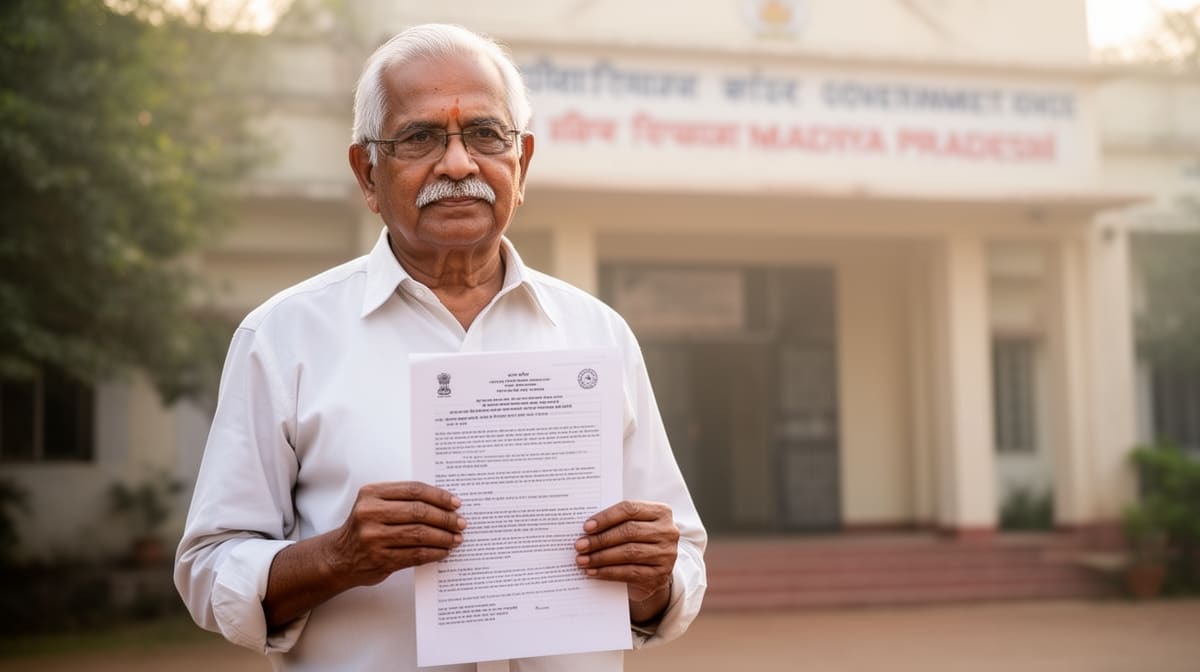
The Madhya Pradesh High Court has struck down the post-retirement recovery of Rs. 1,56,086 from a retired government servant’s gratuity, reaffirming that such actions violate established legal safeguards against arbitrary and iniquitous deductions. The judgment reinforces the principle that recovery of excess payments from retired employees is impermissible under both statutory circulars and binding precedents.
Background & Facts
The Dispute
The petitioner, Mukesh Kumar Patel, was a government servant in the State of Madhya Pradesh who retired on superannuation on 31.01.2025. After retirement, the State Government, through the Department of Finance, initiated recovery of Rs. 1,56,086 from his gratuity amount, alleging an overpayment during his service. The recovery was effected by order dated 28.03.2025 (Annexure P/2), issued by Respondent No. 5.
Key Facts
- The petitioner served in government service until his superannuation on 31.01.2025
- The recovery of Rs. 1,56,086 was made from his gratuity after retirement, without prior adjudication or notice during service
- No departmental enquiry or judicial proceeding was pending against him at the time of retirement
- The petitioner had not been served with any notice of overpayment prior to retirement
- The recovery was made despite the existence of State Government Circulars mandating finalization of pension and gratuity matters before retirement
Procedural History
- 31.01.2025: Petitioner retired on superannuation
- 28.03.2025: Order issued by Respondent No. 5 directing recovery of Rs. 1,56,086 from gratuity
- 16.03.2026: Writ Petition No. 9241 of 2026 filed before the High Court of Madhya Pradesh at Jabalpur seeking quashing of the recovery order
Relief Sought
The petitioner sought quashing of the recovery order dated 28.03.2025 and a direction to refund the amount of Rs. 1,56,086 recovered from his gratuity.
The Legal Issue
The central question was whether recovery of alleged overpayment from a retired government servant’s gratuity, after the completion of service and without prior adjudication, is lawful under Rule 74 of the Madhya Pradesh Civil Services (Pension) Rules, 1976, and in light of the binding precedent in State of Punjab v. Rafiq Masih.
Arguments Presented
For the Petitioner
The petitioner’s counsel relied on two primary legal anchors: first, the judgment of the Supreme Court in State of Punjab and others v. Rafiq Masih (White Washer), (2015) 4 SCC 334, which explicitly prohibits recovery from retired employees; and second, the State Government’s own Circulars dated 29.06.2015 and 08.11.2017, which mandate that pension and gratuity cases must be finalized at least one month before retirement. It was argued that the recovery was not only procedurally defective but also substantively violative of the Supreme Court’s directive that such recoveries are impermissible when they result in harsh, arbitrary, or iniquitous outcomes.
For the Respondent/State
The Government Advocate did not dispute the applicability of the Supreme Court judgment or the circulars but offered no substantive legal justification for the post-retirement recovery. The opposition was limited to a general denial of illegality without citing any contrary precedent or statutory provision permitting such action.
The Court's Analysis
The Court undertook a detailed review of the Supreme Court’s judgment in State of Punjab v. Rafiq Masih, particularly paragraph 18, which enumerates specific situations where recovery from employees is impermissible. The Court noted that clause (ii) of that paragraph explicitly bars recovery from retired employees or those due to retire within one year. The petitioner had retired on 31.01.2025, and the recovery order was passed on 28.03.2025 - over six weeks after retirement - squarely falling within the prohibited category.
"Recovery from retired employees, or employees who are due to retire within one year, of the order of recovery."
The Court further emphasized that the State Government’s own Circulars dated 29.06.2015 and 08.11.2017 required that pension and gratuity cases be finalized 24 months before retirement, with any pending demands resolved at least one month prior to retirement. The fact that no such resolution occurred, and that no NOC was withheld or contested before retirement, rendered the post-retirement recovery procedurally invalid.
The Court also observed that the recovery, if permitted, would amount to an arbitrary and harsh exercise of power, violating the principles of natural justice and equity. The State had ample opportunity to verify service records and resolve discrepancies during the petitioner’s tenure, yet failed to do so. The burden of administrative inefficiency cannot be shifted to a retired employee.
The Verdict
The petitioner succeeded. The Court quashed the recovery order dated 28.03.2025 and directed the State to refund the amount of Rs. 1,56,086 recovered from the petitioner’s gratuity within 30 days of the judgment. No interest was claimed or awarded, and no costs were imposed.
What This Means For Similar Cases
Post-Retirement Recovery Is Per Se Illegal
- Practitioners must immediately challenge any recovery from gratuity or pension after retirement, citing Rafiq Masih as binding precedent
- The mere existence of an alleged overpayment does not justify recovery if the employee has retired
- Administrative delays cannot be used to circumvent statutory timelines for finalization of dues
Circulars Are Binding on State Departments
- State circulars mandating pre-retirement finalization of pension and gratuity are not advisory - they are mandatory directives
- Failure to comply with these circulars renders post-retirement recovery legally unsustainable
- Heads of Departments are duty-bound to issue NOCs on pending demands one month before retirement; silence equals no claim
Procedural Compliance Is Non-Negotiable
- Recovery actions must be initiated and concluded during service, not after
- No departmental enquiry or judicial proceeding can be used as justification for post-retirement deduction if it was not pending at the time of retirement
- Any recovery made after retirement must be challenged as violative of both statutory rules and constitutional equity