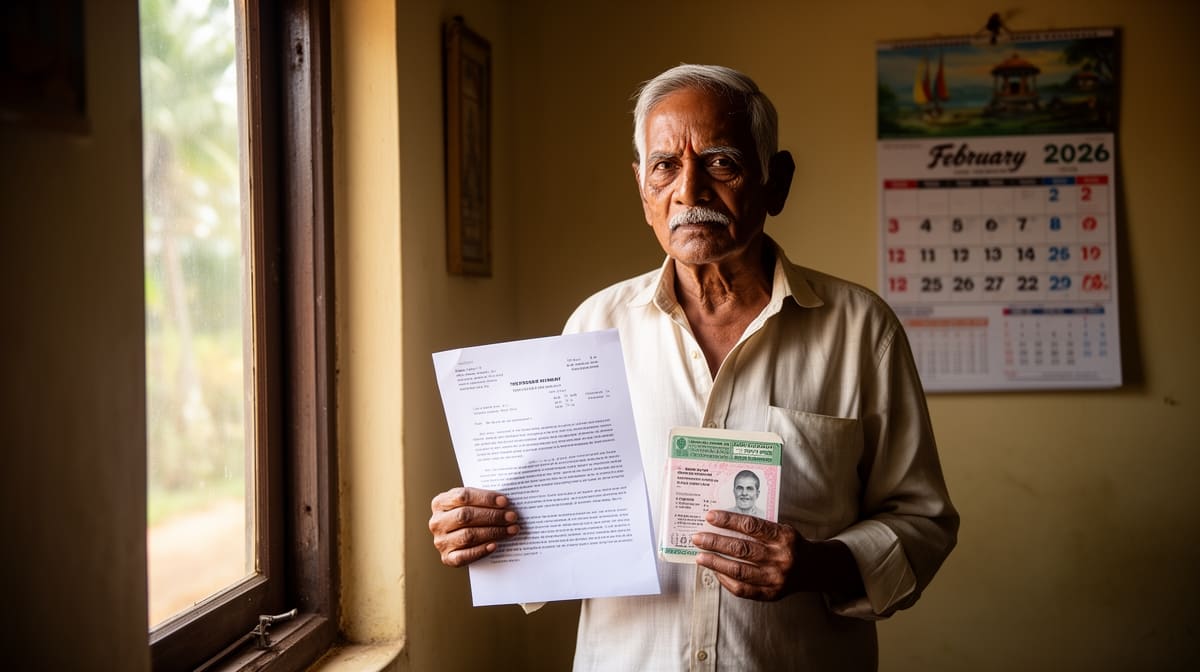
The Madhya Pradesh High Court has delivered a decisive affirmation of the protections afforded to retired government servants against arbitrary recovery of excess payments, reinforcing the Supreme Court’s holding in Rafiq Masih v. State of Punjab. This judgment establishes a clear legal boundary: recovery of overpaid pension or gratuity more than five years after the erroneous payment, especially after retirement, is legally impermissible and violates principles of equity and natural justice.
Background & Facts
The Dispute
The petitioner, Mahesh Prasad Sharma, a retired government servant, faced recovery of an alleged excess pension payment made over a period exceeding five years. The recovery order, dated 13 September 2024, was issued after his retirement, despite no departmental enquiry or judicial proceeding being pending at the time of superannuation. The petitioner contended that the recovery violated both statutory rules and settled judicial principles.
Procedural History
- The petitioner retired in 2023 after a long tenure in state service.
- In 2024, the Finance Department initiated recovery of an alleged overpayment dating back to 2017 - more than five years prior.
- No NOC regarding pending departmental proceedings was issued by the Head of Department within one month of retirement, as mandated by state circulars.
- The recovery order was passed without adherence to Rules 57, 58, and 74 of the Madhya Pradesh Civil Services (Pension) Rules, 1976.
- The petitioner filed this writ petition under Article 226 seeking quashing of the recovery order.
Relief Sought
The petitioner sought quashing of the recovery order dated 13.09.2024 and return of the amount already deducted, relying on the Supreme Court’s judgment in Rafiq Masih v. State of Punjab.
The Legal Issue
The central question was whether recovery of excess pension payments made more than five years prior to the recovery order, and issued after retirement, violates the principles laid down in Rafiq Masih v. State of Punjab and the procedural mandates under the Madhya Pradesh Civil Services (Pension) Rules, 1976.
Arguments Presented
For the Petitioner
The petitioner’s counsel relied on Rafiq Masih v. State of Punjab to argue that recovery from retired employees, particularly where the excess payment spans more than five years, is legally impermissible as it imposes an iniquitous, arbitrary, and harsh burden. It was further submitted that the State had failed to comply with its own circulars dated 29.06.2015 and 08.11.2017, which required finalization of pension cases 24 months before retirement and mandated that absence of an NOC within one month of retirement be deemed as no pending demand.
For the Respondent
The State, through the Government Advocate, did not dispute the timeline of the excess payment or the delay in recovery. Instead, it argued that the recovery was a legitimate exercise of the State’s right to correct accounting errors and that the petitioner had not raised objections during service. No statutory or precedential authority was cited to justify the post-retirement recovery after such a prolonged delay.
The Court's Analysis
The Court undertook a rigorous examination of the Supreme Court’s judgment in Rafiq Masih v. State of Punjab, particularly paragraph 18, which enumerates situations where recovery of excess payments is impermissible. The Court emphasized that the fifth condition in Rafiq Masih - recovery that is iniquitous, harsh, or arbitrary to an extent that outweighs the employer’s right - is not merely discretionary but a constitutional safeguard against abuse of power.
"Recovery in cases where an employee has wrongfully been required to discharge duties of a higher post... or in any other case, where the Court arrives at the conclusion, that recovery if made from the employee, would be iniquitous or harsh or arbitrary to such an extent, as would far outweigh the equitable balance of the employer's right to recover."
The Court held that the State’s failure to act within the stipulated timelines under Rules 57, 58, and 74 of the Pension Rules, coupled with the issuance of circulars mandating timely finalization, rendered the recovery order procedurally invalid. The lapse of over five years, combined with the petitioner’s retirement, created a situation where recovery would be manifestly unjust. The Court further noted that the State’s own circulars created a legitimate expectation that no demand would be raised if no NOC was issued within one month of retirement.
The Court rejected the State’s argument that mere accounting error justifies recovery irrespective of time or hardship. It held that administrative convenience cannot override the principles of fairness, equity, and the protection of retired employees who are no longer in a position to contest or adjust payments.
The Verdict
The petitioner succeeded. The Court quashed the recovery order dated 13.09.2024 and directed the State to return the recovered amount within 30 days. The Court held that recovery of excess pension payments after retirement, where the excess payment occurred more than five years prior, is legally impermissible under Rafiq Masih and violates procedural mandates under the Pension Rules.
What This Means For Similar Cases
Post-Retirement Recovery Beyond Five Years Is Void
- Practitioners representing retired government servants can now invoke Rafiq Masih to challenge any recovery order issued more than five years after the erroneous payment, regardless of whether it occurred during service.
- The five-year threshold is now a bright-line rule in MP and likely persuasive in other states.
Procedural Compliance Is Mandatory, Not Optional
- Government departments must strictly adhere to circulars and rules requiring pension finalization 24 months before retirement and NOC issuance within one month post-retirement.
- Failure to issue an NOC within the stipulated period creates a rebuttable presumption of no pending demand - this must be raised as a defense in recovery proceedings.
Equity Overrides Administrative Convenience
-
Courts will not permit recovery that is disproportionate to the error, especially when the employee is retired and financially vulnerable.
-
Practitioners must emphasize the iniquitous impact on retirees, not just the technical validity of the payment error.
-
Always check the date of the excess payment versus the date of recovery order.
-
If recovery is initiated after retirement and exceeds five years, file a writ petition under Article 226 immediately.
-
Cite Rafiq Masih and the relevant pension rules and circulars as binding authority.
-
Argue that the State’s own procedural lapses bar it from seeking recovery.