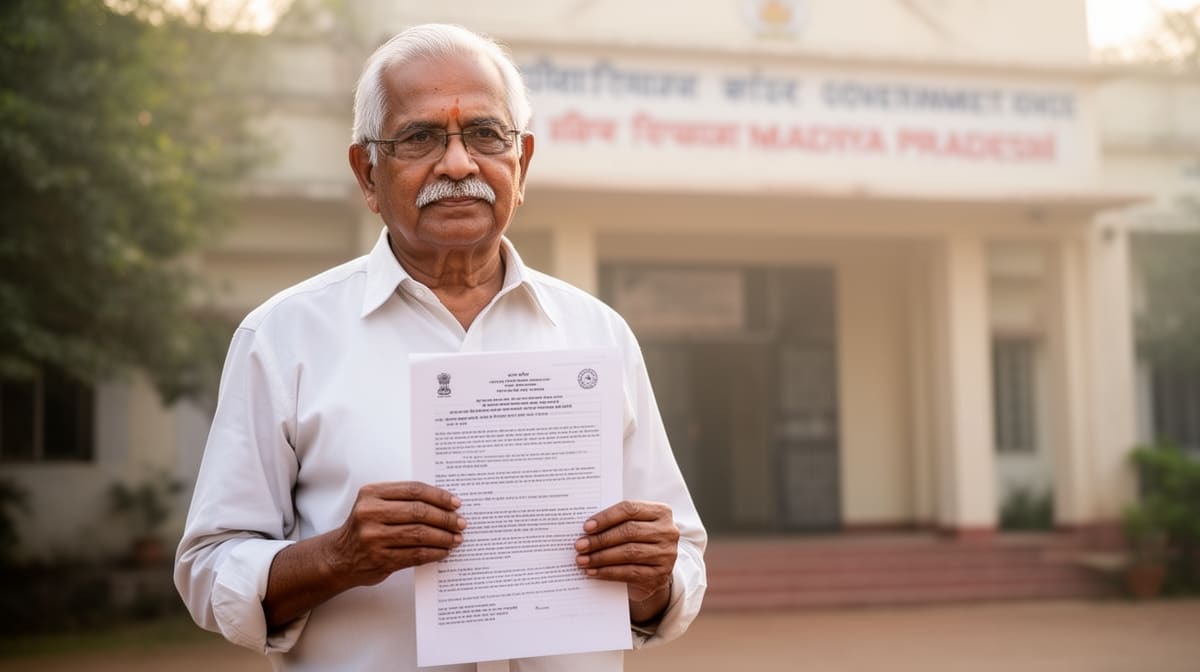
The Madhya Pradesh High Court has struck down the recovery of Rs. 3,02,376 from a retired government employee, affirming that post-retirement deductions violate established circulars and binding precedent. This ruling reinforces the principle that financial adjustments must be completed before retirement, not after, and sets a clear boundary on administrative overreach in pensionary matters.
Background & Facts
The Dispute
The petitioner, Vibhuti Bhushan Pandey, a former government employee, was subjected to a recovery order dated 21.08.2023 for an alleged overpayment of Rs. 3,02,376. The recovery was made after his retirement on 31.08.2023. The petitioner challenged this recovery as illegal, arguing that it contravened both statutory circulars and a binding Full Bench judgment of this Court.
Key Facts
- The petitioner served in the State Government and retired on superannuation on 31.08.2023
- An administrative review concluded that an overpayment of Rs. 3,02,376 had occurred during his service
- The recovery order (Annexure-P/1) was passed on 21.08.2023, just 10 days before retirement
- No recovery was initiated or completed prior to retirement
- The petitioner had no opportunity to contest the overpayment claim before the recovery order was issued
Procedural History
- 21.08.2023: Recovery order issued by Respondent No. 3 (authorizing authority)
- 31.08.2023: Petitioner retired from service
- 05.10.2023: Petitioner filed this writ petition under Article 226 of the Constitution
- 23.03.2026: Hearing concluded before the Hon’ble Justice Vishal Dhagat
The Parties' Positions
Petitioner’s Position: The recovery is illegal because:
- It was made after retirement, in violation of State Government Circulars
- It contravenes the Full Bench judgment in State of M.P. v. Jagdish Prasad Dubey (W.A. No. 815/2017)
- The recovery was initiated within one year of retirement, which the circulars prohibit
Respondent’s Position: The State did not file a written counter, but the Government Advocate orally opposed the petition, arguing that the recovery was necessary to correct an accounting error and that the petitioner had benefited from the overpayment.
Relief Sought
The petitioner sought:
- Quashing of the recovery order dated 21.08.2023
- Refund of Rs. 3,02,376 already recovered
- Directions to the State to recalculate pension without including the disputed amount
The Legal Issue
The central question was whether recovery of alleged overpayment from a government servant after retirement is lawful when the recovery order is passed within one year of retirement, in light of State Government circulars and binding precedent.
Arguments Presented
For the Petitioner
The petitioner’s counsel relied on two primary legal anchors:
- The Full Bench judgment in State of M.P. v. Jagdish Prasad Dubey (W.A. No. 815/2017), which held that recovery of overpayments after retirement is impermissible unless exceptional circumstances exist
- Circular No. F 9-3/2015/Rule/Four, Bhopal dated 29.06.2015, which mandates that recovery proceedings must be completed at least 24 months before retirement
- Circular No. F 9-3/2015/Rule/Four, Bhopal dated 08.11.2017, which explicitly prohibits recovery if retirement is due within one year The counsel argued that the recovery order was passed merely 10 days before retirement, squarely violating these directives and rendering it void ab initio.
For the Respondent
The Government Advocate did not dispute the applicability of the circulars or the precedent. He conceded that the recovery was made close to retirement but argued that the State had a legitimate interest in correcting accounting irregularities. However, no legal authority or exception was cited to justify post-retirement recovery under these circumstances.
The Court's Analysis
The Court began by examining the binding precedent in State of M.P. v. Jagdish Prasad Dubey, which unequivocally held that recovery of overpayments after retirement is illegal unless the overpayment was due to fraud or deliberate misrepresentation - neither of which was alleged here.
"The State cannot be permitted to recover dues after retirement merely because an accounting error occurred during service. The principle of fairness and the protection of vested rights demand that such adjustments be completed before the employee exits service."
The Court then turned to the State’s own circulars. Circular dated 29.06.2015 required that recovery proceedings be initiated at least 24 months before retirement. Circular dated 08.11.2017 further clarified that if retirement is due within one year, recovery shall not be made. The recovery order dated 21.08.2023 was issued when retirement was due on 31.08.2023 - a period of just 10 days. This placed the order squarely within the prohibited window.
The Court emphasized that circulars issued by the State Government, particularly those governing service conditions and financial adjustments, carry the force of law in the absence of contrary statutory provisions. The State cannot evade its own directives by invoking administrative convenience.
The Court also noted that the petitioner had no opportunity to contest the overpayment claim prior to the recovery order, violating the principles of natural justice.
The Verdict
The petition succeeded. The Court quashed the recovery order dated 21.08.2023 (Annexure-P/1). The State was directed to refund the entire amount of Rs. 3,02,376 recovered from the petitioner within 30 days of the judgment. The Court further permitted the respondents to fix the last pay drawn by the petitioner to enable correction of his pension, but explicitly barred any further recovery from pension or other benefits.
What This Means For Similar Cases
Recovery After Retirement Is Per Se Illegal
- Practitioners representing retired government employees must immediately challenge any post-retirement recovery order
- The burden shifts to the State to prove fraud or deliberate misrepresentation to justify such recovery
- Circulars governing recovery timelines are binding and enforceable in writ jurisdiction
One-Year Rule Is Absolute
- If retirement is due within one year, recovery cannot be initiated or completed
- Even if the overpayment occurred years earlier, the State must act well in advance
- Failure to comply renders the recovery void, regardless of the amount or nature of the error
Pension Adjustment Must Be Procedural, Not Punitive
- The Court’s direction to "fix last pay drawn" allows for pension recalculation without recovery
- This establishes a new norm: corrections must be made prospectively, not retroactively
- Practitioners should now routinely request pension recalculation instead of opposing recovery