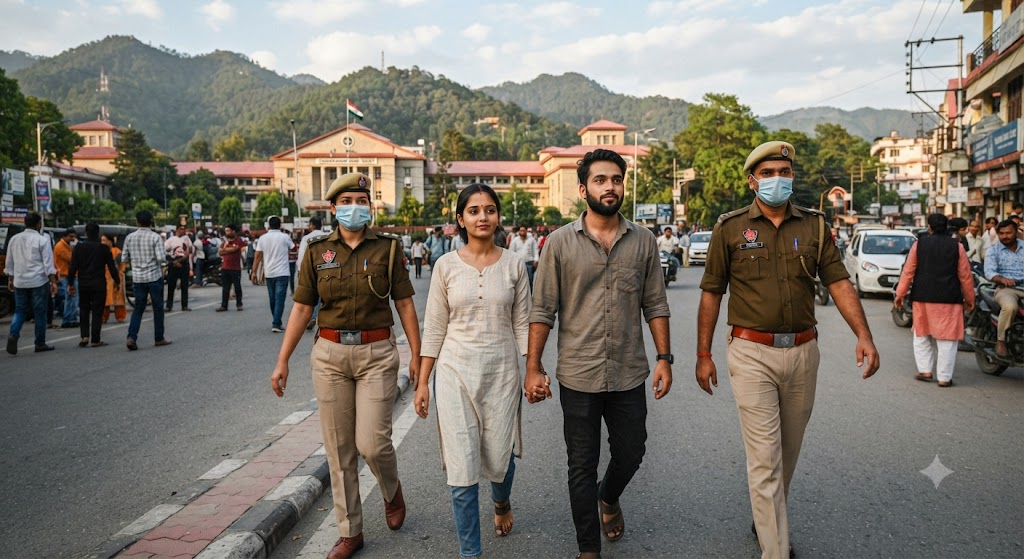
The Uttarakhand High Court upheld the right of an interfaith couple to police protection when faced with threats from family members opposing their love marriage. The court invoked the precedent in Lata Singh v. State of U.P. and the Uniform Civil Code Rule 7(1)(g) to grant relief.
Background & Facts
The Dispute
The petitioners, Fareen Jahan and her spouse, sought protection from threats emanating from the family members of the first petitioner, who opposed their interfaith love marriage. They asserted that their life and liberty were in jeopardy due to intimidation and threats of violence.
Key Facts
- The petitioners developed a relationship and solemnized their Nikah on 09 August 2026.
- Their marriage was registered on 25 August 2026 under Rule 7(1)(g) of the Uniform Civil Code.
- Since the marriage, family members of the first petitioner have issued threats to kill both petitioners.
- The petitioners approached the court apprehending serious harm to their life and liberty.
- The Station House Officer of Police Station Kashipur, District Udham Singh Nagar was directed to assess any threat and provide necessary protection.
Procedural History
- The writ petition was filed directly before the Uttarakhand High Court; no lower court proceedings are recorded in the judgment.
- The matter was heard and decided by a single bench.
Relief Sought
The petitioners prayed for: (i) A writ of mandamus directing the respondents to provide adequate police protection; (ii) Summoning of private respondents (family members) inimical to the marriage for counselling in accordance with law.
The Legal Issue
The central question was whether the court could issue a writ directing police protection to individuals facing threats from family members due to an interfaith marriage, based on the principles laid down in Lata Singh v. State of U.P. and the applicable provisions of the Uniform Civil Code.
Arguments Presented
For the Petitioners
Counsel argued that the threats constituted a violation of Article 21 of the Constitution, citing Lata Singh v. State of U.P. where the Supreme Court held that interfaith couples are entitled to protection. Reliance was placed on Rule 7(1)(g) of the Uniform Civil Code, which mandates registration of such marriages and implies state obligation to safeguard the parties.
For the Respondent
The State submitted that the threat perception was speculative and that the police could act only upon concrete evidence of imminent danger. It contended that the matter was essentially a private family dispute not warranting extraordinary writ relief.
The Court's Analysis
The Court noted that the petitioners had demonstrated a reasonable apprehension of harm stemming from familial opposition to their marriage. It emphasized that the right to life and personal liberty under Article 21 includes the right to choose one's partner and to be protected from unlawful interference.
"In that view of the matter, and in view of the ruling of the Hon'ble Supreme Court in the case of L ata Singh Vs State of U.P. and another, (2006) 5 SCC 475, the petitioners have made out a case for grant of protection."
The Court further observed that the Uniform Civil Code Rule 7(1)(g) facilitates the registration of such marriages and, by implication, casts a duty on the State to ensure the safety of the parties post-registration. The threats alleged were not vague; they were specific and serious, warranting preventive action.
Balancing the liberty of the petitioners against the State's duty to maintain public order, the Court concluded that issuing a direction for police protection was a proportionate and necessary measure.
The Verdict
The petitioners succeeded. The Court directed the Station House Officer, Police Station Kashipur, District Udham Singh Nagar to assess any threat to the life and limb of the petitioners and to provide necessary protection if a threat is found. The S.H.O. was also directed to summon the private respondents and other persons inimical to the marriage for counselling in accordance with law. The writ petition was disposed of accordingly.
What This Means For Similar Cases
Police Protection as a Preventive Measure
- Courts may grant police protection where there is a credible threat to life and liberty arising from opposition to interfaith marriages.
- The threat need not be imminent; a reasonable apprehension suffices.
Role of Personal Laws and Uniform Civil Code
- Registration under personal law or the Uniform Civil Code strengthens the claim for state protection.
- Rule 7(1)(g) of the UCC can be invoked to assert procedural safeguards for interfaith couples.
Balancing Private Disputes and Constitutional Rights
- Family opposition alone does not oust judicial scrutiny when constitutional rights are implicated.
- The State bears a duty to protect individuals exercising their freedom to marry.