The Andhra Pradesh High Court has reaffirmed a clear, precedent-based methodology for calculating compensation for fruit-bearing trees in land acquisition proceedings, rejecting speculative capitalization methods in favor of uniform per-tree rates established by prior judgments. This decision brings much-needed doctrinal clarity to a frequently contested aspect of acquisition disputes.
Background & Facts
The Dispute
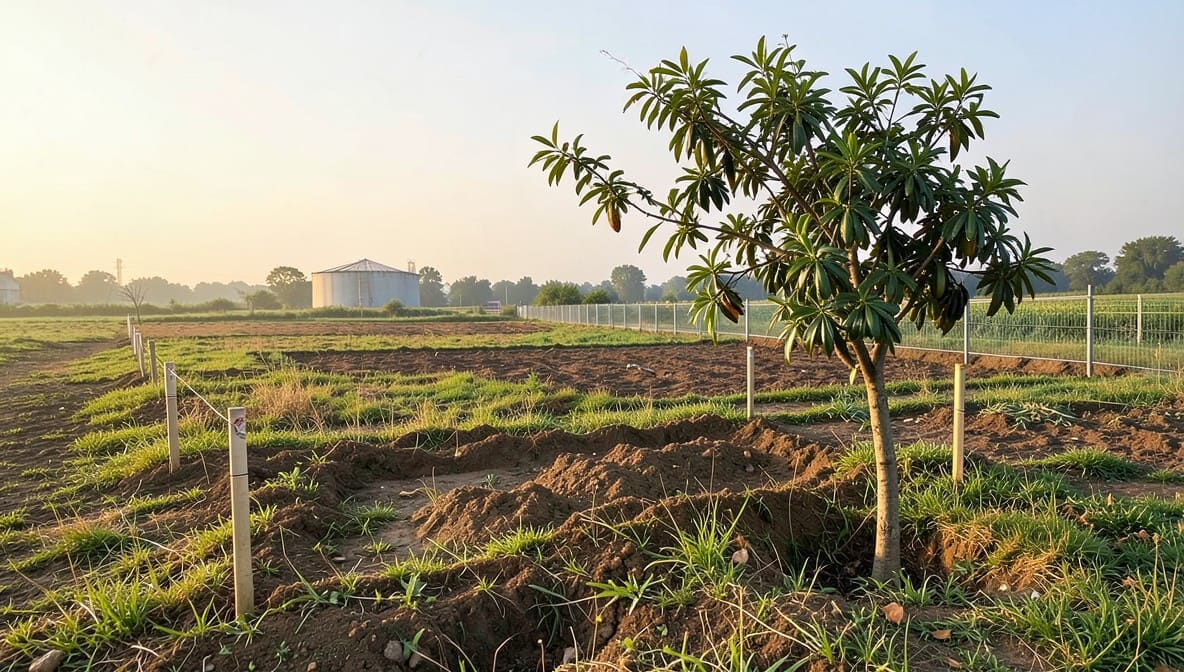
The land acquisition dispute arose from the acquisition of agricultural land in Parnapalli Village, Lingala Mandal, Kadapa District, for the construction of a spillway for the Chitravati Balancing Reservoir. The land, comprising 33.22 cents across multiple survey numbers, was notified for acquisition under the Land Acquisition Act, 1894. The claimant, M. Lakshmaiah, owned 8.06 cents in Survey No. 381 and 1.62 cents in Survey No. 385. The acquired land was rain-fed, with red and black cotton soil, primarily used for cultivating groundnut. The claimant’s land contained 1,076 guava trees, 3 mango trees, and 1 sapota tree, irrigated by a bore-well.
Key Facts
- Draft notification published in the Gazette on 14.02.2001
- Final declaration published in the Gazette on 16.02.2001
- Land acquired: 8.06 cents in Sy.No.381 and 1.62 cents in Sy.No.385
- Trees on acquired land: 1,076 guava trees, 3 mango trees, 1 sapota tree
- Bore-well present on the land
- Land Acquisition Officer (LAO) initially valued land at Rs.35,500 per acre based on 57 sale deeds from 1999 - 2002
- LAO awarded Rs.1,11,823 for trees under G.O.Ms.No.601, Revenue (LA) Department, dated 16.06.1992
- LAO granted 30% solatium and 12% additional market value from 26.02.2001 to 05.08.2002
- Claimant challenged the award before the Reference Court, contending land was irrigated garden land worth Rs.1,00,000 per acre and that bore-well and tree valuation were inadequate
- Reference Court enhanced land value to Rs.50,000 per acre and tree compensation to Rs.7,88,085 using capitalization method
- Reference Court also awarded Rs.10,000 for the well and prescribed layered interest rates
Procedural History
- 14.02.2001: Draft notification published
- 16.02.2001: Final declaration published
- 05.08.2002: LAO issued award No.8/2002-2003
- 2002 - 2003: Claimant filed claim under Section 18 of the Land Acquisition Act
- 23.12.2016: Reference Court (VI Additional District Judge, Kadapa) passed decree enhancing compensation
- 2017: Claimant filed Land Acquisition Appeal Suit No.458/2017 against the LAO
- 2018: LAO filed Land Acquisition Appeal Suit No.21/2018 against the claimant
- 02.04.2026: Judgment delivered by the Andhra Pradesh High Court
The Parties' Positions
For the Claimant (Appellant in LAAS 458/2017)
- Argued land was irrigated garden land, not dry land, and should be valued at Rs.1,00,000 per acre
- Contended tree valuation using capitalization method was correct and should be upheld
- Sought compensation for bore-well worth Rs.50,000
- Later, during hearing, confined claim to per-tree compensation for trees, accepting precedent
For the Land Acquisition Officer (Appellant in LAAS 21/2018)
- Defended the original award and the Reference Court’s enhanced land value
- Argued tree compensation should follow G.O.Ms.No.601
- Contended that per-tree rates of Rs.3,000 were consistently applied by the High Court and should be followed
Relief Sought
- Claimant sought enhancement of land value to Rs.1,00,000 per acre, tree compensation via capitalization, and Rs.50,000 for bore-well
- LAO sought reduction of compensation awarded by the Reference Court
- Both parties sought final determination of compensation under the Land Acquisition Act
The Legal Issue
The central question was whether compensation for fruit-bearing trees in land acquisition must be determined by capitalizing income from yield, or whether a per-tree valuation based on established judicial precedent is the correct and binding method.
Arguments Presented
For the Appellant (Claimant)
Initially, the claimant argued for capitalization of income method to value trees, relying on Ambya Kalya Mhatre (dead) through LRs. v. State of Maharashtra, Bhupendra Ramdhan Pawar v. Vidarbha Irrigation Development Corporation, and Nelatur Sampoornamma v. Special Deputy Collector. He contended that where land value is determined by income yield, trees should be valued as integral to the land’s productivity. However, during oral arguments, he withdrew this contention and agreed to limit his claim to per-tree compensation, accepting the High Court’s consistent precedent of Rs.3,000 per tree, and requested an enhanced rate of Rs.3,500 per tree due to inflation.
For the Respondent (Land Acquisition Officer)
The Government Pleader contended that Ambya Kalya Mhatre permits per-tree valuation when the land is valued by sale comparison, and that the High Court has consistently awarded Rs.3,000 per tree for guava, mango, and sapota trees in prior judgments, including LAAS No.417 of 2008 and LAAS No.80 of 2019. The State argued that capitalization method introduces subjectivity and should not override settled per-tree rates.
The Court's Analysis
The Court undertook a detailed review of the legal principles governing tree compensation under the Land Acquisition Act. It emphasized that while Ambya Kalya Mhatre permits capitalization of income for trees when land value is determined by yield, this method is not mandatory. The Court held that when the land is valued by reference to comparable sales - as was done here - trees must be valued separately, and the most reliable, objective, and uniform method is per-tree valuation based on judicial precedent.
"Where the market value of the land is determined by reference to sale deeds of similar lands in the vicinity, the value of fruit-bearing trees must be assessed independently, and the most consistent and equitable method is the per-tree rate fixed by this Court in prior judgments."
The Court noted that the Reference Court’s use of capitalization for trees was inconsistent with the LAO’s own valuation method (sale-based), creating a doctrinal contradiction. The Court further observed that the claimant, having voluntarily confined his claim to per-tree compensation, had effectively accepted the binding nature of the High Court’s precedent.
The Court examined LAAS No.417 of 2008, which laid down a detailed schedule of per-tree rates for various fruit-bearing species, including Rs.3,000 for guava, mango, and sapota trees. This schedule had been consistently followed in subsequent judgments, including LAAS No.80 of 2019. The Court held that deviation from this schedule without compelling justification would introduce arbitrariness.
The Court rejected the claimant’s request to enhance the rate to Rs.3,500 per tree, noting that while inflation is a factor, the High Court’s precedent-based rates are periodically reviewed and updated through judicial notice, not ad hoc adjustments in individual cases. The Court also upheld the Reference Court’s award of Rs.10,000 for the bore-well, finding it reasonable and supported by evidence.
The Verdict
The appeals were disposed of with consent. The Court set aside the Reference Court’s tree valuation of Rs.7,88,085 and substituted it with per-tree compensation: Rs.3,228,000 for 1,076 guava trees at Rs.3,000 per tree, Rs.9,000 for 3 mango trees, and Rs.3,000 for 1 sapota tree. The claimant is entitled to Rs.10,000 for the bore-well. All statutory benefits, including 30% solatium, 12% additional market value from 26.02.2001 to 05.08.2002, and interest at 9% per annum from possession to one year and 15% thereafter, remain unchanged as per the Reference Court’s order. There shall be no order as to costs.
What This Means For Similar Cases
Per-Tree Rates Are Binding Precedent
- Practitioners must now rely on the High Court’s published per-tree schedule (e.g., Rs.3,000 for guava, mango, sapota) and not attempt to argue capitalization unless land value is determined by income yield
- Any request for higher per-tree rates must be supported by a formal review petition to the Division Bench, not individual claims
Capitalization Method Is Exceptional, Not Default
- Capitalization of income for trees is only applicable when the land’s market value is determined by its agricultural yield, not by sale comparisons
- In 90% of acquisition cases, sale deeds are the basis for land valuation - making per-tree rates the norm
Bore-Well Compensation Must Be Reasonably Justified
-
Compensation for irrigation infrastructure is permissible but must be supported by evidence of cost and utility
-
Rs.10,000 is now a recognized benchmark for bore-wells in similar contexts
-
Always cite LAAS No.417 of 2008 and LAAS No.80 of 2019 when arguing tree compensation
-
Do not rely on G.O.s or arbitrary valuations when judicial precedent exists