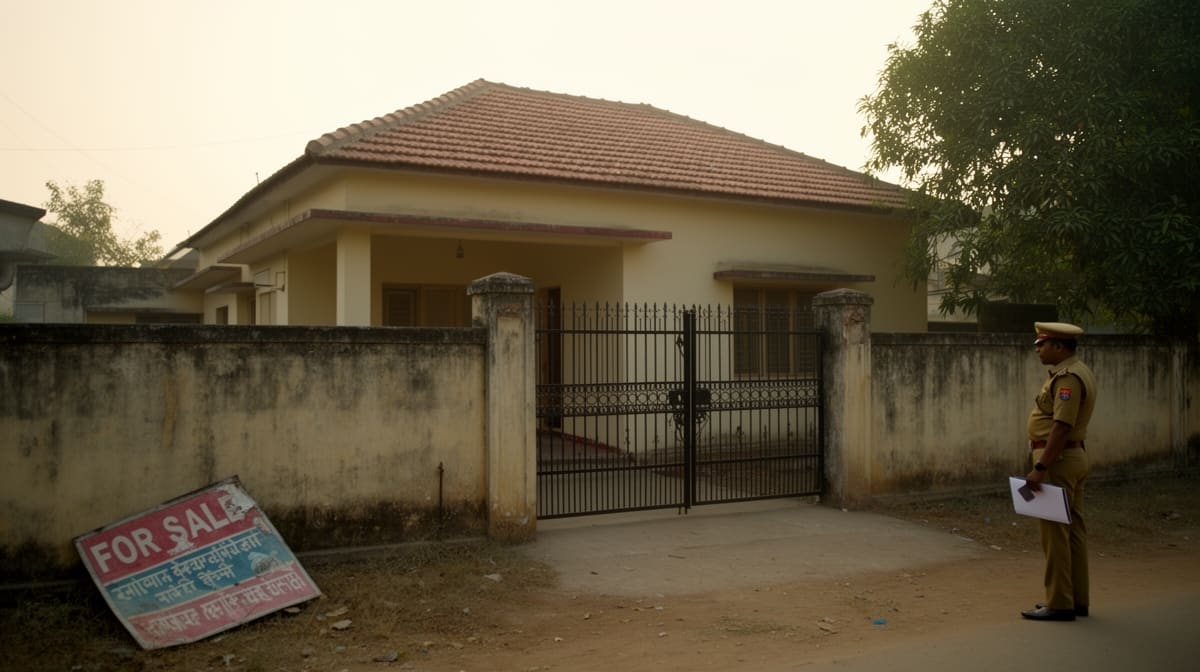
The High Court of Telangana has reaffirmed that peaceful possession of property cannot be disturbed by administrative authorities without following due process of law, even in the absence of a final title determination. This order underscores the constitutional protection afforded under Article 226 against arbitrary state action, offering immediate relief to possessors with prima facie documentary evidence.
Background & Facts
The Dispute
The petitioner, Salla Narsaiah, claims absolute ownership and peaceful possession of an open plot measuring 1600 square feet in Dimma Village, Adilabad District. He asserts title through a registered sale deed dated 02.05.2024 (Document No. 3224 of 2024) and further substantiates his claim with consistent payment of property tax, evidenced by receipts marked as Ex.P3. His name is duly recorded in the Gram Panchayat records, establishing his status as a lawful possessor.
Procedural History
The petitioner filed this writ petition under Article 226 of the Constitution seeking protection against alleged interference by revenue and panchayat authorities. He also filed an interim application under Section 151 of the CPC seeking an injunction against unauthorized interference pending final disposal. The respondents, including the District Collector, Tahasildar, and Panchayat Secretary, were served but did not file detailed written objections.
The Parties' Positions
- The petitioner contended that the respondents had threatened to take possession of the property without notice or legal authority.
- Respondents No. 1 to 3, represented by the Assistant Government Pleader, submitted that no formal action had been taken.
- Respondent No. 4, the Gram Panchayat Secretary, claimed that villagers had held a meeting alleging encroachment by the petitioner on neighboring land and had requested the Panchayat to take action.
Relief Sought
The petitioner sought a writ of mandamus directing the respondents not to interfere with his peaceful possession of the property except in accordance with law, and declaring such interference illegal and unconstitutional.
The Legal Issue
The central question was whether administrative authorities may interfere with a person’s peaceful possession of property, supported by registered documents and tax payments, without following due process of law, even in the absence of a court decree or formal eviction proceeding.
Arguments Presented
For the Petitioner
Counsel for the petitioner relied on the principle that peaceful possession is a protected interest under Article 21 and Article 226. He cited State of Haryana v. Bhajan Lal to argue that possession backed by documentary evidence cannot be disturbed by executive fiat. He emphasized that the petitioner’s possession was open, continuous, and recognized by the Gram Panchayat, and that any interference without notice or hearing violated natural justice.
For the Respondent
The Assistant Government Pleader for the State conceded that no formal action had been initiated against the petitioner. The Standing Counsel for the Gram Panchayat stated that the Panchayat had merely received a complaint from villagers and had not yet taken any step to evict or interfere. He submitted that the Panchayat was awaiting further instructions.
The Court's Analysis
The Court declined to adjudicate the title dispute, noting that the matter involved a complex factual and legal question best resolved through civil proceedings. However, it emphasized that possession, even if not conclusive of title, is a legally protected interest. The Court observed that due process requires notice, opportunity to be heard, and a reasoned order before any interference with possession.
"It is settled law that no authority, however well-intentioned, can dispossess a person of possession without following due process of law, even if the title is disputed."
The Court distinguished between title and possession, holding that while title may be subject to litigation, possession cannot be summarily disturbed. The Court further noted that the Gram Panchayat’s alleged request for action based on a villagers’ meeting does not constitute a legal basis for interference. Administrative action must be grounded in statutory authority and procedural fairness.
The Verdict
The petitioner prevailed. The Court held that administrative authorities cannot interfere with peaceful possession of property without following due process of law. It directed Respondents No. 3 and 4 not to interfere with the petitioner’s possession of the subject property, while clarifying that this order does not determine title or affect disputes with third parties.
What This Means For Similar Cases
Possession Is a Provisional Right Protected by Writ Jurisdiction
- Practitioners may now invoke Article 226 to restrain authorities from disturbing possession supported by registered documents, tax receipts, or official records - even without a title deed.
- Courts will treat peaceful possession as a sufficient ground for interim relief under writ jurisdiction, pending resolution of title disputes.
Administrative Action Requires Procedural Compliance
- Gram Panchayats, revenue officials, and local bodies cannot act on informal complaints or village meetings alone.
- Any action affecting possession must be preceded by: (i) notice to the possessor, (ii) opportunity to explain, and (iii) a written order citing legal basis.
Title Disputes Must Be Resolved Civilly, Not Administratively
- This judgment reinforces that title disputes are civil matters and cannot be resolved by executive orders or panchayat resolutions.
- Lawyers should advise clients to file civil suits for declaration of title while simultaneously seeking writ relief to protect possession.