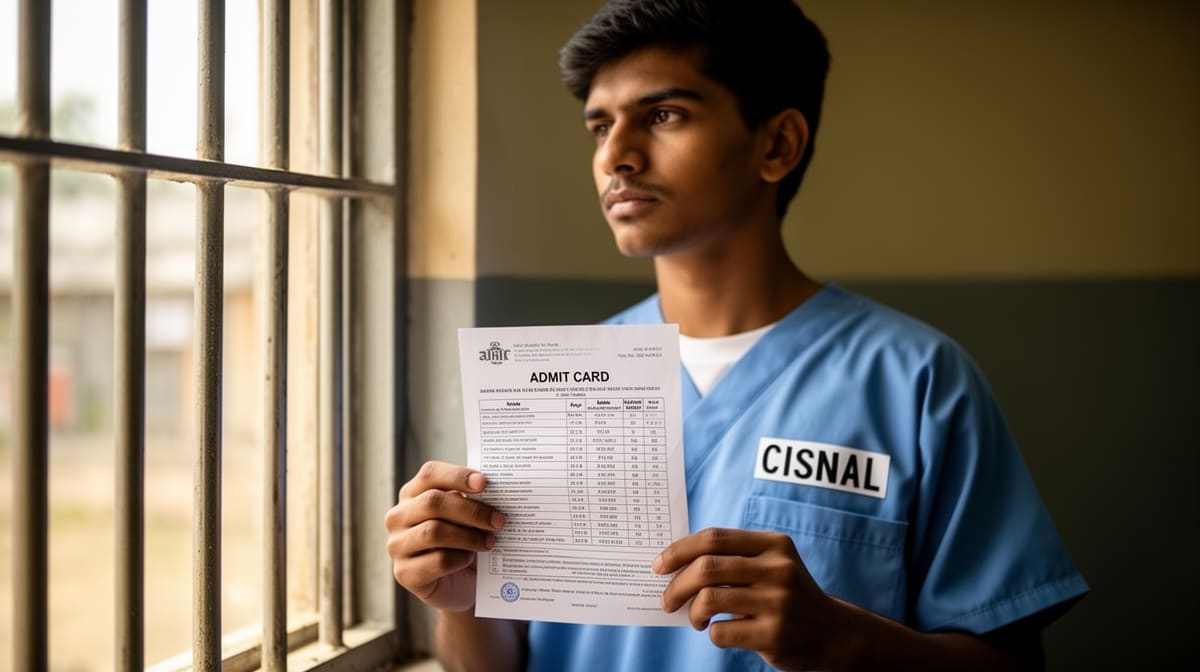
A convict who absconded after being granted parole cannot claim permanent release, even after serving two decades in custody. The Rajasthan High Court has clarified that repeated violations of parole conditions undermine the very foundation of conditional liberty, though prolonged incarceration and subsequent good conduct may warrant limited, temporary relief.
Background & Facts
The Dispute
The petitioner, Yogesh Kumar, was convicted for the offence of murder under Section 302 IPC in connection with FIR No. 185/2017. He was sentenced to life imprisonment by a trial court, and the conviction was upheld on appeal. The petitioner has now spent approximately twenty years in custody, including statutory remissions.
Key Facts
- The petitioner was granted parole for twenty days by a Coordinate Bench of this Court on 10.06.2017 in D.B. Criminal Writ Petition No. 550/2016
- He failed to surrender to prison authorities upon expiry of the parole period on 30.06.2017
- He absconded for a period of one month and seventeen days
- He was re-arrested on 27.07.2017 following a police operation linked to a subsequent case registered during his abscondence
- Since his re-arrest, prison records indicate that his conduct within the jail has been reported as good
- The petitioner has not been granted any further parole since his re-arrest
- He is currently lodged in the Central Jail, Jaipur
Procedural History
- 16.05.2012: Conviction and sentencing for murder
- 10.06.2017: Coordinate Bench grants 20-day parole
- 30.06.2017: Parole period expires; petitioner fails to surrender
- 27.07.2017: Petitioner re-arrested after absconding for 47 days
- 08.06.2026: Present petition filed seeking permanent parole
Relief Sought
The petitioner sought permanent parole on the grounds of long incarceration, good conduct in jail, and rehabilitation potential.
The Legal Issue
The central question was whether a prisoner who has previously absconded during a granted parole period can be granted permanent parole, and whether the reformative theory of punishment permits such relief despite a clear breach of trust.
Arguments Presented
For the Petitioner
The petitioner’s counsel, Ms. Laxmi Ramawat, argued that the petitioner has served over twenty years, including remissions, and has demonstrated consistent good conduct since his re-arrest in 2017. She relied on the reformative theory of punishment and cited State of Haryana v. Bhagwan Das to contend that prolonged incarceration without parole undermines the purpose of rehabilitation. She emphasized that the petitioner’s conduct post-rearrest merits a second chance.
For the Respondent
The Additional Advocate General, Mr. Deepak Choudhary, countered that the petitioner’s deliberate violation of the Court’s parole order in 2017 demonstrated a pattern of disregard for legal conditions and State authority. He submitted that granting permanent parole after such a breach would set a dangerous precedent and erode the integrity of the parole system. He cited State of Rajasthan v. Ram Singh to argue that parole is a privilege, not a right, and must be contingent on sustained good conduct.
The Court's Analysis
The Court examined the jurisprudence surrounding parole, emphasizing that it is a privilege granted under the reformative theory of punishment, designed to facilitate reintegration into society. However, this privilege is conditional and contingent upon the prisoner’s conduct both within and outside the prison.
"The liberal approach adopted under the reformative theory of punishment, aimed at facilitating the reintegration of prisoners into society, was clearly abused by the petitioner."
The Court noted that the petitioner’s failure to surrender after the 2017 parole was not a mere oversight but a deliberate act of defiance, requiring police intervention for re-arrest. This conduct, the Court held, fundamentally undermines the trust required for any further parole concession.
However, the Court also acknowledged the petitioner’s prolonged incarceration and his documented good conduct since re-arrest. It distinguished between permanent parole, which requires unbroken trustworthiness, and temporary parole, which may be granted as a rehabilitative measure even to those with past lapses.
The Court emphasized that the State’s interest in public safety and institutional integrity must be balanced against the prisoner’s right to rehabilitation. In this case, the balance tipped in favor of a limited, supervised release to test continued compliance.
The Verdict
The petition for permanent parole was dismissed. The Court granted the petitioner temporary parole for a period of fifteen days, subject to furnishing a personal bond of Rs. 1,00,000 and one surety of Rs. 1,00,000, to the satisfaction of the Superintendent of the concerned jail. The parole period shall commence from the date of actual release. The Superintendent may impose additional reasonable conditions to ensure return to custody. The petitioner is directed to surrender upon expiry of the parole period. If he complies and maintains good conduct thereafter, he may approach the Court again for further relief.
What This Means For Similar Cases
Violation of Parole Conditions Bars Permanent Release
- A single instance of absconding during parole, especially when deliberate, disqualifies a prisoner from claiming permanent parole
- Courts will not overlook breaches of parole conditions, even if the prisoner has served decades
- The reformative theory does not override the requirement for trustworthiness and compliance
Temporary Parole May Still Be Granted Post-Breach
- Good conduct after re-arrest can justify limited, time-bound parole as a rehabilitative tool
- Temporary parole serves as a probationary measure to test renewed compliance
- Practitioners should advise clients to demonstrate sustained good behavior for at least 12 - 24 months before reapplying
- Bond and surety conditions must be strictly adhered to; failure to surrender will result in immediate re-detention and forfeiture of future claims
Institutional Discretion Is Broad but Not Unfettered
- Jail authorities may impose additional conditions beyond standard terms
- Courts expect strict adherence to all parole conditions; deviations will be treated as violations
- Petitioners must submit prison conduct reports and character affidavits to support applications
- The burden of proving rehabilitation lies squarely on the prisoner, not the State