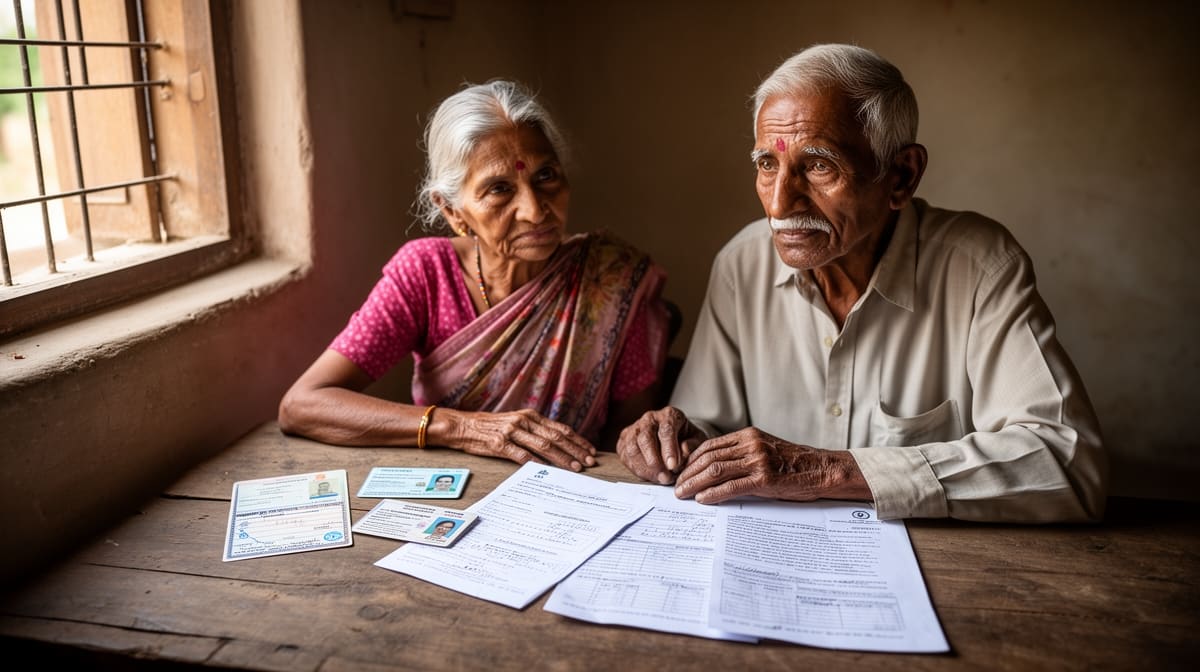
The Rajasthan High Court has clarified that parents of a deceased workman are legally recognized as dependents under the Workmen's Compensation Act, 1923, provided they establish partial or total financial dependency. This ruling overturns a lower tribunal’s erroneous dismissal of a claim based on marital status assumptions and mandates a fresh adjudication grounded in evidence.
Background & Facts
The Dispute
The appellants, Rawta and Chunni Meghwal, are the parents of Nanu, a 17-year-old female labourer who died in a workplace accident in 1999 while transporting concrete on a tractor driven by respondent Makna Ram. The appellants filed a claim for compensation under the Workmen’s Compensation Act, 1923, asserting that Nanu was their sole earner and that they were wholly dependent on her income.
Procedural History
- 1999: Claim petition filed under Section 22 of the Act against respondents 1 - 4 (contractors) and later amended to include respondent 5 (PWD Department) and respondent 6 (contractor Natwar Lal).
- 2001: Five primary issues and two additional issues framed by the Commissioner, including whether the appellants were dependent on Nanu and whether Nanu was married to Gena Ram.
- 2006: Commissioner dismissed the claim without addressing any of the framed issues, relying solely on a Madhya Pradesh High Court judgment concerning the Motor Vehicles Act and erroneously concluding that parents cannot be dependents.
- 2011: Appeal filed before the Rajasthan High Court under Section 30 of the Act.
Relief Sought
The appellants seek compensation of Rs. 2,50,000 with 18% interest and 50% penalty, arguing that they are dependents under Section 2(1)(d) of the Act and that the Commissioner’s failure to adjudicate the framed issues renders the award legally unsustainable.
The Legal Issue
The central question was whether parents of a deceased workman qualify as dependents under Section 2(1)(d) of the Workmen’s Compensation Act, 1923, and whether a Commissioner may dismiss a claim without adjudicating framed issues based on extraneous or irrelevant precedents.
Arguments Presented
For the Appellant
Ms. Vaishnav Nikita argued that Section 2(1)(d) explicitly includes parents (other than widowed mothers) as dependents if wholly or partly dependent on the deceased’s earnings. She cited A & A Accessories v. Commissioner, Workmen’s Compensation (Delhi HC), Thilagavathi v. Deputy Commissioner (Madras HC), and Saraswati Sudam Manwar v. United India Insurance (Bombay HC) to establish that dependency, not marital status, is the decisive factor. She emphasized that the Commissioner ignored evidence - such as the Ration Card, Election ID, and Death Certificate - all of which listed Nanu as the daughter of Rawta, not as Gena Ram’s wife. The reliance on a Motor Vehicles Act judgment was legally misplaced.
For the Respondent
The respondents, particularly the PWD Department, conceded that no employer-employee relationship existed between Nanu and the Department but defended the Commissioner’s dismissal on the ground that Nanu was married and her husband had settled for Rs. 11,000. They relied on the Collector’s letter referencing Gena Ram as the husband, though no formal marriage record was produced. They did not dispute the Commissioner’s failure to address the framed issues.
The Court's Analysis
The Court undertook a rigorous textual analysis of Section 2(1)(d), noting that the definition explicitly includes, under clause (iii)(b), "a parent other than a widowed mother" if wholly or partly dependent on the deceased’s earnings. The Court emphasized that the Act is a beneficial legislation and must be interpreted liberally to achieve its humanitarian purpose.
"A bare perusal of the definition of dependent... will leave no iota of doubt that in case it is shown that the parent (other than a widowed mother) is wholly or partly dependent on the earnings of the workmen at the time of his/her death, then, parents are definitely to be included within the definition of dependent."
The Court distinguished the Madhya Pradesh judgment relied upon by the Commissioner, noting it pertained to the Motor Vehicles Act and the definition of "legal representative" under the CPC - concepts entirely unrelated to dependency under the Workmen’s Compensation Act. The Court held that the Commissioner’s failure to adjudicate the seven framed issues, despite recording extensive evidence, amounted to a complete abdication of judicial duty.
The Court further rejected the reliance on the Collector’s letter as proof of marriage, observing that it was an administrative document with no adjudicatory function and contained no finding on marital status. The absence of any marriage certificate, wedding photos, or community records, coupled with consistent documentation listing Nanu as Rawta’s daughter, rendered the claim of marriage speculative and unsupported.
The Court concluded that the Commissioner’s order was perverse, non-reasoned, and violated principles of natural justice. While the Court had the power to decide the matter finally, it declined to do so to preserve the parties’ right to appeal against a fresh adjudication.
The Verdict
The appellants succeeded. The Court quashed the Commissioner’s 2006 award and remanded the matter for fresh adjudication. The Commissioner must now determine, based on evidence, whether the appellants were wholly or partly dependent on Nanu’s earnings and whether she was married, in accordance with the issues framed. The decision must be rendered within six months.
What This Means For Similar Cases
Dependency Is Not Presumed - It Must Be Proven
- Practitioners must now focus on collecting and presenting documentary evidence of financial dependency, such as bank statements, income affidavits, or ration cards, to establish parental dependency.
- Oral testimony alone is insufficient; corroboration through official documents is critical.
- Claims cannot be dismissed merely because the deceased was of marriageable age or because a third party claims to be the spouse.
Adjudication of Framed Issues Is Mandatory
- Commissioners must issue reasoned, issue-wise findings in every claim under the Act.
- Failure to do so renders the award void ab initio and subject to remand, regardless of the merits.
- Courts will not uphold summary dismissals based on irrelevant precedents or extraneous assumptions.
Precedents Must Be Statutorily Relevant
- Judgments under the Motor Vehicles Act or CPC cannot be cited to interpret the Workmen’s Compensation Act.
- Legal arguments must be anchored in the specific statutory definition of "dependent" under Section 2(1)(d).
- Courts will disregard reliance on unrelated case law, especially when it misstates the scope of the Act.