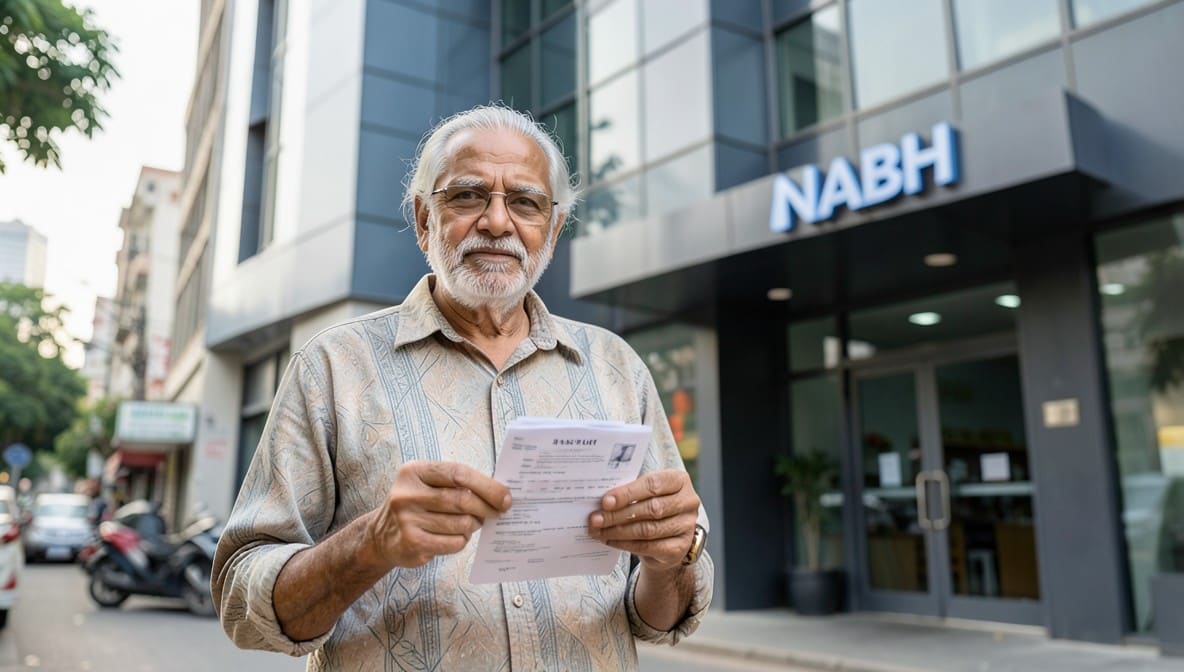
The Punjab and Haryana High Court has reaffirmed that administrative decisions denying public benefits cannot rest on procedural formalities alone. In a significant ruling for retired government servants, the Court emphasized that substantive proof of dependency must supersede rigid documentation requirements, particularly when the claimant has no alternative means to establish familial obligation.
Background & Facts
The Dispute
The petitioner, a retired Police Officer of Haryana Police, incurred medical expenses of ₹2,27,298/- for the treatment of his mother, who was admitted to a hospital in Bahadurgarh, Haryana, in February 2024. He applied for reimbursement under the State Government’s medical reimbursement policy for dependents of retired personnel. The claim was rejected solely because his mother’s name did not appear in his Family ID, despite her having no independent income and being listed as a dependent in his official service records.
Procedural History
- February 2024: Petitioner’s mother admitted for treatment; expenses incurred
- Mid-2024: Petitioner submitted reimbursement application to Welfare Officer, Police Range, Bahadurgarh
- December 2024: Claim rejected by Respondent No.3 on ground that mother’s name was absent from petitioner’s Family ID
- December 2024: Respondent cited petitioner’s father’s land ownership and separate Family ID as evidence of non-dependency
- January 2025: Writ petition filed under Articles 226/227 of the Constitution
Relief Sought
The petitioner sought quashing of the rejection order and direct reimbursement of medical expenses, arguing that the denial violated principles of natural justice and substantive fairness under Article 14 of the Constitution.
The Legal Issue
The central question was whether denial of medical reimbursement under a state policy can be justified solely on the absence of a dependent’s name in a Family ID, when other documentary evidence demonstrates financial and emotional dependency.
Arguments Presented
For the Petitioner
The petitioner’s counsel argued that the Family ID is merely an administrative tool and not a conclusive proof of dependency. He relied on service records showing his mother as a declared dependent, her lack of income, and the absence of any land or property in her name. He cited State of Haryana v. Baldev Singh to assert that administrative decisions must be reasonable and not based on technicalities.
For the Respondent
The State contended that the Family ID is the primary and mandatory document under the reimbursement policy to verify dependency. It highlighted that the petitioner’s father had an annual income of ₹1.9 lakhs and owned substantial land, suggesting the mother was not financially dependent on the petitioner. The State argued that allowing exceptions would open floodgates to fraudulent claims.
The Court's Analysis
The Court acknowledged the State’s interest in preventing misuse of public funds but held that the rejection order was legally unsustainable. It observed that the Family ID, while useful, is not an infallible or exclusive indicator of dependency. The Court noted that the petitioner had submitted service records, medical bills, and affidavits establishing his mother’s reliance on him, none of which were addressed in the impugned order.
"The denial of a legitimate claim on the sole ground of non-inclusion in a Family ID, without examining other corroborative evidence, amounts to arbitrary action and violates the principle of substantive equality under Article 14."
The Court further emphasized that the Respondent had raised new grounds - such as the father’s land ownership and income - that were not part of the original rejection order. This deprived the petitioner of a fair opportunity to respond, violating the doctrine of audi alteram partem. The Court concluded that the only just remedy was to remand the matter for a fresh decision, allowing the petitioner to submit all relevant evidence.
The Verdict
The petitioner prevailed. The Court held that dependency must be assessed on substantive evidence, not merely on the presence of a name in a Family ID. It directed the State to pass a fresh order within three months, considering all documents submitted during the pendency of the petition.
What This Means For Similar Cases
Dependency Cannot Be Reduced to a Document
- Practitioners must now argue that Family IDs are presumptive, not conclusive, evidence of dependency
- Service records, affidavits, income declarations, and medical dependency affidavits are admissible and must be weighed
- Denial without evaluating such evidence invites judicial intervention under Article 14
Administrative Fairness Requires Full Opportunity
- Authorities must not introduce new grounds for rejection in litigation that were absent in the original order
- Petitioners must be given a fair chance to respond to all factual assertions before a final decision
- Failure to do so renders the order voidable on grounds of natural justice
Policy Interpretation Must Be Substantive, Not Formalistic
- Government schemes must be interpreted in favor of beneficiaries where ambiguity exists
- Technical compliance cannot override the spirit of welfare-oriented policies
- Courts will intervene where rigid adherence to procedural norms defeats the purpose of the benefit