The Punjab and Haryana High Court has reaffirmed that long-term contractual employment under state entities, where sanctioned posts remain vacant, cannot be used as a tool to evade statutory and constitutional obligations. The judgment underscores that the State, as a constitutional employer, cannot exploit outsourcing to deny basic employment rights to workers who have performed essential duties for over a decade.
Background & Facts
The Dispute
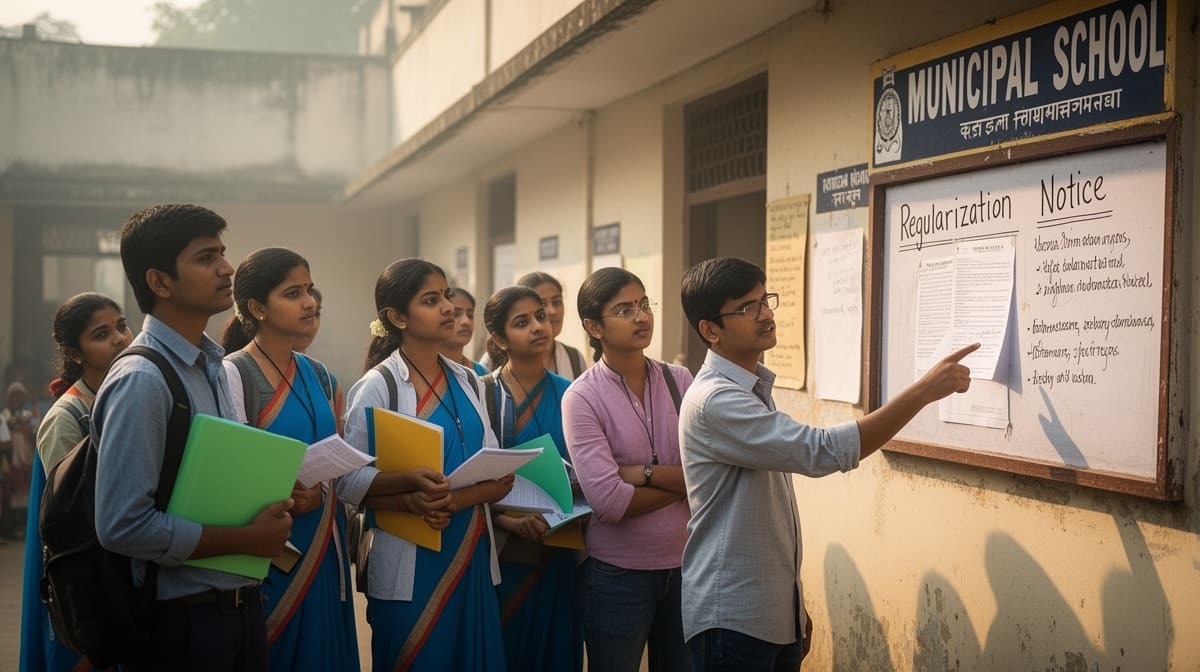
The petitioners, a group of contractual employees, have been working as Clerk-cum-Data Entry Operators with the Municipal Corporation, Bathinda, for a continuous period of 11 to 13 years. Despite performing duties identical to those of regular employees, they were engaged on an outsourced, ad hoc, or temporary basis without any formal regularization. The petitioners seek regularization of their services with all consequential benefits, including pay scales, increments, and pensionary entitlements.
Key Facts
- The petitioners were engaged on a contractual basis over a period spanning 2011 to 2013 and have continued in service without interruption since then.
- No formal recruitment process was conducted for the posts they occupy, despite the existence of sanctioned vacancies.
- Their duties include data entry, clerical work, record maintenance, and public interface functions - tasks that are perennial and integral to the functioning of the Municipal Corporation.
- The respondents have consistently classified them as outsourced or work-charged employees, denying them benefits available to regular staff.
- The petitioners have made repeated representations to the Municipal Corporation and higher authorities, all of which remained unaddressed.
Procedural History
- 2022: In CWP No. 12434 of 2022 (Akash Sharma v. State of Punjab), the High Court held that the Punjab Adhoc Contractual, Daily Wage, Temporary, Work Charged and Outsourced Employees’ Welfare Act, 2016 remains in force and protects the rights of such employees.
- 2024: In CWP No. 23027 of 2016 (Mrs. Gurmit Kaur v. State of Punjab), the Court directed regularization of employees with over 10 years of service.
- 2026: In CWP No. 30248 of 2025 (Harjinder Singh Sidhu v. Municipal Council, Bathinda), decided on 05.03.2026, the Court held that long-term outsourced workers performing regular duties must be treated as de facto employees.
- 2018: In CWP No. 11427 of 2015 (Sukhjad Singh v. State of Punjab), the Court recognized the principle that continuous service under the same employer negates the validity of outsourcing as a legal shield.
- 13.02.2026: The judgment in Akash Sharma was upheld by an intra-Court appeal, reinforcing its precedential value.
- 27.04.2026: Present writ petition filed under Articles 226/227 of the Constitution.
The Parties' Positions
For the Petitioners: The petitioners argue that their prolonged, uninterrupted service, coupled with the State’s failure to fill sanctioned posts through transparent recruitment, renders their engagement a subterfuge. They rely on judgments of the High Court and the Supreme Court to assert that the doctrine of lifting the veil applies, making the Municipal Corporation their de facto employer.
For the Respondents: The Municipal Corporation accepts notice but does not contest the legal principles cited. It concedes that the matter requires a speaking order and agrees to consider the petitioners’ claims in light of binding precedents.
Relief Sought
The petitioners seek:
- Regularization of their services as Clerk-cum-Data Entry Operators
- All consequential benefits including pay scales, increments, and pensionary entitlements
- A direction to the competent authority to pass a reasoned order within a stipulated time
The Legal Issue
The central question is whether long-term contractual employees, who have performed the same duties as regular staff for over a decade in the face of vacant sanctioned posts, can be denied regularization merely on the basis of their contractual label, and whether the State can evade its constitutional obligations under the guise of outsourcing.
Arguments Presented
For the Petitioner
The petitioners relied on multiple judgments of the Punjab and Haryana High Court, including Harjinder Singh Sidhu v. Municipal Council, Bathinda (05.03.2026), which held that continuous service under the same employer, despite contractual labels, creates a de facto employment relationship. They cited the Supreme Court’s decisions in Dharam Singh v. State of U.P. (2025 SCC OnLine SC 1735) and Jaggo v. Union of India (2025 AIR SC 296), which condemned outsourcing as a mechanism to circumvent labor protections. They emphasized the observations in Bhilwara Dugdh Utpadak Sahakari S. Ltd. v. Vinod Kumar Sharma (2011 INSC 632), where the Court held that employers cannot exploit contractual arrangements to deny workers the benefits of permanent employment. The petitioners further invoked Union of India v. K. Velajagan (SLP(C) No. 2868/2018), wherein the Supreme Court directed a vigilance inquiry into illegal ad hoc appointments and affirmed that constitutional employers cannot balance budgets on the backs of temporary workers.
For the Respondent
The respondent, through counsel, accepted notice and did not oppose the legal principles cited. The Advocate conceded that the petitioners’ claims must be adjudicated in light of binding precedents and agreed that a speaking order must be passed by the competent authority.
The Court's Analysis
The Court undertook a comprehensive review of the jurisprudence on outsourcing and regularization. It noted that the State, as a constitutional employer, is bound by the principles of equality, non-exploitation, and fair labor practices under Articles 14 and 21 of the Constitution. The Court observed that the practice of hiring employees on temporary or outsourced terms while maintaining vacant sanctioned posts is not merely an administrative convenience - it is a deliberate evasion of statutory and constitutional duties.
"Outsourcing as an evasion tactic... This new technique of subterfuge has been adopted by some employers in recent years in order to deny the rights of the workmen under various labour statutes... This Court cannot countenance such practices any more."
The Court emphasized that where the principal employer exercises control over the manner of work, and the worker’s livelihood is substantially dependent on that employer, the courts must lift the veil of contractual intermediaries. The Court cited Union of India v. K. Velajagan to underscore that even after a Supreme Court directive to regularize such employees, non-compliance by the State is unacceptable and warrants institutional accountability.
The Court further held that employees who have served for over a decade acquire specialized skills and institutional knowledge, making their abrupt dismissal or continued marginalization both unjust and inefficient. The Court rejected the notion that financial stringency justifies the denial of constitutional rights to public workers.
The Verdict
The writ petition is disposed of with the direction that the respondent Municipal Corporation treat this petition as a comprehensive representation and pass a speaking order after affording the petitioners an opportunity to be heard. The competent authority shall decide the claim of regularization and consequential benefits within three months from the date of receipt of a certified copy of this order. If the petitioners are found entitled, the regularization and all benefits - including pay scales, increments, and pensionary entitlements - shall be granted forthwith. The decision shall be communicated in writing to the petitioners.
What This Means For Similar Cases
Outsourcing Cannot Shield Constitutional Obligations
- Practitioners must now argue that any long-term contractual engagement (10+ years) by a public employer, where sanctioned posts exist, constitutes a de facto employment relationship.
- The burden shifts to the employer to prove that the outsourcing arrangement was not a subterfuge to avoid statutory obligations.
- Courts will apply the "lifting the veil" doctrine aggressively in public employment cases.
State Entities Cannot Delay Regularization Indefinitely
- The three-month deadline sets a precedent for timely adjudication in similar cases.
- Non-compliance with court directions on regularization may trigger contempt proceedings or vigilance inquiries, as per Union of India v. K. Velajagan.
- Petitioners in pending cases may now cite this judgment to seek urgent listing and interim relief.
Skill and Continuity Trump Contractual Labels
- The Court recognized that continuous service creates a legitimate expectation of regularization.
- Employees with over a decade of experience are not "casual" or "temporary" - they are de facto permanent workers.
- This principle applies across all public sector departments, including health, education, and municipal services.