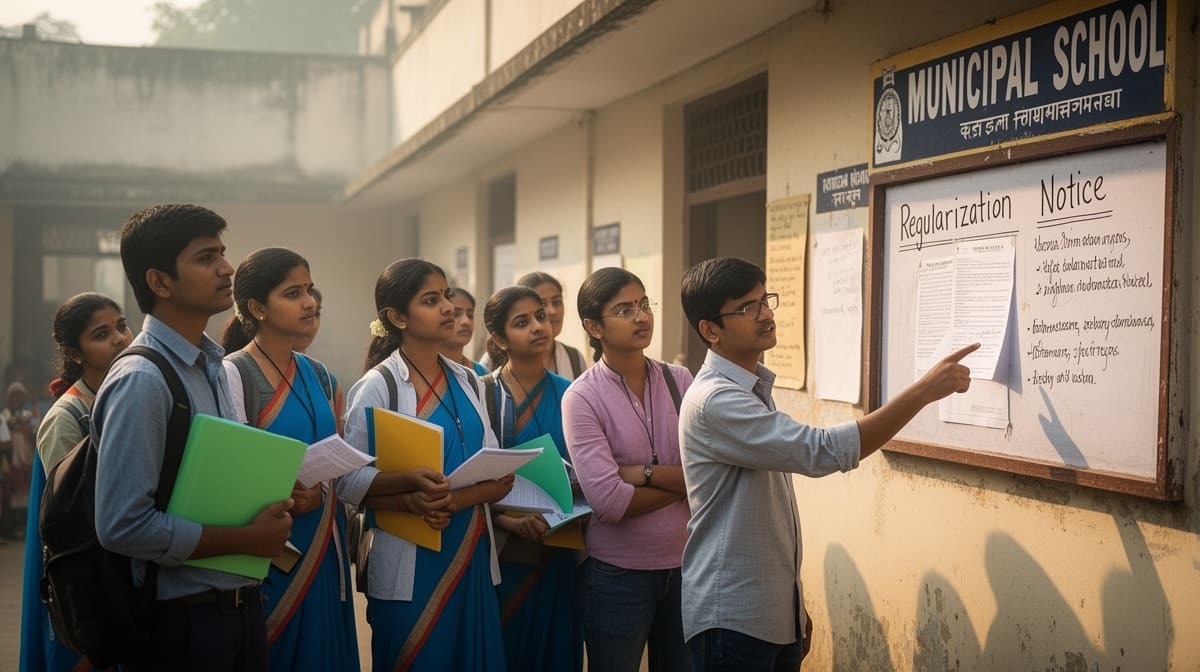
The Punjab and Haryana High Court has delivered a landmark ruling affirming that long-term contractual employees performing essential, recurring public duties cannot be denied regularization merely due to administrative delays or financial constraints. The judgment reinforces the State’s constitutional obligation as an employer and establishes that continuous service over nearly a decade triggers an entitlement to regularization under Articles 14, 16 and 21 of the Constitution.
Background & Facts
The Dispute
The petitioners, comprising teachers, lab attendants, and ayas, were hired on contractual basis by Shivalik Model Senior Secondary School, managed by the Municipal Council, Nangal, following a 2008 advertisement. Their initial appointments began on 4 February 2009 and were renewed annually until 2017. Despite working continuously for over eight years, they were never absorbed into regular posts. In December 2016, the Municipal Council resolved to regularize their services under the Punjab Ad hoc, Contractual, Daily Wage, Temporary, Work Charged and Outsourced Employees' Welfare Act, 2016, and issued regular appointment letters on 28 December 2016. However, the Director, Department of Local Government, stayed this decision on 26 April 2017, citing pending challenges to the Act. Subsequently, the Council issued new contracts retroactively extending their tenure until 9 August 2017, with explicit terms that employment would terminate automatically upon expiry.
Procedural History
- 2009: Petitioners appointed on contractual basis
- 2016: Municipal Council resolved to regularize services
- 28 December 2016: Regular appointment letters issued, subject to Director’s approval
- 26 April 2017: Director stayed regularization decision
- 6 July 2017: Council issued new six-month contracts (10 February 2017 to 9 August 2017)
- 10 August 2017: Relieving order issued without direct communication to petitioners
- 16 August 2017: High Court ordered status quo to be maintained
- 21 August 2017: Petitioners forcibly relieved despite ongoing status quo order
- 25 January 2019: Three petitioners reinstated; others remained out of service
- 13 February 2026: Judgment delivered by Justice Harpreet Singh Brar
Relief Sought
The petitioners sought quashing of the stay order and the subsequent contract extensions, along with a writ of mandamus directing their regularization, payment of equal wages, and counting of past service. They also filed a contempt petition for violation of the status quo order.
The Legal Issue
The central question was whether continuous service of nearly a decade by contractual employees performing perennial public duties creates a legitimate expectation or enforceable right to regularization, even in the absence of sanctioned posts or formal selection, and whether the State can evade this obligation by citing financial constraints or procedural irregularities.
Arguments Presented
For the Petitioner
Learned Senior Counsel argued that the petitioners were appointed against regular posts, performed identical duties as regular staff, and were paid significantly less despite equal work. Reliance was placed on State of Punjab v. Jagjit Singh and Dharam Singh v. State of U.P., emphasizing that ad hocism cannot be a tool for systemic exploitation. The appointment letters issued in 2016, though subject to approval, reflected the State’s acknowledgment of their entitlement. The forcible termination after the status quo order violated natural justice and Article 14.
For the Respondent
The State contended that the petitioners were never selected through formal recruitment, and their appointments were explicitly conditional upon approval by the Director. The Act of 2016 was challenged in court, justifying the stay. The contracts had expired, and the petitioners were not entitled to regularization merely due to prolonged service. The State also denied parity in workload and argued that Jagjit Singh was distinguishable as it involved direct recruitment, not ad hoc appointments.
The Court's Analysis
The Court rejected the State’s reliance on Umadevi as a shield to perpetuate precarious employment. It held that Umadevi does not permit the State to exploit long-term contractual workers performing essential, recurring functions under the guise of temporary appointments. The Court emphasized that the petitioners had been engaged for over eight years, were integrated into the institutional structure, and performed duties identical to regular staff.
"The State (here referring to both the Union and the State governments) is not a mere market participant but a constitutional employer. It cannot balance budgets on the backs of those who perform the most basic and recurring public functions."
The Court noted that the petitioners continued working even after the contract expiry on 9 August 2017, as evidenced by attendance records, participation in Independence Day functions, and official duties on 21 August 2017. The status quo order of 16 August 2017 was deliberately flouted, and the relieving order was communicated indirectly to avoid accountability.
The Court distinguished between illegal appointments and irregular but continuous engagements, holding that the latter, especially when spanning a decade, trigger constitutional obligations under Articles 14, 16 and 21. The State’s failure to maintain establishment registers, justify non-sanctioning of posts, or explore alternatives rendered its financial constraints legally untenable.
The Court further held that the Act of 2016’s withdrawal did not negate the petitioners’ entitlement, as their regularization was based on service history, not statutory provision alone. The delay in regularization was attributable to the State’s non-compliance with court orders, not the petitioners’ conduct.
The Verdict
The petitioners won. The Court held that continuous service of nearly a decade in perennial roles entitles contractual employees to regularization, irrespective of initial procedural irregularities. The impugned stay order and contract extensions were quashed. The petitioners were directed to be reinstated from the date of their unlawful termination and regularized within six weeks. Failure to do so would result in automatic regularization. Past service shall be counted for all benefits, though back wages were denied.
What This Means For Similar Cases
Regularization Is Not Discretionary for Long-Term Contractual Workers
- Practitioners must now argue that any employee serving over 8 - 10 years in recurring roles has a legitimate claim to regularization under Articles 14 and 16
- The burden shifts to the State to prove why regularization is not feasible, not to the employee to prove entitlement
- Mere absence of sanctioned posts or pending recruitment drives cannot justify continued ad hocism
Status Quo Orders Are Binding Even After Contract Expiry
- If a court orders status quo, continued service beyond contract expiry is protected
- Relieving employees after such an order constitutes contempt, regardless of technical contract termination
- Attendance records, official duties, and institutional integration are decisive evidence of ongoing service
Financial Constraints Are Not a Constitutional Defense
- The State must document why it chose precarious employment over sanctioned posts
- Courts will scrutinize whether alternatives were considered and whether similar workers were treated differently
- The phrase "financial stringency" cannot override the constitutional duty to ensure dignity and equal protection