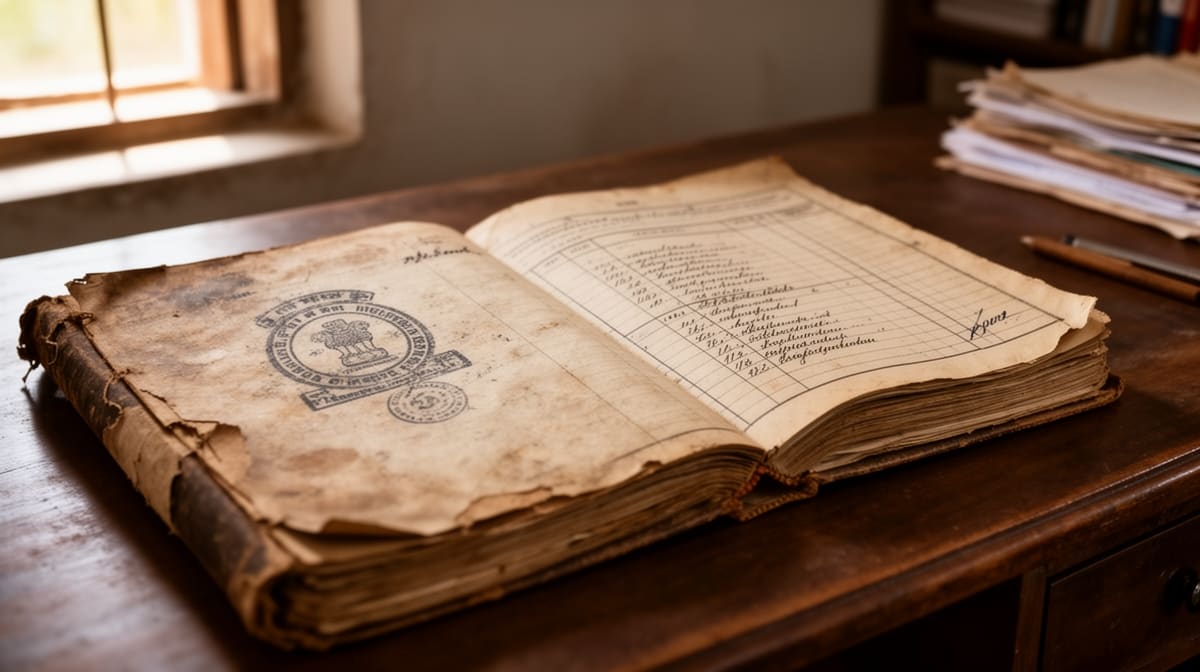
The Supreme Court has reaffirmed that appellate courts cannot permit additional evidence under Order XLI Rule 27 of the Code of Civil Procedure to salvage a fundamentally flawed claim of title, particularly when the claim is predicated on an ex parte decree against non-parties. This ruling clarifies the strict limits of appellate discretion and reinforces the primacy of trial-stage evidence in civil litigation.
Background & Facts
The Dispute
The appellants, Gobind Singh and others, claimed ownership over land in Gwalior, asserting ancestral title and continuous possession for over fifty years. They filed a civil suit in 1989 seeking declaration of title and permanent injunction against the Union of India and other respondents, who were alleged to have trespassed and removed structures on the land.
Procedural History
- 1984: Predecessors of appellants filed a civil suit against the State of Madhya Pradesh, securing an ex parte decree declaring title.
- 1989: Appellants filed Civil Suit No. 5-A of 1990, relying on the 1984 decree and revenue entries.
- 1996: Trial Court decreed the suit in favor of appellants, accepting their claim of title.
- 2009: High Court allowed the Union’s appeal, setting aside the decree on grounds that the 1984 decree was not binding on the Union, which was not a party.
- 2011: High Court dismissed the appellants’ review petition and rejected their application under Order XLI Rule 27 CPC for additional evidence (General Land Register entries).
Relief Sought
The appellants sought restoration of the trial court’s decree and permission to introduce the General Land Register entries as additional evidence to prove the land was recorded as private property.
The Legal Issue
The central question was whether an appellate court may permit additional evidence under Order XLI Rule 27 CPC to cure a fundamental defect in a title claim - namely, reliance on an ex parte decree against non-parties - when the claim lacks independent documentary proof of ownership.
Arguments Presented
For the Petitioner
The appellants contended that the General Land Register entries, showing the land as private property, were critical to establishing title and were not available during trial due to administrative delays. They relied on Union of India v. Ibrahim Uddin to argue that appellate courts have discretion to admit evidence to remove lacunae. They asserted that the trial court’s findings on possession were sufficient and that the High Court erred in not considering the application.
For the Respondent
The Union argued that the 1984 decree was ex parte and non-binding on them, as they were neither impleaded nor heard. They cited State of Karnataka v. K.C. Subramanya to emphasize that Order XLI Rule 27 CPC permits additional evidence only if due diligence was exercised and the evidence was genuinely inaccessible. They further contended that the GLR entries were irrelevant, as mere revenue records do not confer title against the Union, especially when the land was vested in 1953 under a Gazette Notification.
The Court's Analysis
The Court undertook a rigorous interpretation of Order XLI Rule 27 CPC, emphasizing its exceptional and restrictive nature. It held that the provision does not permit litigants to use appellate forums as a second chance to cure defective pleadings or introduce evidence that should have been adduced at trial.
"The provision does not apply, when on the basis of the evidence on record, the appellate court can pronounce a satisfactory judgment."
The Court noted that the appellants’ entire claim rested on an ex parte decree from a suit where the Union was not a party. The High Court correctly held that such a decree could not bind the Union, and the burden then shifted to the appellants to independently prove title. Yet, they produced no title deeds, no witness testimony on the origin of possession, and no evidence of continuous enjoyment prior to 1953.
The Court further observed that the General Land Register entries, even if admitted, could not override the Union’s statutory title under the 1953 vesting order and 1954 Gazette Notification. The application for additional evidence was not merely untimely - it was legally futile.
"The parties do not possess any vested or automatic right to seek admission of additional evidence at the appellate stage."
The Court also condemned the conduct of the appellants, noting the proximity between the ex parte decree and the mutation of revenue records, and the fact that one appellant was a government official. This raised serious questions about bona fides.
The Court concluded that the High Court’s refusal to admit the evidence was not only legally sound but also necessary to prevent abuse of process. The omission to expressly rule on the application during the first appeal was cured by the subsequent review order, which explicitly rejected it.
The Verdict
The appellants lost. The Supreme Court held that Order XLI Rule 27 CPC cannot be invoked to rectify a foundational defect in a title claim based on an ex parte decree against non-parties, especially when no independent proof of ownership exists. The High Court’s dismissal of the application and affirmation of the suit’s dismissal were upheld.
What This Means For Similar Cases
Additional Evidence Cannot Substitute for Trial-Level Proof
- Practitioners must ensure all title documents, witness statements, and revenue records are filed at trial - appellate courts will not permit belated submissions to fill evidentiary gaps.
- Claims based on ex parte decrees against non-parties are legally void unless independently substantiated.
Revenue Records Alone Do Not Confer Title Against the State
- Mere entries in General Land Registers or mutation records cannot override statutory vesting by the Union or State under valid notifications.
- In land disputes involving government property, the burden of proving lawful title is on the claimant, and oral possession claims without documentary corroboration are insufficient.
Courts Will Scrutinize Litigant Conduct in Title Disputes
-
Courts may consider conduct, including timing of suits, proximity to government employment, and procedural manipulation, when assessing bona fides.
-
Applications under Order XLI Rule 27 CPC must be grounded in genuine hardship, not tactical delay.
-
Always verify whether the opposing party was impleaded in prior suits affecting title.
-
Never rely on revenue records as standalone proof of title against the Union or State.
-
File all documentary evidence at trial; appellate courts will not entertain ‘rescue evidence’.