The Punjab and Haryana High Court has affirmed that service of process through electronic means such as WhatsApp, and by affixation at the last known address, constitutes valid substituted service under its own procedural rules. This ruling clarifies the scope of modern service mechanisms in execution proceedings, offering critical guidance to practitioners navigating the intersection of traditional civil procedure and digital communication.
Background & Facts
The Dispute
The petitioner, Dr. R.K. Jain, filed a civil suit for recovery of Rs. 3,52,230/- plus interest against respondents Kishan Bahadur Sunar @ Krishna Bahadur Sunar and Smt. Kamla Sunar. Notice was issued to the respondents, who failed to appear. The trial court proceeded ex parte, and a decree was passed on 20.12.2017. Subsequently, the petitioner filed an Execution Petition and moved an application under Order V Rules 17, 20 and 25, read with Order VI Rule 14-A and Section 151 of the Code of Civil Procedure, 1908, seeking permission to serve the judgment debtor through affixation at the last known address and via WhatsApp.
Key Facts
- The decree was passed on 20.12.2017.
- The application for substituted service was filed in 2024.
- The petitioner had previously secured service upon the respondents in an earlier litigation (Annexure P-2), but that service could not be relied upon in the present execution proceedings.
- The respondents’ current whereabouts were unknown, and no other means of personal service were feasible.
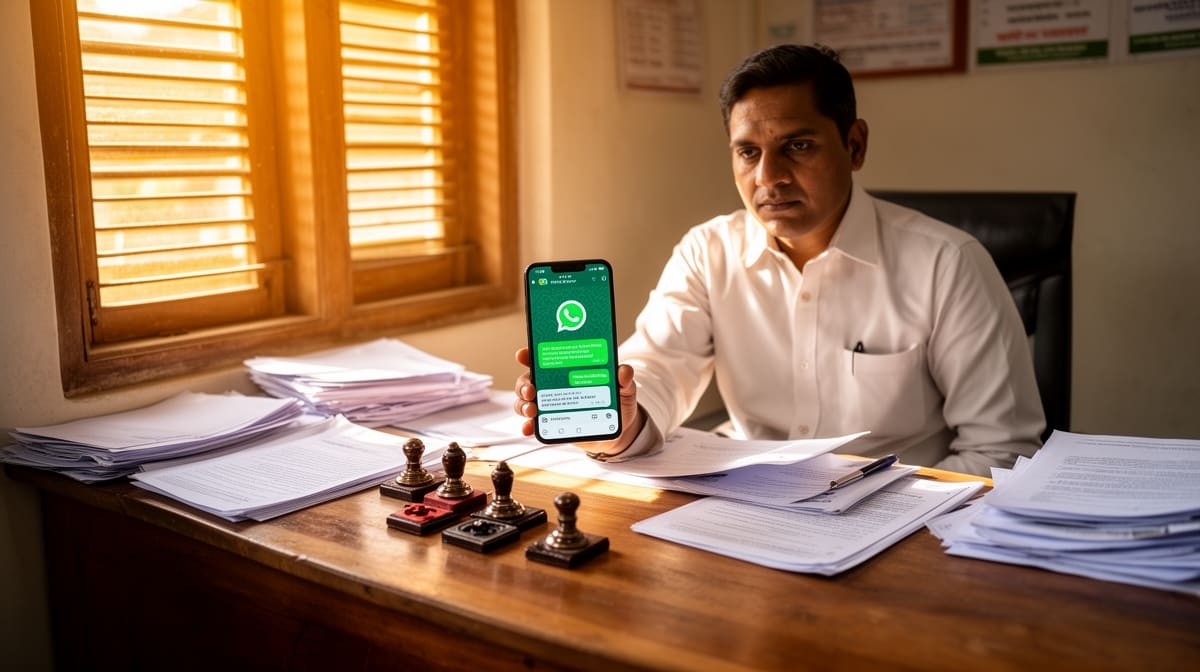
- The petitioner sought to use WhatsApp as an electronic mode of service, having previously communicated with the respondents through the platform.
Procedural History
- 20.12.2017: Ex parte decree passed by the learned Additional Civil Judge (Senior Division), Jind.
- 2024: Application filed under Order V Rules 17, 20, 25 and Order VI Rule 14-A read with Section 151 CPC for substituted service via affixation and WhatsApp.
- 27.01.2026: Learned Executing Court dismissed the application, holding that service in a prior case could not be deemed service in the present proceedings, and that WhatsApp and affixation were not valid modes at this stage.
- 27.04.2026: Civil Revision Petition filed under Article 227 of the Constitution before the Punjab and Haryana High Court.
Relief Sought
The petitioner sought setting aside of the order dated 27.01.2026 and directions to permit service upon the judgment debtor through affixation at the last known address and via WhatsApp.
The Legal Issue
The central question was whether service upon a judgment debtor through affixation at the last known address and via WhatsApp qualifies as valid substituted service under Order V Rule 20 of the CPC and the Punjab and Haryana High Court Rules and Orders, particularly where personal service is unattainable.
Arguments Presented
For the Petitioner
The petitioner argued that the Punjab and Haryana High Court Rules, Volume IV, Chapter VII, Part B, explicitly permit service through electronic means under Rule 1(iii) (e-service), provided the recipient has furnished requisite details. He further contended that affixation under Order V Rule 20 CPC is a recognized mode of substituted service when the defendant is evading service. He submitted that WhatsApp, as a widely used and verifiable electronic communication tool, satisfies the spirit of e-service and should be recognized as a modern, effective substitute for traditional methods.
For the Respondent
The respondents did not appear before the High Court, and no counter-arguments were formally presented.
The Court's Analysis
The Court examined the provisions of the Punjab and Haryana High Court Rules and Orders, particularly Volume IV, Chapter VII, Part B. It noted that Rule 1(iii) explicitly permits service through electronic means where the party has furnished requisite details. The Court held that WhatsApp, as a digital platform capable of delivering messages with read receipts and traceable logs, falls within the ambit of "electronic means" under this rule.
"The Service of Process to the other party can also be effected through electronic means where the party has furnished the requisite details."
The Court further observed that Order V Rule 20 CPC permits substituted service by affixation when the defendant is avoiding service or when ordinary service is not feasible. The Executing Court’s reasoning - that service in a prior case could not be used in the present - was legally sound but irrelevant to the question of whether new modes of service were permissible. The Court emphasized that the purpose of substituted service is to ensure notice reaches the defendant when conventional methods fail, not to impose rigid formalities that defeat justice.
The Court rejected the notion that WhatsApp service is inherently unreliable, noting its widespread use in India and the petitioner’s prior communication history with the respondents through the platform. It held that the Executing Court erred in mechanically dismissing the application without considering the evolving nature of communication and the explicit authorization under the High Court’s own rules.
The Verdict
The petition was allowed. The order dated 27.01.2026 dismissing the application for substituted service was set aside. The petitioner is granted liberty to effect service upon the judgment debtor through affixation at the last known address and via WhatsApp, in accordance with Rule 1(iii) and Rule 2 of Volume IV, Chapter VII, Part B of the Punjab and Haryana High Court Rules and Orders. All pending miscellaneous applications are disposed of.
What This Means For Similar Cases
Electronic Service Is Permissible Under High Court Rules
- Practitioners may now file applications for service via WhatsApp, email, or other verifiable electronic platforms where the recipient has previously communicated through them.
- Courts must evaluate the reliability and prior usage of the platform, not dismiss it outright as "unauthorized."
- Affidavits confirming prior communication and screenshots of messages should be annexed to support such applications.
Affixation Remains a Valid Substitute When Personal Service Fails
- Affixation under Order V Rule 20 CPC is not obsolete; it remains a viable option when the judgment debtor’s whereabouts are unknown.
- Courts must not require proof of absolute certainty of the address - reasonable diligence suffices.
- Photographs of affixation, witness statements, and proof of posting on the last known residence or business premises are sufficient evidence.
Procedural Flexibility Is Mandated by Modern Realities
- The High Court’s recognition of WhatsApp as a valid mode signals a shift toward pragmatic interpretation of service rules.
- Similar applications in other High Courts may now be supported by this precedent, especially where local rules permit e-service.
- Legal practitioners should proactively update their execution strategies to include digital service options in cases involving evasive debtors.