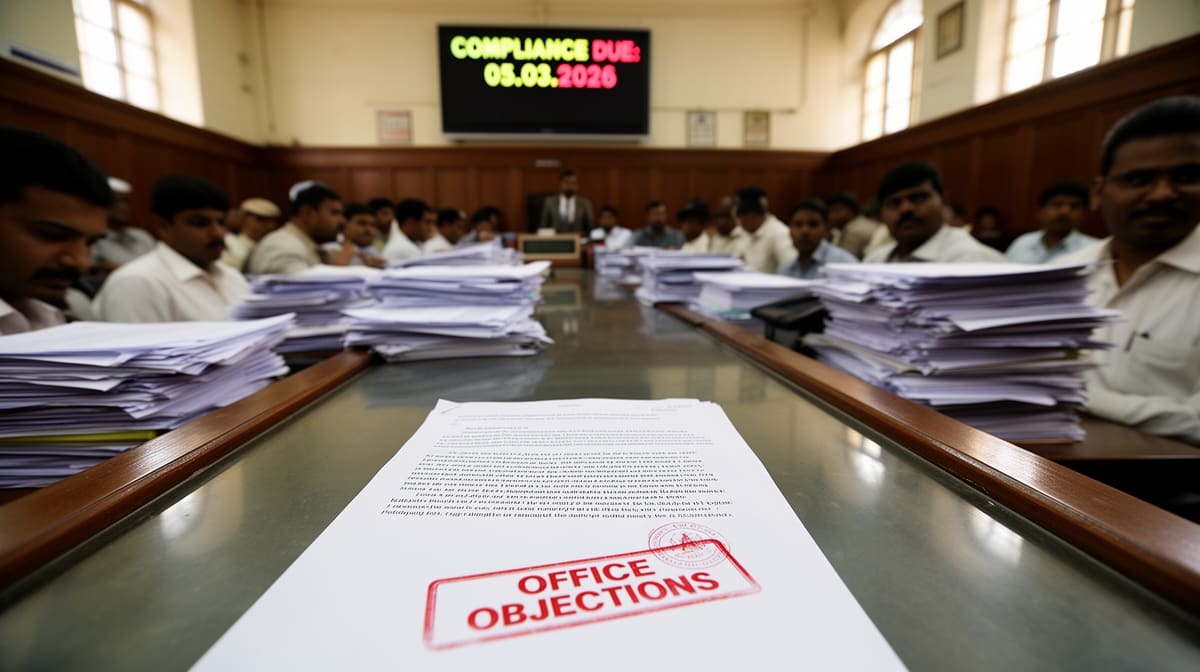
The Madras High Court has reaffirmed a foundational principle of civil procedure: that execution courts cannot refuse to number petitions under Order 21 Rule 97 of the CPC on preliminary grounds of maintainability. This ruling ensures procedural fairness by requiring courts to first assign a number and then adjudicate substantive issues after notice to all parties.
Background & Facts
The Dispute
The petitioner, J. Logeswaridas, sought to challenge an eviction order passed in Execution Petition No.7 of 2025, filed in the context of a long-standing title dispute over property at Door No.264, Kamarajar Street, Erode. The respondents, Renu Sivakumar and others, had obtained a decree for possession in Original Suits Nos.42/2007 and 17/2007, which were affirmed on appeal in 2019. The petitioner, a third party to those suits, claimed an interest in the property and sought to reopen the execution proceedings under Order 21 Rule 97 of the CPC, read with Section 151, alleging obstruction to possession.
Key Facts
- The respondents obtained an eviction order against the 4th respondent on 16.10.2015 in RCOP No.5/2014.
- On 11.03.2026, the Execution Court passed an order directing delivery of possession in EP No.7/2025.
- The petitioner filed two applications before the Execution Court on 08.03.2026 seeking: (i) reopening of the execution case, and (ii) recording of obstruction to possession.
- The Execution Court returned these applications without numbering them, on the ground that the petitioner was not a party to the execution proceedings.
- The petitioner challenged this action by filing the present Civil Revision Petition on 15.03.2026.
Procedural History
- 16.10.2015: Eviction order passed in RCOP No.5/2014 against the 4th respondent.
- 12.06.2018: Original Suits Nos.42/2007 and 17/2007 decreed in favor of respondents.
- 26.08.2019: Appeals dismissed by the High Court, confirming the decree.
- 14.09.2021: Second Appeals dismissed by the High Court.
- 20.10.2022: Supreme Court granted status quo in SLPs Nos.18150 and 18151/2021.
- 11.03.2026: Delivery of possession ordered in EP No.7/2025.
- 08.03.2026: Petitioner filed applications before Execution Court.
- 09.03.2026: Execution Court returned applications without numbering.
- 15.03.2026: Civil Revision Petition filed before Madras High Court.
- 24.03.2026: Judgment delivered.
Relief Sought
The petitioner sought: (1) setting aside the order dated 09.03.2026 returning the applications without numbering; (2) direction to the Execution Court to number the applications; and (3) opportunity to contest maintainability after notice to all parties.
The Legal Issue
The central question was whether an executing court may refuse to number an application under Order 21 Rule 97 of the CPC on the ground of non-maintainability, prior to affording notice and hearing to the parties.
Arguments Presented
For the Petitioner
The petitioner’s counsel relied on P. Surendran v. State by Inspector of Police (2019) 9 SCC 154 and Selvaraj and Others v. Koodankulam Nuclear Power Plant India Limited (2021) 3 LW 677. He argued that numbering is a purely administrative act and that the court cannot assume the role of the respondent by pre-judging maintainability. He emphasized that judicial determination of maintainability can only occur after the petition is numbered and parties are heard.
For the Respondent
No arguments were presented by the respondents, as the Court disposed of the matter without issuing notice to them, finding no prejudice to their interests.
The Court's Analysis
The Court examined the nature of the act of numbering a petition under the CPC and its relationship to judicial function. It held that the registry or executing court cannot act as a gatekeeper to determine maintainability before the petition is formally admitted.
"The act of numbering a petition is purely administrative. The objections taken by the Madras High Court Registry on the aspect of maintainability requires judicial application of mind by utilizing appropriate judicial standard."
The Court cited P. Surendran to underscore that the power to determine maintainability is a judicial function that cannot be delegated to the registry or an executing officer. It further relied on Selvaraj to affirm that the court must not "wear the cap of the defendant" and pre-judge the merits of a petition before service of notice.
The Court observed that the Execution Court, by returning the petitioner’s application without numbering, effectively decided the issue of maintainability without affording any opportunity of hearing. This violated the principles of natural justice and the procedural safeguards under Section 151 of the CPC.
The Court emphasized that the role of the court in execution proceedings is that of an impartial arbiter, not an adversary. The question of whether the petitioner is a proper party under Order 21 Rule 97 can only be decided after the petition is numbered, notice is given, and both sides are heard.
The Verdict
The Civil Revision Petition is allowed. The order dated 09.03.2026 returning the petitioner’s applications without numbering is set aside. The Registry of the Principal District Munsif Court, Erode, is directed to number the applications and place them before the learned Principal District Munsif, who shall consider and dispose of the same on merits after giving notice to all parties, within two weeks from the date of receipt of a copy of this order. The original documents shall be returned to the petitioner’s counsel upon verification. No costs are awarded.
What This Means For Similar Cases
Numbering Is Not Discretionary
- Practitioners may now insist that any application under Order 21 Rule 97 CPC be numbered immediately upon filing, regardless of perceived lack of locus standi.
- Courts cannot refuse to number petitions on grounds of maintainability, jurisdiction, or party status at the pre-admission stage.
- Any refusal to number must be challenged immediately by way of revision or writ.
Judicial Function Cannot Be Delegated
- Registry staff or court clerks may not screen petitions for substantive legal sufficiency.
- All preliminary objections to maintainability must be raised and adjudicated only after the petition is numbered and parties are heard.
- This principle applies equally to applications under Section 151 CPC, Order 9 Rule 13, and other procedural remedies.
Procedural Fairness Trumps Technicality
- The judgment reinforces that procedural fairness under Section 151 CPC overrides rigid adherence to party status in execution.
- Third parties with a colorable interest in execution proceedings must be given a fair opportunity to be heard.
- Courts must avoid adopting an adversarial posture toward petitioners at the filing stage.