The Bombay High Court has reaffirmed a foundational principle of procedural justice: the absence of a necessary party renders adjudication legally invalid. In a third round of litigation over a 2008 co-operative society auction, the Court quashed prior orders not on the merits of the auction’s compliance with statutory deposit rules, but because the auction purchaser - whose rights were directly at stake - was never made a party to the proceedings.
Background & Facts
The Dispute
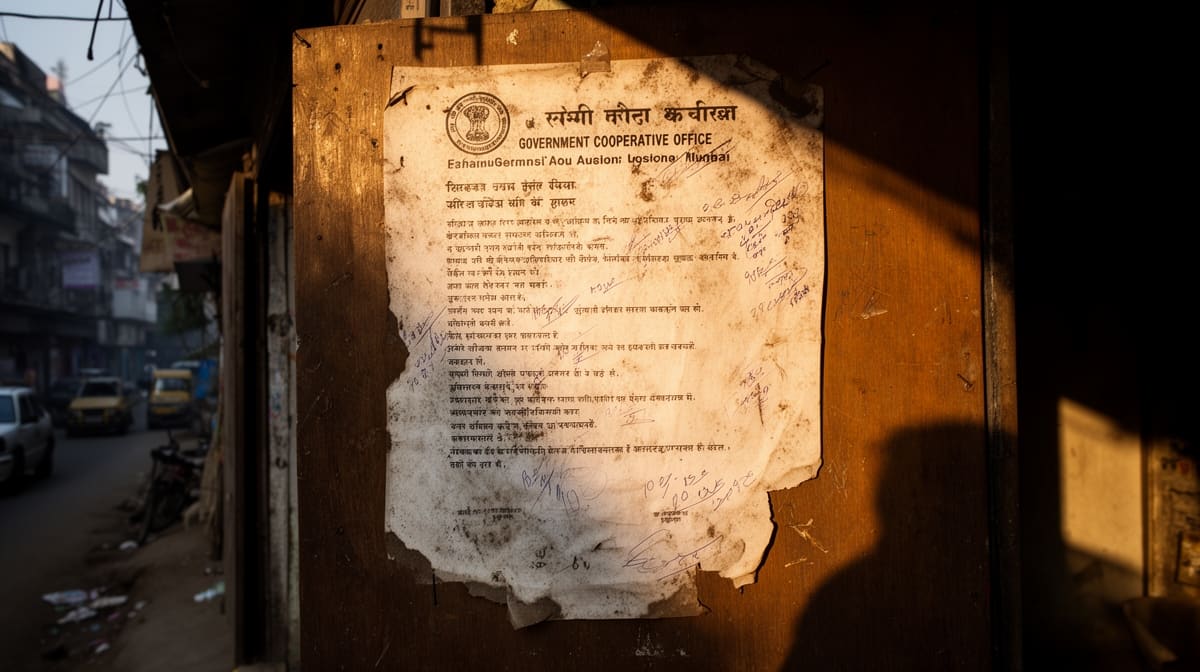
The dispute arises from the auction of property belonging to M/s. Shilpa Shares and Securities, a borrower defaulting on a loan from The National Co-operative Bank Limited. The Bank, as mortgagee, initiated recovery proceedings under the Maharashtra Co-operative Societies Act, 1960, leading to an auction of the mortgaged property on 11 February 2008. The auction was conducted under Rule 107 of the Maharashtra Co-operative Societies Rules, 1961.
Key Facts
- The auction concluded on 11.02.2008, with a third party purchasing the property.
- Sub-rule (g) of Rule 107 requires the auction purchaser to deposit 15% of the bid amount "immediately" after the auction.
- The deposit was made on 13.02.2008, two days after the auction.
- The petitioners (borrowers) challenged the auction in the first round, leading to its setting aside on 11.02.2008 for non-compliance with sub-rule (g).
- In the second round, the petitioners filed a revision under Section 154-2A of the Act, which was dismissed on technical grounds for non-compliance with mandatory procedural requirements.
- In the present round, petitioners claim they have now complied with Section 154-2A and seek a merits-based hearing on the sub-rule (g) violation.
- The auction purchaser, who paid the full consideration and took possession, was never joined as a party in any of the proceedings challenging the auction.
Procedural History
- 11.02.2008: Auction conducted by the Special Recovery Officer.
- 13.02.2008: 15% deposit made by auction purchaser.
- 2008 - 2010: First challenge filed by petitioners; auction set aside for non-compliance with Rule 107(g).
- 2011 - 2012: Second challenge filed under Section 154-2A; dismissed for procedural non-compliance.
- 2024: Present writ petition (WP(C) No. 18746 of 2024) filed before Bombay High Court, alleging cure of procedural defect under Section 154-2A.
- 06.04.2026: Judgment delivered by Justice Amit Borkar.
The Parties' Positions
Petitioners (M/s. Shilpa Shares and Securities): Argue that the delay in depositing 15% of the bid amount violates the mandatory requirement under Rule 107(g), rendering the auction void ab initio. They claim the defect under Section 154-2A has now been cured and the matter must be heard on merits.
Respondent (National Co-operative Bank): Opposes the petition on two grounds: (1) the auction purchaser was not impleaded, making the proceedings defective; and (2) the petitioners have abused the writ jurisdiction through repeated litigation.
Auction Purchaser (Intervenor): Contends that the petitioners have exhausted all remedies, raised identical issues repeatedly, and that his rights as a bona fide purchaser cannot be ignored. He asserts that writ jurisdiction should not be used to re-litigate settled matters.
Relief Sought
The petitioners sought quashing of the Revisional Authority’s order upholding the auction and a direction to re-adjudicate the challenge to the auction on its merits, specifically regarding non-compliance with Rule 107(g).
The Legal Issue
Can a challenge to the validity of a co-operative society auction under Rule 107 be adjudicated when the auction purchaser, whose rights are directly and adversely affected, has not been made a party to the proceedings?
Arguments Presented
For the Petitioner
The petitioners relied on M/s. Shilpa Shares and Securities and Adishakti Developers to argue that Rule 107(g) imposes a mandatory condition, and any deviation - even by one day - invalidates the auction. They contended that their compliance with Section 154-2A now permits the court to examine the substantive grievance. They argued that the auction purchaser’s rights are derivative and can be adjudicated even without his presence.
For the Respondent
The Bank and the auction purchaser contended that the auction purchaser is a necessary party under the principles of natural justice. Any order affecting his title or possession must be passed only after giving him an opportunity to be heard. They cited settled law that non-joinder of a necessary party vitiates the entire proceeding, and that such a defect cannot be cured at a later stage, even if the petitioners have now complied with Section 154-2A.
The Court's Analysis
The Court did not engage with the substantive question of whether a two-day delay in depositing 15% of the bid amount invalidates the auction. Instead, it focused squarely on the procedural defect.
"The auction purchaser has acquired rights in the property. If the auction is set aside, his rights will be directly affected. Therefore, he is a necessary party. In absence of such party, any adjudication on validity of auction becomes incomplete and legally improper."
The Court emphasized that the challenge under sub-rule 14 of Rule 107 was not merely a technical objection - it sought to annul a completed transaction affecting third-party rights. The auction purchaser was not a mere bystander; he was the person who had paid the full consideration, taken possession, and invested in the property. His absence rendered the entire adjudication void.
The Court rejected the petitioners’ argument that joining the auction purchaser at the revision stage under Section 154-2A could cure the initial defect. It held that the foundational proceedings under sub-rule 14 were defective from inception. A procedural error of this magnitude - failure to join a necessary party - cannot be remedied by subsequent procedural compliance.
The Court further noted that the petitioners had already litigated the same issue twice, and that the writ jurisdiction, being discretionary, must not be used to perpetuate endless litigation. However, rather than dismissing the petition outright, the Court opted for a remedial approach to ensure justice.
The Verdict
The writ petition was disposed of with the following directions: (1) The orders of the Revisional Authority and the Special Recovery Officer are quashed; (2) The petitioners are permitted to amend their application under sub-rule 14 of Rule 107 to implead the auction purchaser as a party; (3) The Special Recovery Officer shall conduct a fresh hearing with all parties - including the Bank and the auction purchaser - on 15 April 2026; (4) The Special Recovery Officer shall render a decision within four weeks of the hearing; (5) Any party aggrieved by the new decision may approach the appropriate forum in accordance with law. No costs were awarded.
What This Means For Similar Cases
Necessary Parties Cannot Be Omitted in Property Disputes
- Practitioners must identify and implead all persons whose rights are directly affected by the relief sought, especially in auction-based recovery proceedings.
- Failure to join an auction purchaser in challenges to co-operative society auctions will result in automatic invalidation of the proceeding, regardless of the merits of the claim.
Procedural Defects Are Not Curable After the Fact
- A defect in joinder at the initial stage cannot be cured by subsequent compliance with statutory timelines or by raising the issue at a higher appellate stage.
- Courts will not entertain challenges to completed transactions where the affected third party was never heard.
Writ Jurisdiction Is Not a Tool for Repeated Litigation
- Courts will scrutinize repeated filings on the same subject, particularly where the petitioner has previously lost on procedural grounds.
- The doctrine of res judicata and abuse of process apply even in writ petitions where substantive rights are not yet finally adjudicated.