The Supreme Court has reaffirmed that strict compliance with statutory timelines for depositing auction proceeds is not a mere procedural formality but a condition going to the root of validity. Failure to deposit the full purchase amount within the prescribed period renders the auction sale a nullity, irrespective of subsequent acceptance by the creditor or delay in challenge by the debtor.
Background & Facts
The Dispute
The dispute arose from the auction sale of a plot of land in Chembur, Mumbai, owned by Panditrao Borse, a partner in the defaulting firm M/s. Borse Brothers. The Mahanagar Co-operative Bank, having recovered an ex parte award of Rs. 24.2 lakh plus interest against the firm under Section 91 of the Maharashtra Co-operative Societies Act, 1960, initiated recovery proceedings. The Special Recovery and Sale Officer (SRO) auctioned the property on 29.01.2005 for Rs. 1.51 crore. M/s. Adishakti Developers, the highest bidder, deposited only 35% of the amount on the day of auction and the balance in four installments, the last on 17.03.2005 - over 45 days after the auction.
Procedural History
- 04.04.1994: Co-operative Court passed ex parte award against Borse Brothers and partners.
- 04.07.1996: Recovery certificate issued under Section 98 of the 1960 Act.
- 29.01.2005: Property auctioned; Adishakti Developers bid Rs. 1.51 crore.
- 18.03.2005: SRO confirmed sale and handed physical possession to Adishakti.
- 13.06.2005: Registered conveyance deed executed in favor of Adishakti.
- 2005: Legal heirs of Panditrao Borse (who died in 2001) filed Writ Petition No. 5401 of 2005; dismissed on grounds of alternative remedy under Rule 107.
- 2008: Legal heirs filed Revision Application No. 326 of 2008 under Section 154 of the 1960 Act, challenging the auction.
- 29.12.2009: Joint Registrar set aside the auction sale for non-compliance with Rule 107(11)(h).
- 26.03.2018: Bombay High Court upheld the Joint Registrar’s order.
Relief Sought
The appellants (Adishakti Developers and the Bank) sought to set aside the High Court’s order that declared the auction sale void. They argued that the Bank’s acceptance of delayed payments constituted waiver, and that revision under Section 154 was not maintainable after the High Court had dismissed the earlier writ petition.
The Legal Issue
The central question was whether failure to deposit the full auction amount within fifteen days under Rule 107(11)(h) of the Maharashtra Co-operative Societies Rules, 1961, renders the auction sale a nullity, and whether such a violation can be waived by the creditor’s conduct.
Arguments Presented
For the Appellant/Petitioner
Adishakti Developers and the Bank contended that:
- The 15-day deposit requirement under Rule 107(11)(h) is for the benefit of the creditor (the Bank), and since the Bank accepted the delayed payments without objection, the violation was waived.
- Reliance was placed on Sri Siddheshwara Co-operative Bank Ltd. v. Ikbal, where the Supreme Court held that mandatory timelines under SARFAESI Rules could be waived by mutual written agreement.
- Revision under Section 154 was not maintainable because the legal heirs had an alternative remedy under Rule 107(13) and had failed to avail it within 30 days.
- The confirmation order was not an ‘order’ amenable to revision under Section 154, citing Ramchandra Sitaram Mulik v. Janata Nagari Sahakari Patsanstha Ltd.
For the Respondent/State
The legal representatives of Panditrao Borse and the State argued that:
- Rule 107(11)(h) is mandatory and non-negotiable; non-compliance renders the sale a nullity, not a mere irregularity.
- Reliance was placed on Shilpa Shares & Securities v. National Co-operative Bank Ltd., which held that failure to deposit within stipulated time invalidates the sale.
- The revision was maintainable under Section 154 because it is a statutory power independent of Rule 107 remedies.
- No waiver occurred because the legal heirs were unaware of the payment irregularities until the mutation proceedings in 2006.
- The auction violated natural justice as the heirs were not served notice of proceedings.
The Court's Analysis
The Supreme Court undertook a detailed statutory interpretation of Section 154 of the 1960 Act and Rule 107(11)(h) of the 1961 Rules. It held that the power of revision under Section 154 is wide and not circumscribed by the procedural remedies under Rule 107. The Court distinguished Sri Siddheshwara Co-operative Bank Ltd. on the ground that SARFAESI Rules explicitly permitted extension of time by written agreement, whereas Rule 107(11)(h) contains no such provision.
"The provisions of Rule 107(11)(h) are not merely for the benefit of the creditor but serve a larger public purpose to maintain the sanctity of public auctions, else non-serious bidders would manipulate prices, delaying the entire recovery process."
The Court emphasized that Rule 107(11)(h) imposes a mandatory condition with no discretion for extension of time for the principal purchase amount. The failure to deposit the balance within 15 days triggered the consequences under Rule 107(11)(i) and (j): forfeiture of deposit and mandatory resale with fresh proclamation. The Court reaffirmed Shilpa Shares as binding precedent: such non-compliance renders the sale a nullity, not merely voidable.
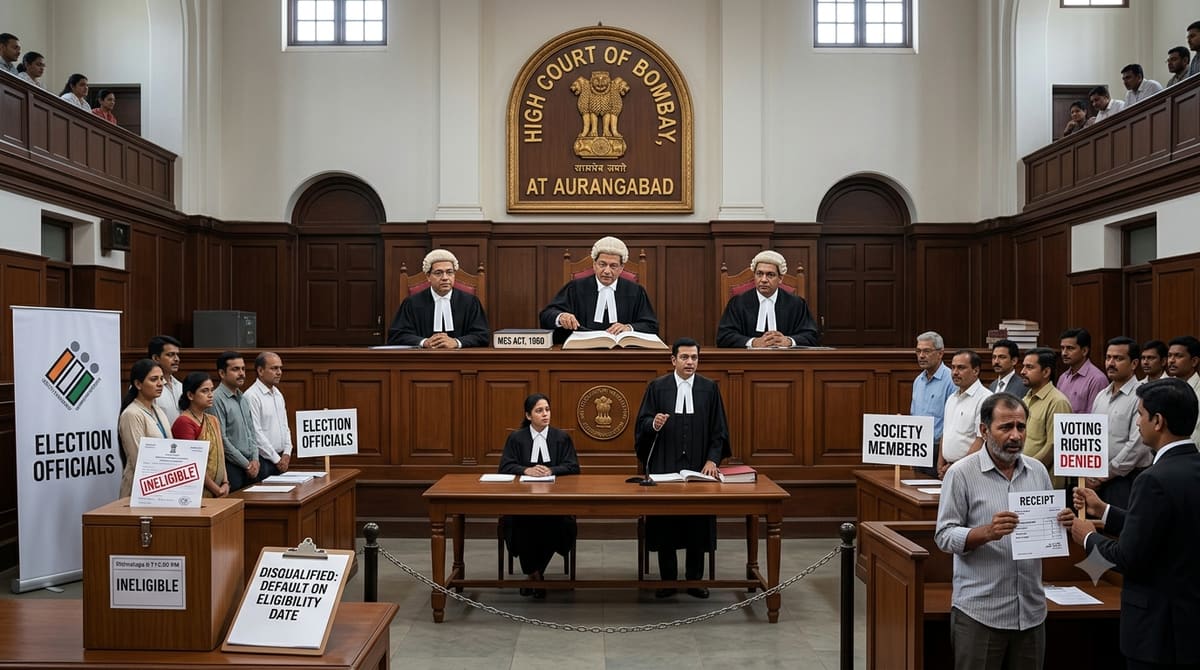
The Court also rejected the waiver argument, noting that waiver requires clear conduct or express consent by the party whose right is being waived. Here, the legal heirs of Panditrao Borse - whose property was being auctioned - had no knowledge of the payment irregularities until the mutation application in 2006. The Bank’s acceptance of delayed payments did not constitute waiver by the judgment-debtor’s heirs.
Regarding maintainability of revision, the Court held that Section 154 empowers the State Government or Registrar to examine the legality and regularity of any order passed by a subordinate officer, including confirmation of sale. The fact that an alternative remedy existed under Rule 107 did not oust the revisional jurisdiction.
The Verdict
The appellants’ appeals were dismissed. The Supreme Court upheld the High Court’s finding that the auction sale was void ab initio due to non-compliance with Rule 107(11)(h). The Court modified the High Court’s order to direct a fresh auction of the property under Rule 107(11)(j), with the Bank required to refund Adishakti Developers’ deposit with 6% interest. The judgment-debtor and creditor retained the right to settle dues before the Recovery Officer.
What This Means For Similar Cases
Auction Sales Are Null and Void for Non-Compliance with Mandatory Deposit Timelines
- Practitioners must treat statutory deposit deadlines under Rule 107(11)(h) as non-negotiable; any delay, even with creditor’s acquiescence, invalidates the sale.
- A buyer cannot rely on the creditor’s acceptance of late payment as a shield against challenge by the original owner.
- Courts will not permit circumvention of statutory timelines through informal arrangements.
Revision Under Section 154 Is Independent of Rule 107 Remedies
- A party need not exhaust Rule 107 remedies before invoking revision under Section 154.
- Revisional jurisdiction under Section 154 is a statutory safeguard against procedural illegality and cannot be ousted by the existence of alternative remedies.
- Practitioners may file revision even after 30 days under Rule 107, provided sufficient cause for delay is shown.
Waiver Requires Clear Consent from the Affected Party, Not Just the Creditor
- Waiver of mandatory statutory conditions requires the consent of the party whose rights are directly affected - in this case, the judgment-debtor or their heirs.
- Creditor’s silence or acceptance of late payment does not equate to waiver by the property owner.
- Practitioners must establish affirmative conduct or written agreement by the affected party to plead waiver successfully.