The Bombay High Court has delivered a significant ruling on the liability of auction purchasers in cooperative housing societies, holding that membership admission under Section 23(2) of the Maharashtra Co-operative Societies Act, 1960 (MCS Act) cannot be granted unless past maintenance dues of the previous owner are cleared. The judgment reinforces Section 154B-7 of the MCS Act, which mandates that no transfer of share or interest in a housing society becomes effective unless all dues are paid, thereby protecting the financial stability of cooperative societies.
Background & Facts
The Dispute
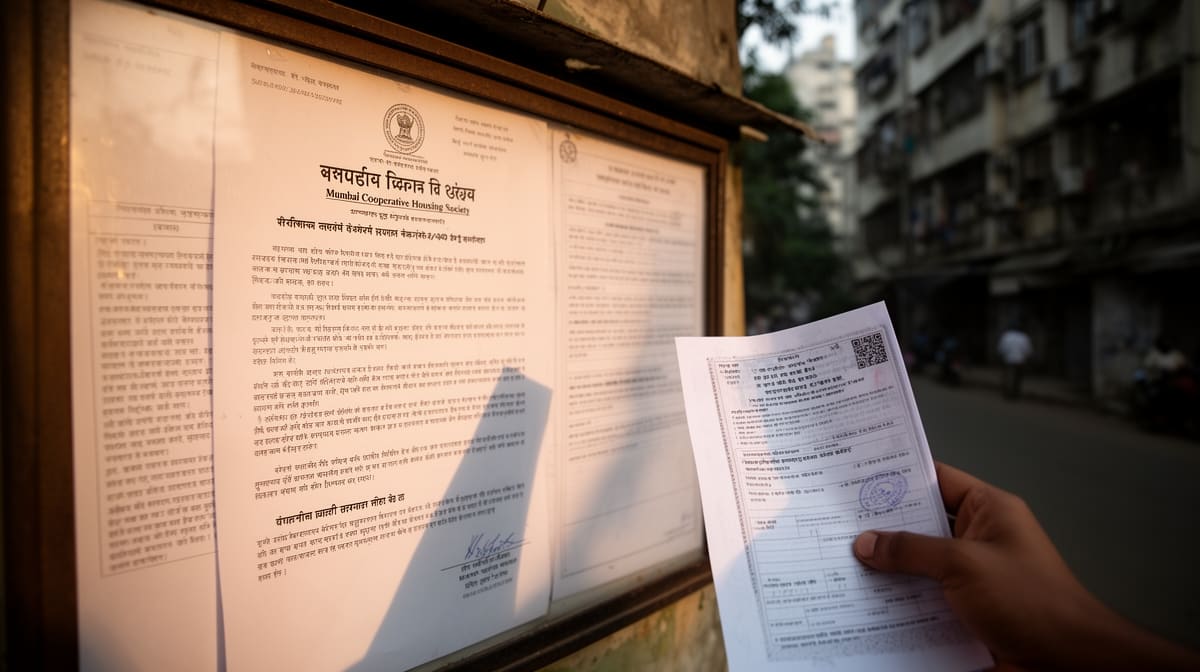
The petitioner, Monarch Orchid Co-operative Housing Ltd., is a registered cooperative housing society in Kharghar, Navi Mumbai. The dispute arose when Respondent Nos. 4 and 5 (Padalkars) purchased Flat No. 1101 in an auction conducted by North Kanara Goud Saraswat Brahmin Co-operative Bank Limited (the Bank) under the Securitisation and Reconstruction of Financial Assets and Enforcement of Security Interest Act, 2002 (SARFAESI Act). The previous owners, Mr. Milind Purohit and Minal Purohit (Purohits), had defaulted on maintenance payments, accumulating arrears of Rs. 8,05,925/- by October 2023. The Society refused to admit the Padalkars as members until the dues were cleared, leading to the present litigation.
Key Facts
- 15.03.2016: Purohits purchased the Flat with a mortgage to the Bank.
- 12.11.2017: Society issued first demand notice for maintenance dues (Rs. 1,91,813/-).
- 05.03.2020: Society issued final demand notice (Rs. 4,53,789/-).
- 07.02.2021: Society informed the Bank of dues (Rs. 5,46,719/-).
- 01.03.2021: Bank issued possession notice under Section 13(4) of the SARFAESI Act.
- 17.03.2023: Padalkars purchased the Flat in an E-auction for Rs. 86,20,000/-.
- 17.03.2023: Padalkars requested waiver of past dues but agreed to abide by Society rules.
- 19.03.2023: Society wrote to the Bank, insisting on clearance of dues before possession.
- 28.03.2023: Bank handed over possession to Padalkars, stating they had agreed to pay pending and future dues.
- 09.04.2023: Padalkars informed the Society they would pay maintenance only from 28.03.2023.
- 10.10.2023: Society issued demand notice for Rs. 8,05,925/-.
- 26.10.2023: Padalkars filed an application under Section 23(2) of the MCS Act for membership admission.
- 04.01.2024: Assistant Registrar allowed the application, directing the Society to admit Padalkars as members.
- 04.04.2024: Joint Registrar dismissed the Society’s revision application.
- 28.03.2025: Society filed the present writ petition, challenging both orders.
Procedural History
- 26.10.2023: Padalkars filed application under Section 23(2) MCS Act before Assistant Registrar.
- 04.01.2024: Assistant Registrar allowed the application, directing admission of Padalkars as members.
- 04.04.2024: Joint Registrar dismissed the Society’s revision application.
- 28.03.2025: Society filed Writ Petition No. 8034 of 2025 before Bombay High Court.
- 24.06.2025: High Court stayed the Assistant Registrar’s order.
- 14.07.2026: Judgment pronounced, allowing the writ petition.
The Parties' Positions
For the Petitioner (Society)
- Argued that Section 154B-7 of the MCS Act bars transfer of membership unless past dues are cleared.
- Relied on the Sale Certificate, which explicitly stated that the purchase was subject to payment of pending dues.
- Contended that Padalkars had full knowledge of the dues and agreed to pay them, as evidenced by their letter dated 17.03.2023 and email dated 16.10.2023.
- Cited judgments in Tanvi's Diamoda Cooperative Housing Society Ltd. v. State of Maharashtra and Banganga Anurag Co-operative Housing Society Limited v. The Divisional Joint Registrar, which upheld the Society’s right to insist on dues clearance.
For the Respondents (Padalkars)
- Argued that the Society’s refusal to admit them was arbitrary and unlawful.
- Contended that past dues were not their personal liability and could not be enforced against them.
- Relied on Brightland Cooperative Housing Society Ltd. v. Divisional Joint Registrar, where the Court held that disputed dues could not be a ground for denying membership.
- Alleged suppression of material facts by the Society, including the pendency of a dispute under Section 91 of the MCS Act for recovery of dues.
- Argued that the Society’s conduct amounted to abuse of process, as it was pursuing parallel remedies.
Relief Sought
The Society sought:
- Quashing of the orders dated 04.01.2024 (Assistant Registrar) and 04.04.2024 (Joint Registrar).
- A declaration that Padalkars were not entitled to membership without clearing past dues.
- Directions to the authorities to refuse membership until dues were paid.
The Legal Issue
The central question was whether an auction purchaser of a flat in a cooperative housing society can be denied membership under Section 23(2) of the MCS Act on the ground of non-payment of past maintenance dues of the previous owner. Specifically:
- Does Section 154B-7 of the MCS Act mandate clearance of past dues as a precondition for membership admission?
- Can the Society refuse membership to an auction purchaser who inherits the liability of past dues under the Sale Certificate?
- Does the pendency of a Section 91 dispute for recovery of dues disentitle the Society from relying on Section 154B-7?
Arguments Presented
For the Petitioner (Society)
- Section 154B-7 of the MCS Act is mandatory and bars transfer of membership unless dues are cleared.
- The Sale Certificate explicitly stated that the purchase was subject to payment of pending dues, binding Padalkars to this condition.
- Padalkars had full knowledge of the dues and agreed to pay them, as evidenced by their communications.
- The judgments in Tanvi's Diamoda and Banganga Anurag support the Society’s position that auction purchasers inherit the liability of past dues.
- The Society’s refusal to admit Padalkars was lawful and justified, as it was protecting the financial interests of other members.
For the Respondents (Padalkars)
- Past dues were not their personal liability, and the Society could not enforce them against Padalkars.
- The Society’s conduct amounted to abuse of process, as it was pursuing parallel remedies (membership refusal and Section 91 dispute).
- The judgment in Brightland supports their case, as it held that disputed dues could not be a ground for denying membership.
- The Society suppressed material facts, including the pendency of the Section 91 dispute, which disentitled it from relief.
- The Society’s refusal was arbitrary, as it did not follow due process in determining the dues.
The Court's Analysis
The Court conducted a detailed examination of the statutory framework under the MCS Act, particularly Section 154B-7, which states:
"No transfer of share or interest of a member... shall be effective unless the dues of the housing society are paid."
Key Legal Principles Established:
-
Mandatory Nature of Section 154B-7:
- The Court held that Section 154B-7 is mandatory and uses negative language to emphasize that transfer of membership is not effective unless dues are paid.
- The provision is designed to protect the financial stability of cooperative societies, which rely on timely maintenance payments to fund essential services.
-
Auction Purchaser’s Liability:
- The Court rejected the argument that auction purchasers are not liable for past dues. It held that Padalkars inherited the liability attached to the Flat under the Sale Certificate, which explicitly stated that the purchase was subject to payment of pending dues.
- The ‘As is Where is’ and ‘Whatever There Is’ clauses in the Sale Certificate were interpreted to extend beyond the physical condition of the Flat to include financial liabilities, such as maintenance dues.
- Reliance was placed on the Supreme Court’s judgment in K.C. Ninan v. Kerala State Electricity Board, which held that such clauses put the purchaser on notice of all claims and dues affecting the property.
-
Charge on the Flat Under Section 154B-14:
- The Court noted that Section 154B-14 of the MCS Act creates a charge on the Flat for unpaid dues, which transfers to the auction purchaser.
- Thus, Padalkars could not escape liability merely because they were not the original defaulters.
-
Distinction Between Disputed and Undisputed Dues:
- The Court distinguished between cases where dues are undisputed (as in the present case) and those where dues are seriously disputed (as in Brightland).
- In Brightland, the Society had failed to provide a clear break-up of dues, leading the Court to hold that Section 154B-7 could not be invoked without adjudication.
- In contrast, the dues in the present case were admitted, and the Society had communicated them clearly to Padalkars. Thus, the ratio of Tanvi's Diamoda applied.
-
Parallel Remedies Not Barred:
- The Court rejected the argument that the Society’s filing of a Section 91 dispute disentitled it from relying on Section 154B-7.
- It held that the Society was entitled to pursue both remedies: refusing membership and recovering dues through legal proceedings.
- The pendency of the Section 91 dispute did not convert the dues into a disputed amount, nor did it imply admission of Padalkars as members.
-
Suppression of Material Facts:
- While the Society failed to disclose the pendency of the Section 91 dispute, the Court held that this omission was not material, as it did not affect the merits of the case.
- The Court relied on S.J.S. Business Enterprises (P) Ltd. v. State of Bihar and State (NCT of Delhi) v. BSK Realtors LLP, which held that suppression must be of a material fact that would influence the outcome.
Critique of Lower Authorities’ Orders:
- The Assistant Registrar erred in holding that the Bank did not communicate pending dues to Padalkars and that the Society failed to perform its statutory duty.
- The Joint Registrar failed to correct these errors, merely upholding the Assistant Registrar’s order without applying the statutory provisions or precedents.
"The Assistant Registrar has recorded a virtually incorrect finding that the Bank did not communicate to Padalkars about pending maintenance dues... Padalkars were fully aware of past maintenance dues in respect of the Flat and in any case, became aware of the same while conduct of auction on 17 March 2023."
The Verdict
The Court allowed the writ petition and set aside the impugned orders