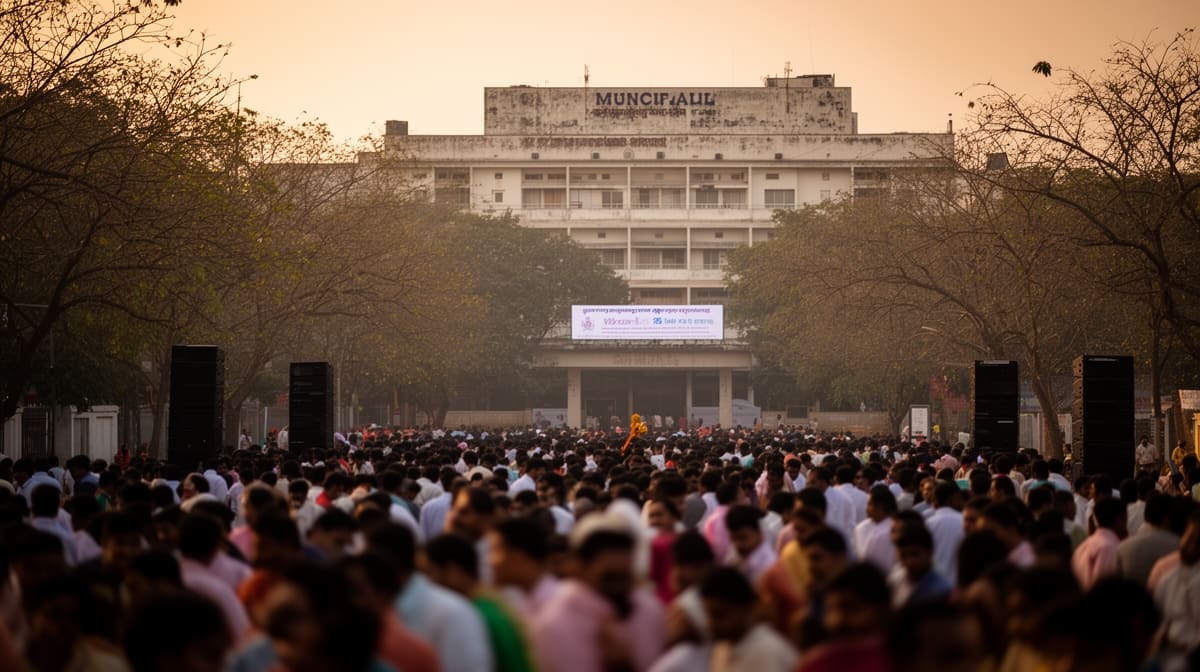
The Bombay High Court has issued a stern directive reinforcing the enforceability of the Noise Pollution (Regulation and Control) Rules, 2000, particularly against unregulated public function venues in urban centers. This suo motu and public interest litigation initiative underscores the judiciary’s growing role in compelling executive compliance with long-ignored environmental norms that directly impact public health.
Background & Facts
The Dispute
The litigation arose from persistent complaints regarding uncontrolled noise from marriage halls, lawns, and club houses in Nagpur’s Civil Lines area. Residents, including petitioner Dr. Bhupendrakumar K. Wasnik, alleged chronic exposure to noise levels exceeding permissible limits, leading to physical and mental health deterioration. Despite the existence of the Noise Pollution Rules since 2000 and guidelines issued by the Maharashtra Pollution Control Board (MPCB) in 2016, enforcement remained absent.
Procedural History
The matter was consolidated from three sources:
- PIL No. 90/2025 filed by Dr. Bhupendrakumar K. Wasnik and others
- PIL No. 8/2025 filed by Awantika Chitnavis
- Suo motu PIL No. 16/2025 initiated by the Court itself after reviewing systemic non-compliance
The Court first issued directions on 5 March 2026, ordering authorities to verify compliance. On 11 March 2026, respondents published a notice - only one day before the next hearing - raising judicial concern over delayed compliance.
The Parties' Positions
- Petitioners and amicus curiae: Argued that the Rules and MPCB guidelines have been systematically ignored, rendering environmental protections illusory.
- Respondents (MPCB, Nagpur Municipal Corporation, State): Admitted widespread non-compliance but claimed efforts were underway. No concrete evidence of prior enforcement actions was produced.
Relief Sought
The petitioners sought:
- Immediate cessation of operations by non-compliant venues
- Mandatory acquisition of consent from MPCB
- Installation of acoustic enclosures and sewage treatment plants
- Withdrawal of permissions granted in violation of guidelines
- Accountability of local authorities for inaction
The Legal Issue
The central question was whether local authorities and function venues are legally bound to comply with the Noise Pollution (Regulation and Control) Rules, 2000, and whether the Maharashtra Pollution Control Board’s 2016 guidelines constitute enforceable directives under the Environment (Protection) Act, 1986.
Arguments Presented
For the Petitioner
The petitioners relied on Section 3 of the Environment (Protection) Act, 1986, which empowers the Central Government to frame rules for noise pollution control. They cited Rule 5 of the Noise Pollution Rules, 2000, which mandates that all public venues using loudspeakers or sound systems must obtain prior permission. They further invoked Circular No. 24-11-2016 issued by MPCB under the direction of the National Green Tribunal, arguing that such circulars, issued under statutory authority, carry the force of law. Precedents like M.C. Mehta v. Union of India were cited to establish the state’s duty to protect environmental rights under Article 21.
For the Respondent
The respondents conceded non-compliance but argued that enforcement was hindered by lack of resources and administrative backlog. They contended that the 2016 circular was merely advisory and not a statutory mandate. They also claimed that many venues operated under legacy permissions granted before the guidelines were issued, and retrospective application would be unjust.
The Court's Analysis
The Court rejected the argument that the MPCB circular was merely advisory. It held that the circular was issued under the statutory mandate of the Noise Pollution Rules and the National Green Tribunal’s binding order in Application No. 53/2015. The Court emphasized that environmental norms are not discretionary and that delay in implementation cannot be equated with compliance.
"The State cannot afford to treat environmental protection as a bureaucratic formality. When rules framed under the Environment (Protection) Act remain unenforced for over two decades, the right to life under Article 21 becomes a hollow promise."
The Court examined the specific requirements under the guidelines: sewage treatment plants, acoustic enclosures, dense vegetation buffers, and prior permission for sound systems. It found that none of the 13 identified venues in Civil Lines had submitted proof of compliance. The Court further held that permission granted without adherence to these conditions is ultra vires and must be revoked.
The Court also clarified that Section 38, 70, 136, and 149 of the Maharashtra Police Act provide independent grounds for action against noise violations, reinforcing the environmental framework with criminal liability.
The Verdict
The petitioners succeeded. The Court held that all marriage halls, lawns, and club houses must obtain valid consent from MPCB and comply with acoustic and sewage guidelines under the Noise Pollution Rules, 2000. Permissions granted in violation of these norms are void, and authorities must withdraw them immediately. The Nagpur Municipal Corporation was directed to submit all existing permissions and justifications for non-compliance.
What This Means For Similar Cases
Compliance Is Mandatory, Not Optional
- Practitioners must now treat MPCB guidelines issued under statutory authority as binding, not advisory
- Any venue operating without MPCB consent for sound systems is operating illegally, regardless of prior permissions
- Local bodies cannot claim resource constraints as a defense for non-enforcement
Enforcement Triggers Criminal Liability
- Police stations must treat noise complaints under Sections 38, 70, 136, and 149 of the Maharashtra Police Act as actionable offenses
- Failure to file reports on citizen complaints, as directed in this case, may constitute dereliction of duty
- Municipal corporations risk legal action for issuing or renewing permissions without environmental due diligence
Judicial Oversight Extends to Procedural Diligence
- Delayed compliance, such as publishing notices the day before a hearing, will be viewed as bad faith
- Courts will hold officials personally accountable for systemic inaction on environmental orders
- Future petitions may seek contempt proceedings against authorities for non-compliance with environmental directives