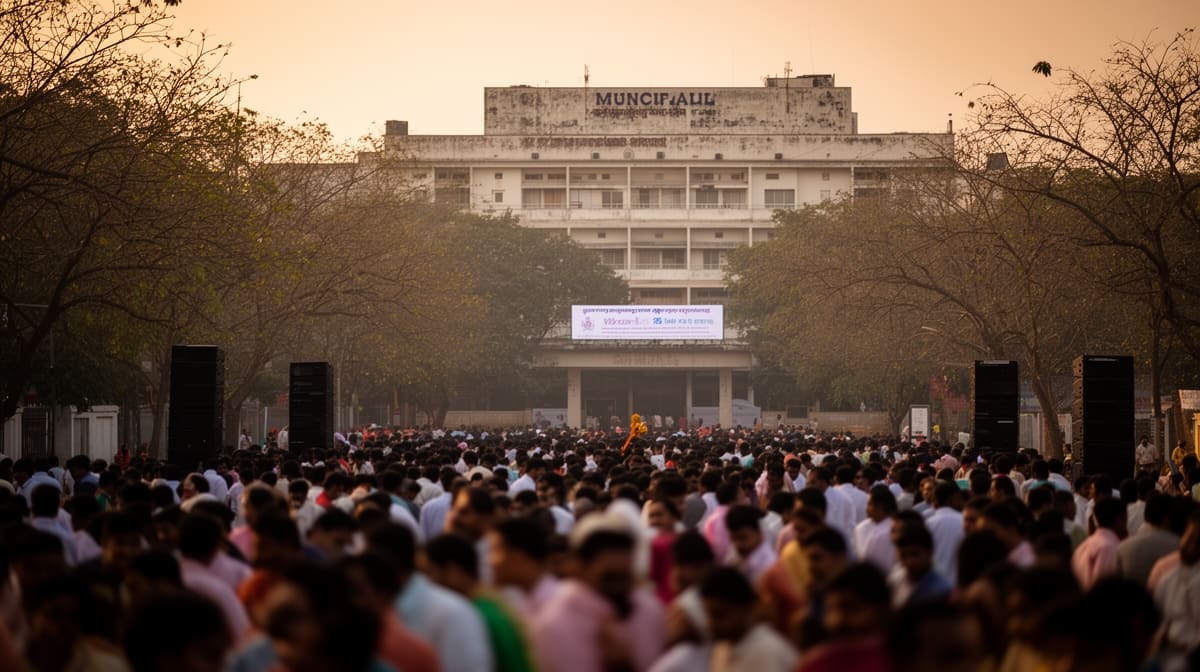
The Andhra Pradesh High Court has reaffirmed that state authorities cannot treat environmental protection guidelines as optional. In a decisive writ petition, the Court mandated strict implementation of Noise Pollution Rules and binding Supreme Court directives, establishing that non-enforcement constitutes a violation of constitutional obligations under Article 21.
Background & Facts
The Dispute
The petitioner, a resident of Anantapur, filed a representation on 06.03.2026 highlighting persistent noise pollution from public events, construction activities, and religious gatherings that violated the Noise Pollution (Regulation and Control) Rules, 2000 framed under the Environment (Protection) Act, 1986. Despite repeated complaints to local authorities, no action was taken to enforce permissible decibel limits or restrict noise-generating activities during prohibited hours.
Procedural History
- The petitioner submitted a formal representation to the District Collector and Municipal Corporation on 06.03.2026.
- No response or remedial action was taken by Respondents 2 to 4 - Superintendent of Police, District Collector, and Anantapur Municipal Corporation.
- On 12.03.2026, the petitioner filed Writ Petition No. 7045/2026 under Article 226 seeking a writ of mandamus.
Relief Sought
The petitioner sought a direction to the respondents to:
- Strictly implement the Noise Pollution (Regulation and Control) Rules, 2000
- Comply with the Supreme Court’s guidelines in In re: Noise Pollution (V) (2005) 5 SCC 733
- Issue binding orders to curb unlawful noise emissions, particularly during night hours and near sensitive zones
The Legal Issue
The central question was whether state authorities have a non-discretionary duty to enforce environmental noise regulations and Supreme Court-mandated guidelines, even in the absence of a specific complaint-driven order.
Arguments Presented
For the Petitioner
The petitioner’s counsel, M. Balanaga Srinivas, argued that:
- The Noise Pollution Rules, 2000 are statutory instruments with mandatory compliance under Section 6 of the Environment (Protection) Act, 1986.
- The Supreme Court in In re: Noise Pollution (V) laid down comprehensive, binding guidelines for all states, including restrictions on loudspeakers, construction work hours, and public event noise.
- Failure to act constitutes a violation of the right to a healthy environment under Article 21 of the Constitution.
- The Court’s prior directives in 2005 SCC 733 are not advisory but enforceable through writ jurisdiction.
For the Respondent/State
The Assistant Government Pleader, P. Ajay Babu, conceded that rules exist but contended that:
- Enforcement requires specific complaints and resource allocation.
- Absence of a formal order from the Court in the past meant no immediate obligation.
- Local bodies lacked adequate personnel to monitor compliance uniformly.
The Court's Analysis
The Court rejected the State’s argument that enforcement is discretionary. It emphasized that environmental protection is not a matter of administrative convenience but a constitutional imperative. The Court relied on In re: Noise Pollution (V) (2005) 5 SCC 733, which held that noise pollution is a form of environmental degradation that directly impacts public health and dignity.
"The guidelines issued by this Court are not mere suggestions; they are binding directives that every state authority must implement without delay or excuse."
The Court further noted that the Noise Pollution Rules, 2000 are not self-executing merely because they are framed under delegated legislation - they derive mandatory force from the parent Act and judicial affirmation. The failure of Respondents 2 to 4 to act, despite clear statutory and judicial mandates, amounted to a dereliction of duty under Article 21 and Article 48A.
The Court also distinguished this from routine administrative inaction by citing the non-delegable nature of environmental duties under public trust doctrine, which obligates the State to act as trustee of natural resources for public benefit.
The Verdict
The petitioner succeeded. The Court held that state authorities have a non-discretionary duty to enforce noise pollution guidelines under the Environment (Protection) Act, 1986 and Supreme Court directives. It directed Respondents 2 to 4 to implement the Noise Pollution Rules and In re: Noise Pollution (V) guidelines immediately, with compliance reports to be filed within four weeks.
What This Means For Similar Cases
Enforcement of Environmental Guidelines Is Mandatory
- Practitioners can now invoke Article 226 to compel enforcement of environmental guidelines even without prior litigation.
- Authorities cannot plead lack of resources or absence of formal orders as justification for inaction.
- Any citizen may file a writ petition to enforce compliance with notified rules and judicial directives.
Judicial Directives Bind All Levels of Administration
- Supreme Court guidelines in environmental matters are not advisory - they carry the force of law.
- District Collectors, Municipal Corporations, and Police must integrate these guidelines into daily operational protocols.
- Failure to comply may attract contempt proceedings or writs of mandamus in future.
Noise Pollution Is a Fundamental Rights Issue
- Noise exceeding permissible limits is no longer treated as a nuisance but as a violation of the right to life and health.
- Legal challenges must now frame noise complaints as Article 21 violations, not merely administrative grievances.
- Medical evidence of health impact, while helpful, is not mandatory to establish a prima facie case for judicial intervention.