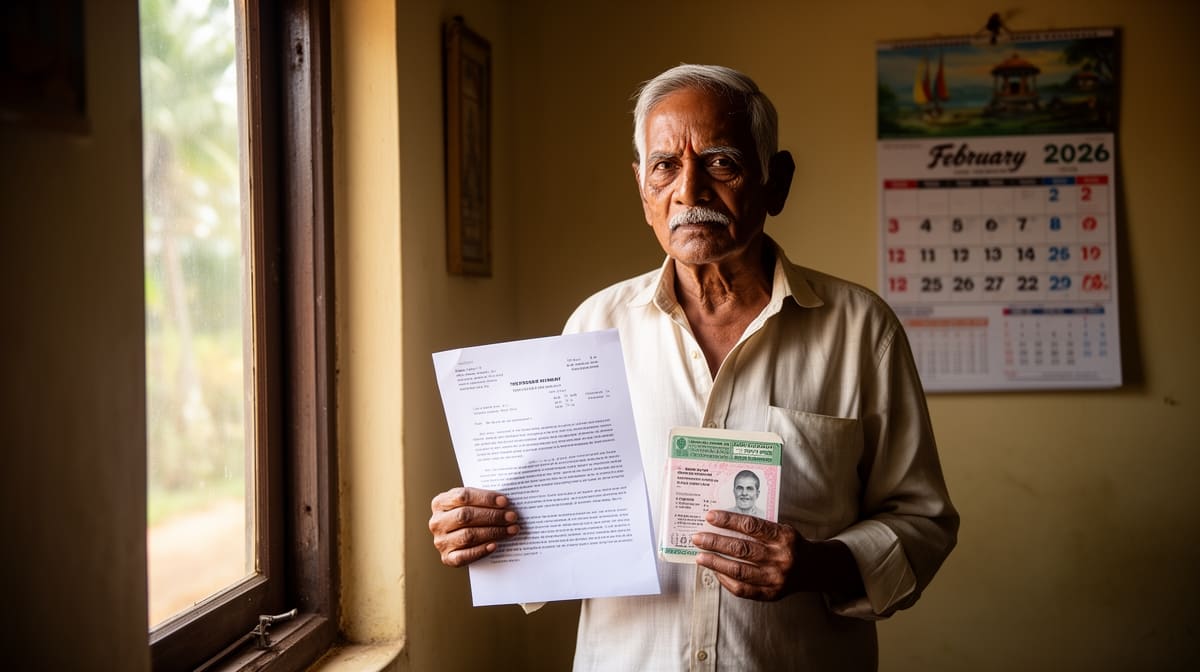
The Central Administrative Tribunal’s judgment in O.A. No. 35/2025 establishes a critical safeguard for pensioners and their families: the state cannot claw back financial benefits granted decades earlier unless fraud or misrepresentation is proven. This ruling reinforces the principle that administrative convenience cannot override the constitutional right to fair treatment, especially for those who have already retired or lost their breadwinner.
Background & Facts
The Dispute
The applicant, widow of the late Sh. Tajinder Pal Singh Salaria, a former Executive Engineer in the Power Development Department, seeks restoration of her family pension and withheld gratuity. Her husband, who served for over thirty years, was granted eight advance increments upon his initial appointment as Junior Engineer in 1993 under government directives aimed at uniformity for degree-holding officers. These increments were consistently applied across his service and were never challenged during his lifetime.
Procedural History
- 1993: Late husband appointed as Junior Engineer and granted eight advance increments as per government policy.
- 2004: Promoted to Assistant Engineer (Civil) with no adjustment to prior increments.
- 24-03-2023: Late husband died in harness while serving as Executive Engineer.
- 29-02-2024: Respondent No. 2 issued GPO and FPPO retroactively revising emoluments from 1993, reducing family pension and withholding Rs. 20,00,000 gratuity.
- 2025: Applicant filed Original Application before CAT Jammu seeking quashing of the orders and release of dues.
Relief Sought
The applicant sought: (1) quashing of the impugned GPO and FPPO; (2) release of withheld gratuity; (3) payment of family pension based on actual last pay drawn; (4) interest at 24% on delayed payments; and (5) compensation for violation of natural justice.
The Legal Issue
The central question was whether the government can recover excess pay granted to a deceased employee’s estate after a lapse of over thirty years, without proving fraud or providing notice during the employee’s lifetime, and whether such recovery violates the principles of natural justice and equity.
Arguments Presented
For the Petitioner
The applicant’s counsel argued that the increments were granted uniformly across the department, with no concealment or misrepresentation by the deceased. Citing State of Punjab v. Rafiq Masih and Thomas Daniel v. State of Kerala, counsel emphasized that recovery is impermissible where the employee played no role in the error and where the benefit was enjoyed for decades. The failure to issue notice during the employee’s lifetime violated natural justice. The applicant also relied on the J&K High Court’s judgment in Jamsheed Ahmad Khan v. UT of J&K, which barred post-retirement recovery absent fraud.
For the Respondent
The respondents contended that the increments were granted erroneously under a misinterpretation of pay rules and that recovery of excess payments is a legitimate administrative corrective measure. They argued that public funds must be protected and that the error, though long-standing, remained legally invalid. No argument was made that the deceased had committed fraud or misrepresented facts.
The Court's Analysis
The Tribunal conducted a thorough review of binding precedents from the Supreme Court and the High Court of Jammu and Kashmir and Ladakh. It emphasized that recovery of excess pay is not an automatic right of the employer but must be weighed against the hardship inflicted on the employee or their dependents.
"As between two parties, if determination is rendered in favour of the party, which is weaker of the two, without any serious detriment to the other... the issue resolved would be in consonance with the concept of justice..."
The Court noted that the deceased had received the increments for over thirty years, with no objection from the department. The state’s silence during his service constituted acquiescence. The Tribunal held that recovery after retirement or death, without notice or fraud, is arbitrary and violative of Article 14 and Article 21. It further relied on Jagdish Prasad Singh v. State of Bihar, which mandated reimbursement with interest where pension was wrongly reduced.
The Court rejected the state’s claim of administrative necessity, stating that equity and fairness must prevail over bureaucratic rigidity, especially when the beneficiary is a widow dependent on pensionary benefits. The failure to afford the deceased an opportunity to be heard before revising his emoluments was a clear breach of natural justice.
The Verdict
The applicant won. The Tribunal held that recovery of excess pay granted decades ago without fraud or notice is illegal, and directed immediate release of the withheld gratuity and arrears of family pension. The impugned orders were quashed, and interest at 6% was mandated from the date of withholding until realization.
What This Means For Similar Cases
Recovery Is Not Permissible After Retirement Without Fraud
- Practitioners must argue that any post-retirement recovery of pay benefits is void unless fraud or misrepresentation is proven.
- The burden lies on the state to establish intentional wrongdoing by the employee - not mere administrative error.
- Cases involving long-standing pay fixation (over five years) are presumptively protected under Rafiq Masih.
Natural Justice Requires Notice Before Revision
- No revision of emoluments can be made retroactively without affording the employee a hearing during their lifetime.
- Failure to issue notice or opportunity to explain constitutes a violation of audi alteram partem.
- This applies equally to family pensioners; dependents inherit the right to procedural fairness.
Gratuity Cannot Be Withheld for Pay Disputes
- Gratuity is a statutory right under the Payment of Gratuity Act, 1972, and cannot be appropriated to offset alleged overpayments in salary.
- Employers must pursue recovery through separate, lawful channels - not by withholding terminal benefits.
- Any such withholding is illegal and attracts interest under the Tribunal’s inherent powers.