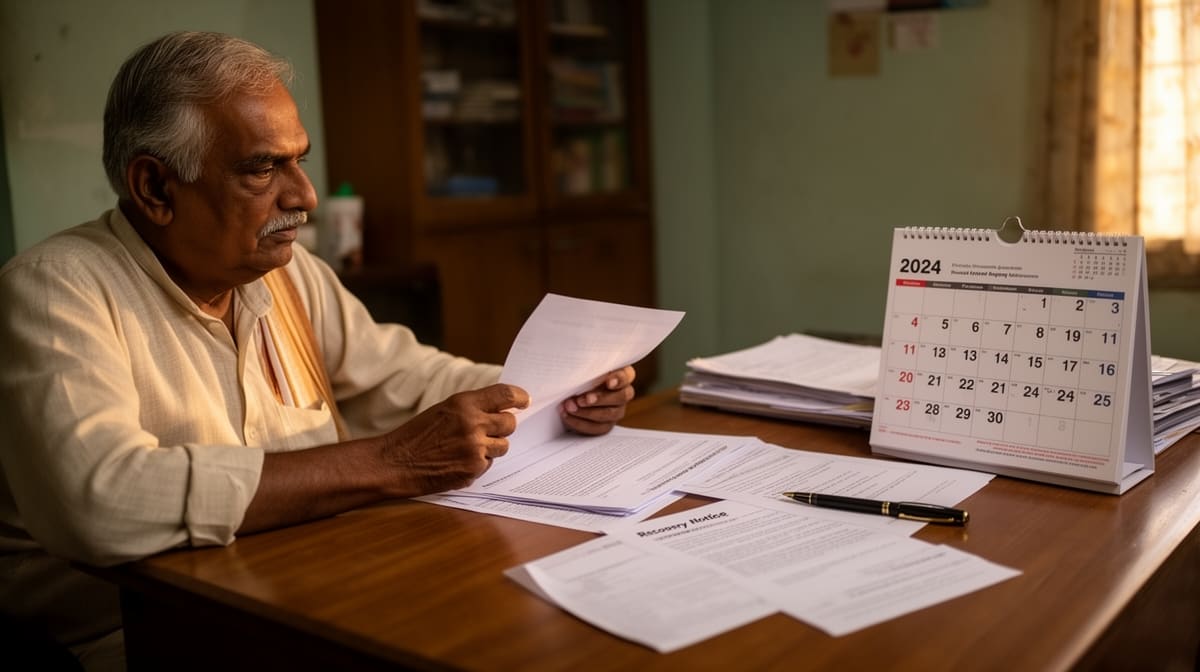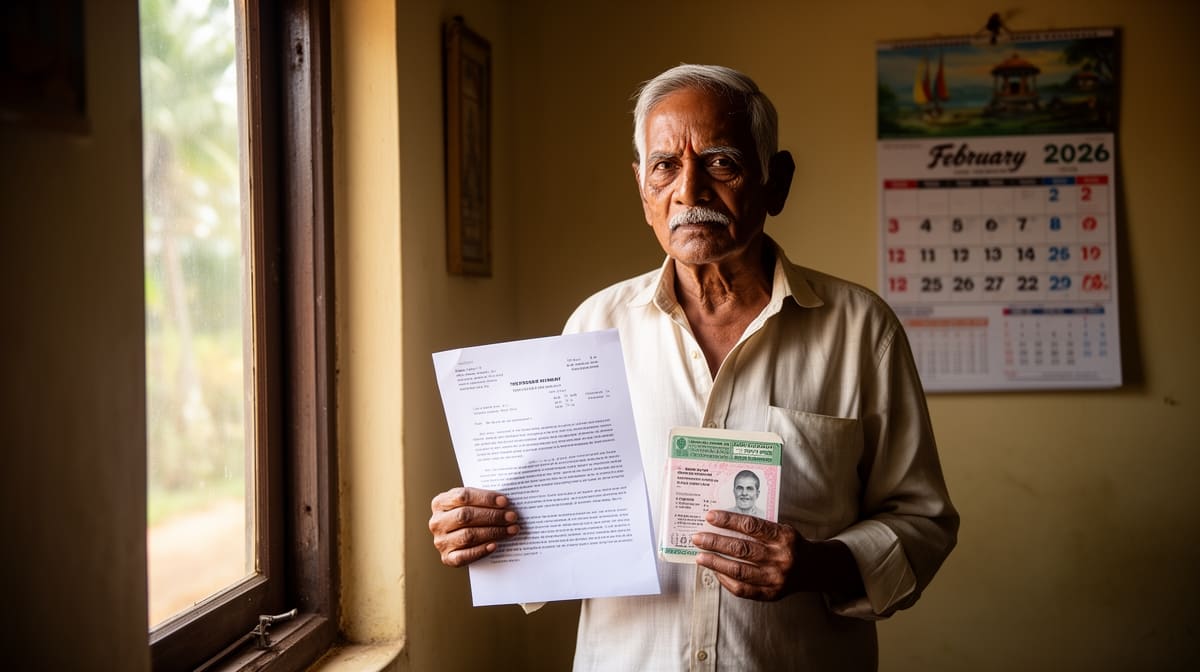
The Central Administrative Tribunal has delivered a landmark ruling affirming that recovery of excess salary paid over a decade cannot be enforced against a retired employee, even if the payment resulted from administrative error. The judgment reinforces the Supreme Court’s doctrine in Rafiq Masih that equitable principles must prevail over technical rectification when the employee bears no fault.
Background & Facts
The Dispute
The applicant, a retired Chargeman (Electrical) from the Naval Ship Repair Yard, was granted two financial upgradations under the MACP scheme: the 2nd MACP with grade pay of Rs.2,800/- effective 01.09.2008, and the 3rd MACP with grade pay of Rs.4,200/- effective 24.07.2009. These were granted based on service records available at the time. However, on the eve of his retirement on 31.05.2021, the authorities issued an order cancelling both MACPs, claiming they were granted erroneously due to retrospective cadre restructuring effective 01.01.2006. As a result, a recovery of Rs.2,46,279/- was directed from his Death Cum Retirement Gratuity (DCRG).
Procedural History
- 01.09.2008: 2nd MACP granted with grade pay Rs.2,800/-
- 24.07.2009: 3rd MACP granted with grade pay Rs.4,200/-
- 01.01.2006: Cadre restructuring retrospectively applied, making applicant ineligible for 2nd MACP
- 13.04.2021: Annexure-A5 issued, directing recovery of Rs.2,46,279/- from DCRG
- 16.12.2025: Hearing before CAT
- 17.02.2026: Tribunal delivers judgment
Relief Sought
The applicant sought quashing of Annexure-A5, declaration that the recovery is illegal and violative of Articles 14, 16, 21 and 300A of the Constitution, and directions to refund the recovered amount with interest from the date of retirement.
The Legal Issue
The central question was whether the State can recover excess payments made under the MACP scheme for over a decade from a retired employee’s DCRG, when the employee played no role in the error and the mistake was not detected despite annual audits.
Arguments Presented
For the Petitioner
The applicant’s counsel argued that the recovery was arbitrary, violative of natural justice, and contrary to Rafiq Masih. He emphasized that the applicant had no knowledge of the restructuring’s retrospective effect, did not misrepresent facts, and had passively received benefits for over 12 years. He cited Regional Cancer Centre v. Ganga Devi to show that post-retirement recovery without notice is illegal. He further contended that the State’s failure to detect the error during routine audits negated any claim of bona fide rectification.
For the Respondent
The State contended that the MACP grants were based on a misinterpretation of the scheme and were therefore void ab initio. It relied on Raj Kumar Batra and Chandigarh Administration v. Naurang Singh to assert that administrative mistakes can be corrected at any time. It argued that the applicant was a Group-B employee from 2012 and thus ineligible for MACP benefits granted to Group-C employees, making the payments ultra vires.
The Court's Analysis
The Tribunal undertook a rigorous analysis of the Rafiq Masih precedent, which established a five-year threshold beyond which recovery becomes iniquitous. The Court noted that the excess payments spanned from 2008 to 2021 - over 12 years - far exceeding the five-year limit laid down in paragraph 18 of Rafiq Masih. The Court observed:
"Recovery in cases where the excess payment has been made for a period in excess of five years, before the order of recovery is issued, is impermissible."
The Tribunal rejected the State’s reliance on Raj Kumar Batra and Naurang Singh, distinguishing them on the ground that those cases involved short-term errors detected promptly. Here, the error persisted for more than a decade despite internal audits and multiple promotions. The Court emphasized that the applicant had no role in the misgrant - no misrepresentation, no fraud, no concealment. The State’s own administrative negligence could not be visited upon the employee.
The Court further held that the retrospective application of cadre restructuring did not invalidate the MACP grants retroactively, as the employee had acted in good faith based on official communications. The fact that the applicant received higher pay for over a decade created a legitimate expectation, which the State could not unilaterally withdraw without violating principles of fairness.
The Tribunal also dismissed the argument that the applicant was a Group-B employee, noting that the MACP grants were made while he was in Group-C positions, and the Rafiq Masih protections apply irrespective of group classification when the five-year threshold is crossed.
The Verdict
The applicant won. The Tribunal held that recovery of excess MACP payments made over a decade is iniquitous and impermissible under Rafiq Masih. It quashed Annexure-A5 and directed the respondents to refund Rs.2,46,279/- within four months, with interest at 6% per annum if delayed.
What This Means For Similar Cases
Recovery After Five Years Is Per Se Iniquitous
- Practitioners must now argue that any recovery of excess pay beyond five years is legally impermissible, regardless of whether the error was administrative or clerical
- The burden shifts to the employer to prove the employee acted fraudulently or with knowledge of the error
- Even if the payment was technically unlawful, the doctrine of laches and equitable estoppel bar recovery after prolonged acquiescence
Retired Employees Are Shielded from Retroactive Adjustments
- DCRG and pension benefits crystallize upon retirement and cannot be subject to retrospective clawbacks
- Employers must conduct timely audits and rectify errors before the five-year window closes
- Post-retirement recovery attempts must be challenged on grounds of violation of Article 300A and principles of natural justice
MACP Grants Cannot Be Cancelled Retrospectively Without Notice
- Financial upgradations under MACP, once granted and enjoyed for years, create a legitimate expectation
- Retrospective cancellation without prior notice or opportunity to be heard violates Article 14 and natural justice
- Employers must issue formal show-cause notices before cancelling any benefit, even if based on a later clarification