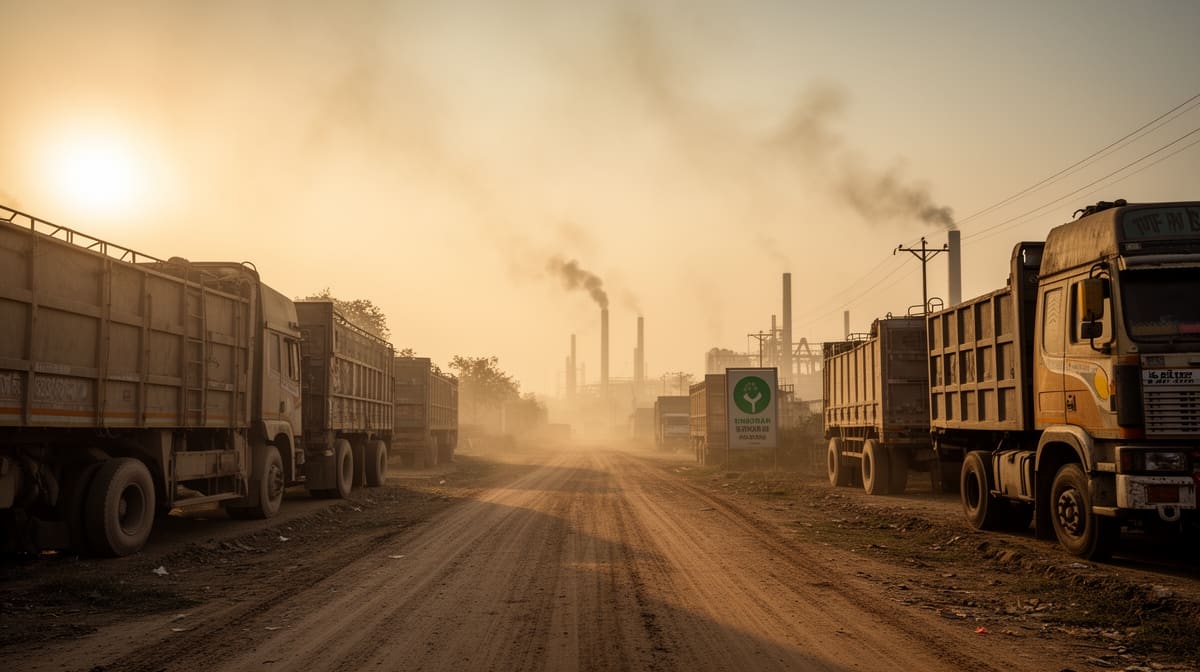
The National Green Tribunal has issued a significant interim ruling on the enforceability of mandatory crop residue co-firing obligations for thermal power plants, clarifying that statutory compliance cannot be evaded merely due to market unavailability of mandated biomass inputs. This decision sets a critical precedent for environmental regulators and power generators navigating the intersection of regulatory mandates and supply chain realities.
Background & Facts
The Dispute
The appellant, Panipat Thermal Power Station, is a thermal power plant operator in Haryana that is subject to regulatory obligations under the Commission for Air Quality Management in National Capital Region and Adjoining Areas Act, 2021 (CAQM Act, 2021). The dispute arises from the imposition of an environmental compensation of Rs. 8,97,93,640 by the Commission for Air Quality Management in National Capital Region and Adjoining Areas (CAQM) for non-compliance with Rule 5 of the Environment (Utilization of Crop residue by Thermal Power Plants) Rules, 2023. The rule mandates that thermal power plants blend a minimum of 5% torrefied biomass pellets or briquettes made from crop residue with coal for co-firing purposes.
Key Facts
- The Environment (Utilization of Crop residue by Thermal Power Plants) Rules, 2023 came into force on 01.04.2023, prescribing mandatory co-firing of 5% biomass pellets
- The CAQM issued advisory notices from 2021 onwards, followed by statutory directions under the CAQM Act, 2021
- The appellant submitted that torrefied biomass pellets were not commercially available in sufficient quantities in the NCR region during the financial year 2024-2025
- The Central Electricity Authority (CEA) acknowledged this difficulty in a communication dated 27.08.2025, noting that the total availability of torrefied pellets in NCR was 564 TPD, while the appellant’s utilization was significantly lower
- The appellant made repeated efforts to procure the pellets but was unable to secure adequate supply despite due diligence
- The CAQM imposed compensation on 01.04.2026, relying on a formula under Rule 3 of the 2023 Rules, without accepting the appellant’s claim of force majeure or legal impediment
Procedural History
- 01.04.2023: Environment (Utilization of Crop residue by Thermal Power Plants) Rules, 2023 notified
- 27.08.2025: CEA communication acknowledging limited availability of torrefied pellets in NCR
- 01.04.2026: CAQM issued order imposing environmental compensation of Rs. 8,97,93,640
- 24.04.2026: Appeal filed before NGT under Section 18 of the CAQM Act, 2021
- 24.04.2026: Interim application (IA No. 325/2026) for stay of compensation order heard
Relief Sought
The appellant seeks stay of the compensation order dated 01.04.2026, and ultimately, quashing of the order on grounds that non-compliance was due to objective supply constraints beyond its control, and not due to negligence or willful violation.
The Legal Issue
The central question is whether the imposition of environmental compensation under Rule 3 of the Environment (Utilization of Crop residue by Thermal Power Plants) Rules, 2023 is justified when the mandated biomass input is not commercially available in sufficient quantities, despite the regulated entity’s diligent efforts to procure it.
Arguments Presented
For the Appellant
The appellant’s counsel argued that Rule 5’s obligation is contingent on the availability of torrefied pellets, and that the CEA’s communication dated 27.08.2025 confirmed the systemic shortage. They contended that the CAQM’s order ignored the principle of impossibility of performance and failed to consider whether the appellant had taken all reasonable steps to comply. Reliance was placed on the doctrine of force majeure and the requirement of proportionality under environmental law. The appellant emphasized that the CAQM did not examine whether the non-compliance was due to statutory or market impediments, as permitted under Rule 5.
For the Respondent
The CAQM’s counsel argued that the obligation to co-fire biomass has been in place since 2021 through advisories, and the 2023 Rules codified a clear statutory duty. They submitted that the CAQM followed due process by issuing a show cause notice, constituting a committee, and applying the prescribed formula under Rule 3. They maintained that the burden of ensuring supply chain resilience lies with the regulated entity, and that market unavailability cannot override statutory obligations. They further asserted that natural justice was upheld and the compensation was calculated objectively.
The Court's Analysis
The National Green Tribunal acknowledged the statutory imperative behind the biomass co-firing mandate, recognizing its importance in reducing stubble burning and air pollution in the National Capital Region. However, the Court observed that the CAQM’s order failed to engage with the CEA’s communication dated 27.08.2025, which explicitly noted the scarcity of torrefied pellets in the region. The Tribunal held that while regulatory compliance is non-negotiable, the imposition of punitive compensation must account for objective barriers beyond the control of the regulated entity.
"The obligation to use torrefied pellets cannot be enforced in a vacuum where the market infrastructure to supply them remains underdeveloped, and the regulatory authority itself has acknowledged the shortfall."
The Court emphasized that the CAQM’s methodology for calculating compensation assumed full compliance capability, without assessing whether the appellant had made genuine efforts to procure the biomass. The Tribunal noted that the CAQM did not examine whether the appellant had approached alternative suppliers, sought government assistance, or explored substitute sources, as required under the spirit of the Rules.
The Court further held that the principle of natural justice requires the regulator to consider all relevant circumstances, including supply chain constraints, before imposing financial penalties. The absence of such an inquiry rendered the order procedurally flawed.
The Verdict
The National Green Tribunal granted a conditional stay of the environmental compensation order dated 01.04.2026. The appellant is directed to deposit 50% of the imposed amount, i.e., Rs. 4,48,96,820, within six weeks from 24.04.2026. The full order shall remain stayed pending final disposal of the appeal. Rejoinder, if any, must be filed by the appellant within two weeks. The appeal is listed for hearing on 27.07.2026 along with Appeal No. 42/2026.
What This Means For Similar Cases
Regulatory Enforcement Must Account for Supply Chain Realities
- Practitioners representing thermal power plants must document all procurement attempts, supplier communications, and regulatory acknowledgments of scarcity
- Environmental regulators must conduct a fact-specific inquiry into supply chain viability before imposing penalties under biomass co-firing rules
- The burden of proving impossibility lies with the regulated entity, but regulators must not ignore official data confirming market constraints
CAQM’s Penalty Formula Requires Contextual Application
- The formula under Rule 3 cannot be applied mechanically; it must be calibrated to actual availability and efforts made
- Future compensation orders must include a section addressing whether force majeure or statutory impediments were considered
- Entities should proactively submit supply gap reports to CAQM and CEA to create a contemporaneous record
Precedent for Other Environmental Mandates
- This ruling may influence enforcement of similar mandates under RERA, RERA, or EPR rules where input availability is uncertain
- It reinforces that environmental law must balance regulatory goals with economic feasibility
- Legal challenges to penalties under other environmental rules may now cite this order to argue for proportionality and contextual compliance assessment