The Tripura High Court has affirmed that Anganwadi Workers and Helpers are statutory employees under the National Food Security Act, 2013, and their engagement cannot be terminated merely due to the relocation of Anganwadi centres. The judgment mandates full payment of honorarium during periods of forced non-performance and directs immediate re-engagement.
Background & Facts
The Dispute
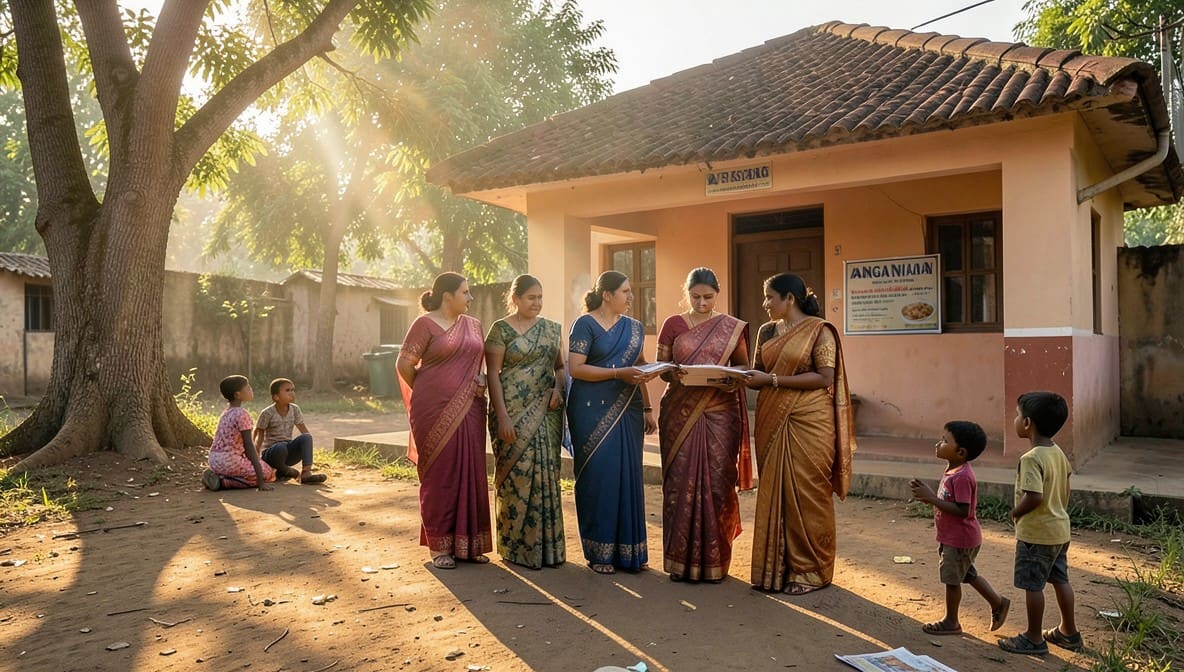
The petitioners, 10 Anganwadi Workers (AWWs) and Anganwadi Helpers (AWHs), were engaged between 2007 and 2010 under the Integrated Child Development Services (ICDS) Scheme in the Damcherra ICDS Project, North Tripura. They served in Anganwadi centres located in the Khakchang Para Bru Camp, serving the Reang migrant community. Their appointments were made through a uniform selection process governed by the State’s 2019 Guidelines, which required public advertisement, interview by a statutory selection board, and eligibility criteria including residency, education, and age.
Key Facts
- All petitioners were selected through the State’s standardized procedure under Notification No.F:1(1-21)-ICDS/SWE/2018/5271(100) dated 17.01.2019.
- The petitioners had been continuously serving for 12 to 18 years without interruption.
- On 28.12.2022, the Child Development Project Officer (CDPO) issued a memorandum stating that the Bru Camp had been shifted from Khakchang Para to Khahamthai Para in late November 2022.
- All Anganwadi centres in Khakchang Para were closed and locked; equipment and utensils were moved.
- The CDPO directed that the honorarium of all petitioners be stopped from December 2022 until further orders.
- No formal termination order was issued; the petitioners were neither re-engaged nor provided alternative postings.
- The State did not appoint new workers at the new location; instead, it left the positions vacant.
- The petitioners were prevented from discharging duties not due to any fault of their own, but due to administrative inaction.
- The State Government had issued a scheme setting the superannuation age for AWWs and AWHs at 60 years.
Procedural History
- 28.12.2022: Honorarium stopped by CDPO order.
- 2023: Petitioners filed Writ Petitions (WP(C) No.550 of 2024 and WP(C) No.518 of 2025) before the Tripura High Court.
- 24.07.2025: Single Judge held that withholding honorarium was improper but directed only 50% payment from December 2022 to July 2025, and directed the Director to decide the petitioners’ fate within 15 days.
- 10.09.2025: Single Judge followed the same reasoning in WP(C) No.518 of 2025.
- 2025: State filed Writ Appeals W.A. No.101 of 2025 and W.A. No.114 of 2025.
- 2026: Petitioners filed W.A. No.16 of 2026 challenging the partial relief granted.
- 30.03.2026: Oral arguments heard.
- 29.04.2026: Judgment delivered.
The Parties' Positions
For the State
- Argued that petitioners were engaged on a contingent basis, tied to the existence of the Bru Camp.
- Relied on engagement letters stating service would end when migrants moved.
- Claimed the principle of "No work, no pay" applied since petitioners did not render services after December 2022.
- Contended that Anganwadi centres are separate establishments and not part of a unified statutory structure.
- Asserted that financial constraints justified non-payment.
For the Petitioners
- Relied on Maniben Maganbhai Bhariya v. Distt. Development Officer, Dahod (2022) 16 SCC 343 and State of Tripura v. Smt. Bina Rani Paul (W.A. No.83 of 2024).
- Argued that AWWs and AWHs hold statutory posts under the National Food Security Act, 2013.
- Contended that the "contingent" nature of engagement was rendered invalid post-NFSA 2013.
- Stated that relocation of the centre does not terminate employment; re-engagement at the new location was mandatory.
- Invoked Article 14, arguing that arbitrary termination violated equality.
- Highlighted that the State itself recognized their service through pension schemes and uniform recruitment.
Relief Sought
The petitioners sought:
- Immediate re-engagement at the new Anganwadi centre in Khahamthai Para.
- Full payment of honorarium from December 2022 until re-engagement.
- Declaration that their posts are statutory and cannot be terminated without cause.
- Setting aside of the Single Judge’s order granting only 50% honorarium.
The Legal Issue
The central questions were: (1) Whether Anganwadi Workers and Helpers hold statutory posts under the National Food Security Act, 2013? (2) Can their engagement be terminated due to relocation of the Anganwadi centre? (3) Is the State bound to pay full honorarium when non-performance is caused by its own administrative inaction?
Arguments Presented
For the Appellant/Petitioner
The petitioners relied on Maniben’s case, where the Supreme Court held that AWWs and AWHs perform statutory duties under the National Food Security Act, 2013, and their posts are no longer temporary or contingent. The Court in Maniben declared that honorarium is in fact a wage, and Anganwadi centres are an extended arm of the State. The Tripura High Court in Bina Rani Paul applied this to Tripura, rejecting the notion that each centre is a separate entity. The petitioners argued that the engagement letters containing "as long as migrants stay" clauses were unconscionable under Central Inland Water Transport Corpn. v. Brojo Nath Ganguly, given the vast inequality in bargaining power. They emphasized that the State’s own pension scheme for AWWs/AWHs recognized their service as continuous and long-term.
For the Respondent/State
The State contended that the petitioners were hired under a welfare scheme, not as permanent employees. It cited the engagement letters as binding contracts limiting service to the duration of the Bru Camp. It argued that since no work was performed after December 2022, no honorarium was due. It claimed that the State’s financial burden would be excessive if required to pay back wages and re-engage workers. It further argued that the Single Judge’s 50% payment order was a reasonable compromise.
The Court's Analysis
The Court undertook a comprehensive analysis of the statutory framework under the National Food Security Act, 2013, and its implications for the status of Anganwadi Workers and Helpers. It emphasized that Section 4 and Section 6 of the Act impose a statutory obligation on the State to provide supplementary nutrition to pregnant women, lactating mothers, and children under six years. These obligations are discharged through Anganwadi Centres, which the Supreme Court in Maniben’s case explicitly recognized as statutory institutions.
"Anganwadi centres have become an extended arm of the Government in view of the enactment of the 2013 Act and the Rules framed by the Government of Gujarat. The Anganwadi centres have been established to give effect to the obligations of the State defined under Article 47 of the Constitution. It can be safely said that the posts of AWWs and AWHs are statutory posts."
The Court held that the State’s attempt to classify AWWs and AWHs as "contingent" or "temporary" employees was legally unsustainable after the enactment of the NFSA 2013. The uniform selection process, governed by the 2019 Guidelines, involved statutory bodies (Block Development Officers, Medical Officers, CDPOs), further confirming the institutional nature of their roles.
The Court rejected the State’s reliance on the "No work, no pay" principle, noting that the petitioners were not voluntarily absent but were prevented from working by the State’s closure of centres without providing alternative postings. The Court invoked the doctrine of unconscionable contracts from Central Inland Water Transport Corpn., holding that clauses allowing unilateral termination without cause, especially where the worker has no bargaining power, are void.
The Court also dismissed the State’s financial hardship argument, stating that the State cannot evade statutory obligations on grounds of fiscal policy. The State’s own pension scheme for AWWs/AWHs demonstrated its recognition of their long-term service.
The Court further held that the relocation of the Bru Camp to Khahamthai Para did not extinguish the need for Anganwadi services; the ICDS Project continued in the same area. Therefore, the State had a duty to re-engage the petitioners at the new location.
The Verdict
The petitioners succeeded. The Tripura High Court allowed W.A. No.16 of 2026 and dismissed W.A. No.101 of 2025 and W.A. No.114 of 2025. The Court modified the Single Judge’s order and directed: (i) the State to re-engage the petitioners at the Khahamthai Para Bru Camp or any other Anganwadi centre under the Damcherra ICDS Project within four weeks; and (ii) the State to pay full honorarium to the petitioners from December 2022 until their re-engagement, within eight weeks. No costs were awarded.
What This Means For Similar Cases
Statutory Posts Cannot Be Terminated Arbitrarily
- Practitioners must now treat AWWs and AWHs as statutory employees under the NFSA 2013, not temporary workers.
- Any termination or non-renewal based on relocation, budget cuts, or administrative convenience is void.
- Courts will strike down engagement clauses that purport to make service contingent on the existence of a specific community or camp.
Full Honorarium Due During Forced Non-Performance
- If the State prevents an AWW/AWH from working (e.g., by closing a centre without providing an alternative), the "No work, no pay" principle does not apply.
- Full honorarium must be paid for the entire period of non-performance caused by State inaction.
- This applies even if the worker is not physically present at the original location.
Uniform Recruitment = Uniform Status
-
The existence of a standardized, transparent selection process across all Anganwadi centres confirms their integration into a unified statutory framework.
-
State governments cannot claim that each centre is a separate entity to avoid statutory obligations like gratuity, pension, or continuity of service.
-
Any attempt to count employees centre-wise to evade the Payment of Gratuity Act, 1972, is legally untenable.
-
Practitioners representing AWWs/AWHs should now cite Maniben’s case and Bina Rani Paul as binding precedent in all States.
-
Writ petitions challenging non-payment or non-reengagement should be filed under Article 226, invoking Article 14 and statutory rights under NFSA 2013.
-
State departments must revise engagement letters to remove "temporary" or "contingent" language.