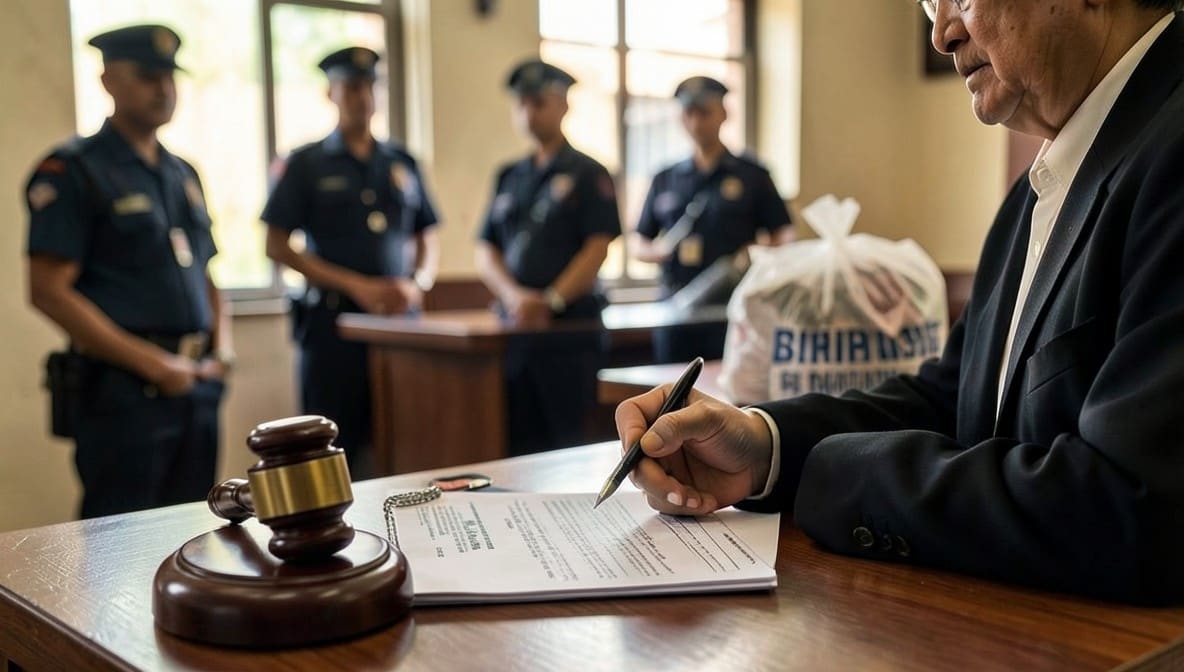
The Uttarakhand High Court has granted bail in a narcotics case after identifying critical procedural failures in the prosecution’s recovery process, reinforcing that compliance with mandatory safeguards under the Narcotics Drugs and Psychotropic Substances Act is not optional but foundational to the validity of any charge. The judgment underscores that unexplained anomalies in police documentation can undermine the entire prosecution narrative, even without a final determination on guilt.
Background & Facts
The Dispute
The applicant, Aklakh, is in judicial custody in connection with FIR Crime No. 315 of 2025, registered at Police Station Kiccha, District Udham Singh Nagar, under Sections 8 and 22 of the Narcotic Drugs and Psychotropic Substances Act, 1985 (NDPS Act). The prosecution alleges that on 25.09.2025, during a routine check, police recovered 300 tablets of Buprenorphine and Naloxone Sublingual Tablets (IP Vernor-N) and 20 Diazepam injections from his possession. The FIR was lodged on the same day.
Key Facts
- The applicant was apprehended at approximately 19:20 hours on 25.09.2025.
- The FIR was registered at 22:08 hours on the same day, nearly three hours later.
- The arrest memo and inventory report, allegedly prepared at the spot prior to FIR registration, bear the FIR number (315/2025).
- No independent public witness was present during the alleged recovery, despite the location being described as a public place.
- No inventory of the seized contraband was prepared as required under Section 52-A of the NDPS Act.
- No sample of the seized drugs was drawn and certified before a competent Magistrate as mandated by law.
- The mandatory safeguards under Section 50 of the NDPS Act, requiring prior notice to the accused of their right to be searched in the presence of a gazetted officer or magistrate, were not followed.
- The applicant has no prior criminal record and is a permanent resident of Udham Singh Nagar.
- The applicant has been in custody since 26.09.2025.
Procedural History
- 25.09.2025: Alleged recovery and apprehension of applicant.
- 25.09.2025: FIR Crime No. 315/2025 registered at 22:08 hours.
- 26.09.2025: Applicant taken into judicial custody.
- 06.04.2026: Bail application filed before the Uttarakhand High Court.
- 06.04.2026: Court directed State counsel to produce G.D. entry explaining the presence of FIR number on pre-FIR documents.
- 06.04.2026: State counsel conceded no G.D. entry exists to explain the anomaly.
The Parties' Positions
For the Applicant
- The recovery is fabricated and planted.
- Sections 50 and 52-A of the NDPS Act were violated: no prior notice of search, no inventory, no sample certification.
- The arrest memo and inventory report bear the FIR number despite being allegedly prepared before the FIR was registered, indicating fabrication.
- No independent witness was present during recovery.
- The applicant is a first-time offender with no risk of absconding or tampering with evidence.
- Prolonged incarceration serves no purpose given the likely lengthy trial.
For the Respondent/State
- The recovery was lawful and conducted in accordance with the NDPS Act.
- The presence of the FIR number on pre-FIR documents is an administrative oversight, not evidence of fabrication.
- No G.D. entry exists to explain the anomaly, but this does not invalidate the recovery.
- The seriousness of the offence under Sections 8 and 22 of the NDPS Act militates against bail.
Relief Sought
The applicant seeks release on bail pending trial, with conditions to ensure cooperation with investigation and prevent abuse of liberty.
The Legal Issue
The central question was whether the failure to comply with mandatory procedural safeguards under Sections 50 and 52-A of the NDPS Act, coupled with an unexplained discrepancy in the timing and documentation of the arrest memo and inventory report, raises sufficient doubt about the prosecution’s version to warrant the grant of bail.
Arguments Presented
For the Applicant
The applicant’s counsel relied on State of Punjab v. Baldev Singh and Kunwar Singh v. State of U.P. to argue that non-compliance with Sections 50 and 52-A renders the recovery inadmissible and casts serious doubt on the prosecution’s case. The presence of the FIR number on documents allegedly prepared before the FIR was registered is not a clerical error but evidence of a fabricated sequence of events. The absence of an independent witness and the lack of a G.D. entry further erode the credibility of the prosecution’s narrative. The applicant’s clean record and local residence negate any risk of flight.
For the Respondent/State
The State counsel contended that the recovery was lawful and that minor procedural lapses do not automatically entitle the accused to bail. While conceding the absence of a G.D. entry, the State argued that the drugs were recovered in a public place and the accused was apprehended in possession of contraband. The gravity of the offence under the NDPS Act, they submitted, justifies continued custody pending trial.
The Court's Analysis
The Court did not evaluate the truth of the allegations but focused on the integrity of the prosecution’s documentation. It noted that the arrest memo and inventory report, which are foundational to establishing the chain of custody and legality of seizure, bear the FIR number despite being claimed to have been prepared prior to the registration of the FIR. This chronological impossibility cannot be reconciled with ordinary police procedure.
"The arrest memo and inventory report allegedly prepared at the spot bear the F.I.R. number, even though the F.I.R. is stated to have been lodged subsequently. The prosecution has not been able to explain this discrepancy by producing any corresponding G.D. entry, which raises a doubt regarding the sequence of events as projected by the prosecution."
The Court emphasized that Sections 50 and 52-A of the NDPS Act are not mere formalities but statutory safeguards designed to prevent abuse and ensure evidentiary integrity. The failure to comply with these provisions, especially in the absence of any explanation, creates a reasonable doubt about the authenticity of the recovery. The Court further noted that the State’s concession on the non-existence of a G.D. entry was fatal to its case. In light of these material irregularities, the Court held that the applicant has made out a case for bail, even in a serious drug offence, because the prosecution’s version is not credible on its own record.
The Verdict
The applicant succeeded. The Court granted bail on the following conditions: (a) execution of a personal bond with two reliable sureties in the same amount to the satisfaction of the trial court; (b) no travel abroad without prior court permission; (c) cooperation with the investigation as required; (d) no tampering with evidence or witnesses; (e) surrender of passport, if any. The bail is liable to be cancelled upon violation of any condition.
What This Means For Similar Cases
Procedural Compliance Is Non-Negotiable in NDPS Cases
- Practitioners must challenge the admissibility of recovery in any NDPS case where Sections 50 or 52-A are violated, regardless of the quantity of contraband.
- Courts will not overlook discrepancies in arrest memo, inventory, or sample certification - even if the accused is found with drugs.
- The burden is on the prosecution to explain anomalies; silence or vague assertions are insufficient.
Documentary Inconsistencies Can Defeat Prosecution Narrative
- If documents bear dates or references inconsistent with the prosecution’s timeline (e.g., FIR number on pre-FIR reports), the court may treat this as indicative of fabrication.
- The absence of a G.D. entry to explain such inconsistencies is a decisive factor in bail decisions.
- Independent witnesses are not optional; their absence in public place recoveries weakens the prosecution’s credibility.
Bail Is Not Denied Solely on Gravity of Offence
- Even in serious NDPS cases, bail may be granted if procedural violations create reasonable doubt.
- The Court’s focus was not on the nature of the drugs but on the integrity of the process.
- First-time offenders with local ties and no flight risk are entitled to bail when the prosecution’s case is undermined by its own records.