The Punjab and Haryana High Court has clarified that mere possession of a non-commercial quantity of narcotics, coupled with a confessional statement of uncertain veracity, cannot justify denial of regular bail under Section 37 of the NDPS Act. The judgment underscores that pre-trial detention must be justified by concrete risk factors, not speculative allegations.
Background & Facts
The Dispute
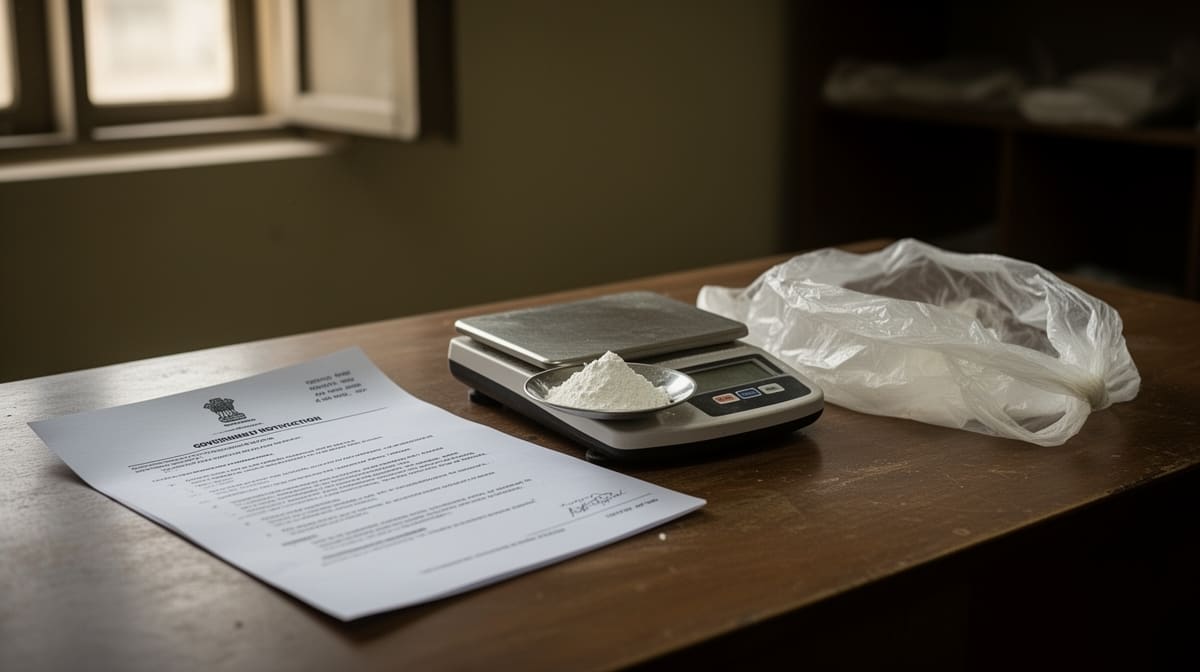
The petitioner, Karanjot Singh alias Kichi alias Ghichu, was arrested on 23.12.2025 in connection with FIR No.71 dated 23.12.2025 registered at Police Station Mattewal, District Amritsar, under Sections 21, 27-A, 29, 61, and 85 of the Narcotic Drugs and Psychotropic Substances Act, 1985. The prosecution alleges that 14 grams of heroin and ₹1000/- were recovered from him at Tahli Sahib near Village Mattewal. The recovery of ₹1000/- is designated as "drug money" solely on the basis of the petitioner’s alleged confessional statement.
Key Facts
- The quantity of heroin recovered - 14 grams - is below the threshold for commercial quantity under the NDPS Act.
- The prosecution has not produced independent corroboration for the claim that ₹1000/- constitutes drug money.
- The petitioner has been in custody since 23.12.2025.
- As of 16.04.2026, the petitioner had undergone 3 months and 23 days of incarceration.
- The custody certificate filed by the State indicates the petitioner is also涉案 in one other FIR, but no details of that case are disclosed in the judgment.
- The petitioner has no prior criminal record in the present case.
- No evidence suggests the petitioner is likely to abscond or tamper with evidence.
Procedural History
- 23.12.2025: Arrest of petitioner; FIR registered.
- 16.04.2026: Custody certificate submitted to court by the State.
- 17.04.2026: Petition under Section 483 of the Bharatiya Nagarik Suraksha Sanhita, 2023, filed for regular bail.
Relief Sought
The petitioner sought regular bail on the grounds that the quantity of contraband is non-commercial, the basis for invoking Section 37 is unsubstantiated, and there is no risk of flight or evidence tampering.
The Legal Issue
The central question was whether the invocation of Section 37 of the NDPS Act - which imposes stringent bail conditions - is justified when the contraband recovered is non-commercial in quantity and the only basis for treating cash as "drug money" is an uncorroborated confessional statement.
Arguments Presented
For the Petitioner
Learned counsel argued that 14 grams of heroin is not a commercial quantity under the NDPS Act, and therefore Section 37 should not apply. The recovery of ₹1000/- as "drug money" was asserted to be a speculative inference drawn solely from the petitioner’s confession, the admissibility and truth of which remain to be tested at trial. Counsel emphasized the petitioner’s prolonged custody of over three months, absence of prior record, and lack of any indication of flight risk or interference with evidence. Reliance was placed on Maulana Mohd. Amir Rashadi v. State of U.P. and Sridhar Das v. State to argue that bail cannot be denied merely because an offence under NDPS is alleged.
For the Respondent
The State contended that the nature of the offence under the NDPS Act is serious and that the presence of ₹1000/- as drug money triggers the rigors of Section 37. Counsel submitted that the custody certificate showed the petitioner’s involvement in another case, suggesting a pattern of criminal conduct. The State argued that bail should be denied to deter drug trafficking and uphold public order.
The Court's Analysis
The Court observed that the quantity of heroin - 14 grams - is clearly non-commercial under the NDPS Act. The designation of ₹1000/- as "drug money" was found to rest entirely on the petitioner’s confessional statement, the veracity of which cannot be presumed at the bail stage. The Court held that such a statement, without corroboration, cannot be the sole foundation for invoking the stringent provisions of Section 37.
"The sole basis of terming the recovery of ₹1000/- as drug money is the confessional statement of the petitioner, veracity of which will be tested during the course of trial."
The Court further noted that the petitioner had already spent over three months in custody and that no tangible material had been presented to suggest he would abscond or obstruct justice. While acknowledging the petitioner’s involvement in another FIR, the Court held that antecedents alone cannot override the specific facts of the case at hand. The Court cited Maulana Mohd. Amir Rashadi v. State of U.P., Sridhar Das v. State, and its own prior decisions in Akhilesh Singh v. State of Haryana and Balraj v. State of Haryana to affirm that bail must be granted where the conditions for denial under Section 37 are not substantiated.
The Court emphasized that bail proceedings are not trials and that the court must avoid prejudging the merits of the case. The absence of any evidence of flight risk or tampering, combined with the non-commercial nature of the contraband, rendered continued incarceration unjustified.
The Verdict
The petition was allowed. The petitioner is ordered to be released on regular bail upon furnishing bail/surety bonds to the satisfaction of the concerned CJM/Duty Magistrate. The petitioner shall remain bound by eight specific conditions, including not tampering with evidence, not absconding, depositing his passport, providing his mobile number to the Investigating Officer, and submitting a monthly affidavit confirming no new offences. The State is mandated to move for cancellation of bail forthwith if the petitioner is found to have committed any offence post-release. The Court directed compliance with these conditions without delay.
What This Means For Similar Cases
Confessional Statements Alone Cannot Trigger Section 37
- Practitioners must challenge the application of Section 37 where cash recovery is based solely on uncorroborated confessions.
- Courts must distinguish between mere possession of small quantities and commercial-scale trafficking.
- The burden shifts to the prosecution to demonstrate objective grounds for invoking stringent bail conditions.
Pre-Trial Custody Duration Is a Material Factor
- Prolonged incarceration without trial weighs heavily in favor of bail, especially in non-commercial NDPS cases.
- Courts should not treat custody duration as a neutral factor - it is a compelling reason to avoid further detention.
- Delay in trial does not justify continued pre-trial detention absent concrete risk.
Antecedents Must Be Contextualized
- Involvement in other cases cannot be a blanket ground for denial of bail in the present matter.
- Each FIR must be evaluated on its own facts; antecedents are relevant but not determinative.
- Courts must avoid cumulative prejudice by conflating unrelated allegations.