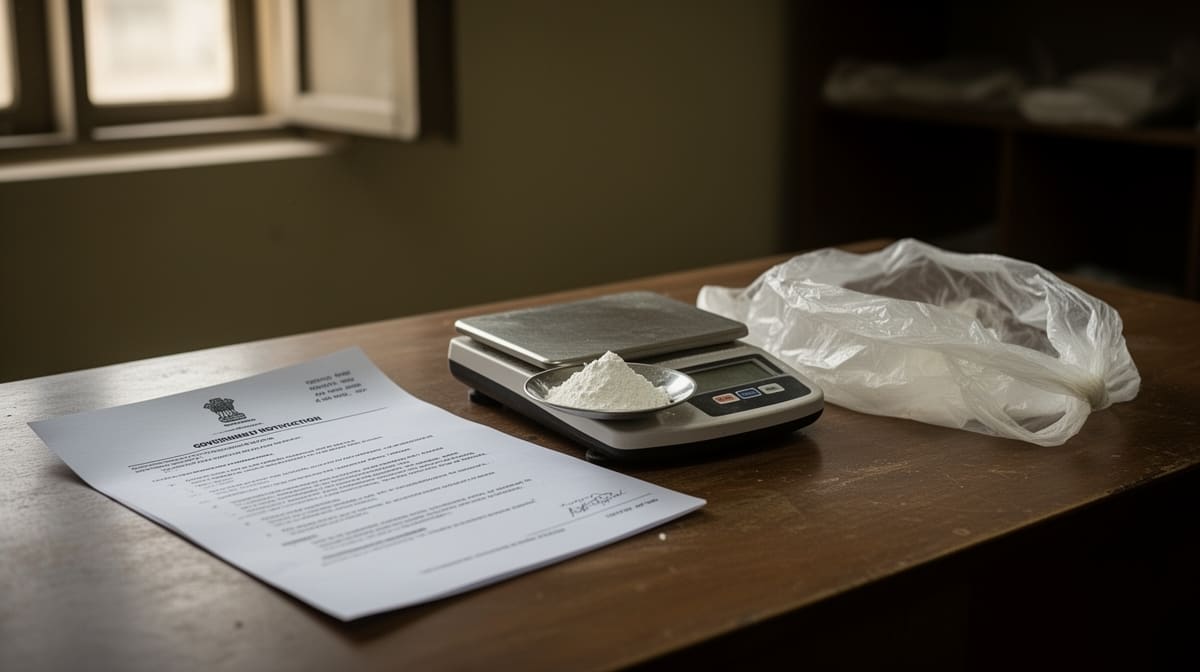
The Himachal Pradesh High Court has significantly clarified the application of proportionality in sentencing under the NDPS Act, suspending a four-year imprisonment term for possession of 38.5 grams of Nitrazepam. The judgment underscores that sentencing must align with the statutory framework and the scale of the offence, rejecting mechanical imposition of maximum penalties for minor quantities.
Background & Facts
The Dispute
The appellants, Balwant Singh and another, were convicted by the Special Judge, Rohru, District Shimla, under Section 22 read with Section 29 of the Narcotic Drugs and Psychotropic Substances (NDPS) Act, 1985, for possession of 38.5 grams of Nitrazepam. They were sentenced to four years’ rigorous imprisonment, a fine of ₹20,000, and in default of payment, one year’s simple imprisonment. The appellants filed an appeal against the conviction and sentence, and simultaneously applied for suspension of sentence pending disposal of the appeal.
Key Facts
- 70 tablets of Nitrazepam, each containing 10 mg (totaling 700 mg or 0.7 grams), were recovered from the exclusive and conscious possession of the appellants
- The prosecution established possession beyond reasonable doubt
- The total quantity of Nitrazepam recovered was 38.5 grams (equivalent to 3,850 mg)
- The Central Government has notified 500 grams of Nitrazepam as the "commercial quantity" under the NDPS Act
- The appellants have been in custody since conviction, having undergone four months of imprisonment as of 21.03.2026
- Applicant No. 1 suffers from joint problems and is undergoing regular treatment at Indira Gandhi Medical College, Shimla, and a hospital in Solan
Procedural History
- 20.11.2025: Conviction and sentencing by Special Judge, Rohru, District Shimla
- 2026: Appeal filed before the High Court of Himachal Pradesh as Cr. Appeal (C-SB) No. 56 of 2026
- 21.03.2026: Appellants had served four months of the four-year sentence
- 07.04.2026: Application for suspension of sentence reserved for orders
- 01.06.2026: Judgment delivered by Justice Rakesh Kainthla
The Parties' Positions
Appellants: Argued that the sentence is grossly disproportionate to the quantity involved, especially given that 500 grams is the threshold for a 10-year minimum sentence. They submitted that they have a strong case for acquittal and are suffering from medical conditions requiring ongoing care. They relied on Rajesh Kumar v. State (Govt. of NCT), Delhi.
Respondent/State: Opposed the application, asserting that drug offences harm society, the prosecution case was proven beyond reasonable doubt, and there was no material to suggest likelihood of acquittal. The State contended that suspension should not be granted in NDPS cases involving conscious possession.
Relief Sought
The appellants sought suspension of the substantive sentence of imprisonment pending disposal of their appeal, subject to conditions such as deposit of fine and furnishing of bonds.
The Legal Issue
Whether the imposition of a four-year imprisonment term for possession of 38.5 grams of Nitrazepam, where 500 grams is the statutory commercial quantity, violates the principle of proportionality, and whether suspension of sentence is warranted pending appeal.
Arguments Presented
For the Appellant
Counsel relied on the principle of proportionality in sentencing, arguing that a sentence of four years for less than 8% of the commercial quantity (38.5g out of 500g) is manifestly excessive. She cited Rajesh Kumar v. State (Govt. of NCT), Delhi, where the Delhi High Court suspended a sentence for possession of a small quantity of drugs, emphasizing that sentencing must reflect the scale of the offence. She highlighted the appellants’ medical condition and the likelihood of delay in hearing the appeal, which would result in undue incarceration.
For the Respondent
The Deputy Advocate General contended that possession of any quantity of a controlled substance under the NDPS Act is a serious offence against public order and health. He argued that the conviction was based on solid evidence of exclusive possession and that the court should not interfere with the trial court’s sentencing discretion. He maintained that suspension of sentence in NDPS cases is generally not warranted unless exceptional circumstances are shown.
The Court's Analysis
The Court undertook a detailed analysis of the statutory framework under the NDPS Act, particularly the distinction between "small quantity" and "commercial quantity". It noted that while Section 22 prescribes punishment for possession, the quantum of punishment must be guided by proportionality, especially where the quantity involved is far below the threshold for enhanced punishment.
"Applying the principle of proportionality, a person possessing 38.5 grams could not have been prima facie sentenced to undergo imprisonment for four years."
The Court observed that 38.5 grams constitutes less than 8% of the notified commercial quantity of 500 grams. It further noted that the appellants had already served four months of a four-year sentence, meaning they had endured a substantial portion of the punishment that, on a proportional scale, might reasonably be imposed for such a quantity. The Court held that continuing incarceration pending appeal would amount to punitive excess, particularly where the appeal raises a substantial question of law regarding sentencing.
The Court also considered the medical condition of Applicant No. 1, not as a decisive factor, but as a corroborative element supporting humanitarian grounds for suspension. It emphasized that the appellants had not challenged the conviction itself but the disproportionality of the sentence, and that the appeal had a prima facie merit.
The Court rejected the State’s argument that suspension should be denied in all NDPS cases, holding that blanket denial would violate the principle of individualized justice and the constitutional guarantee against arbitrary punishment.
The Verdict
The application is allowed. The substantive sentence of four years’ imprisonment is suspended subject to the appellants depositing the fine of ₹20,000 and furnishing personal bonds of ₹25,000 each with one surety in the like amount, to the satisfaction of the Trial Court, within one month. The appellants must undertake to appear before the High Court when required and surrender to serve the sentence if the appeal is dismissed. A copy of this order may be produced from the High Court’s website, and authorities shall not insist on a certified copy. The Trial Court is directed to transmit the bonds to the High Court for record.
What This Means For Similar Cases
Proportionality Overrides Mechanical Sentencing
- Practitioners must now argue that sentences under the NDPS Act must be calibrated to the quantity possessed, not merely the fact of possession
- Possession of less than 10% of the commercial quantity should trigger a presumption against maximum or near-maximum sentences
- Courts must conduct a proportionality assessment before imposing imprisonment exceeding two years for non-commercial quantities
Suspension of Sentence Is Not Barred in NDPS Cases
- Suspension pending appeal is permissible where the sentence appears disproportionate and the appeal raises a substantial question of law
- Medical condition, though not determinative, may support humanitarian grounds for suspension
- The burden shifts to the State to justify why suspension should be denied when the sentence is prima facie excessive
Website-Generated Orders Are Legally Valid for Practical Purposes
- Certified copies are not mandatory for compliance with bail or suspension orders if a downloadable copy from the High Court website is produced
- Authorities must accept digital copies unless verification is specifically required
- This reduces procedural delays and administrative burdens on appellants