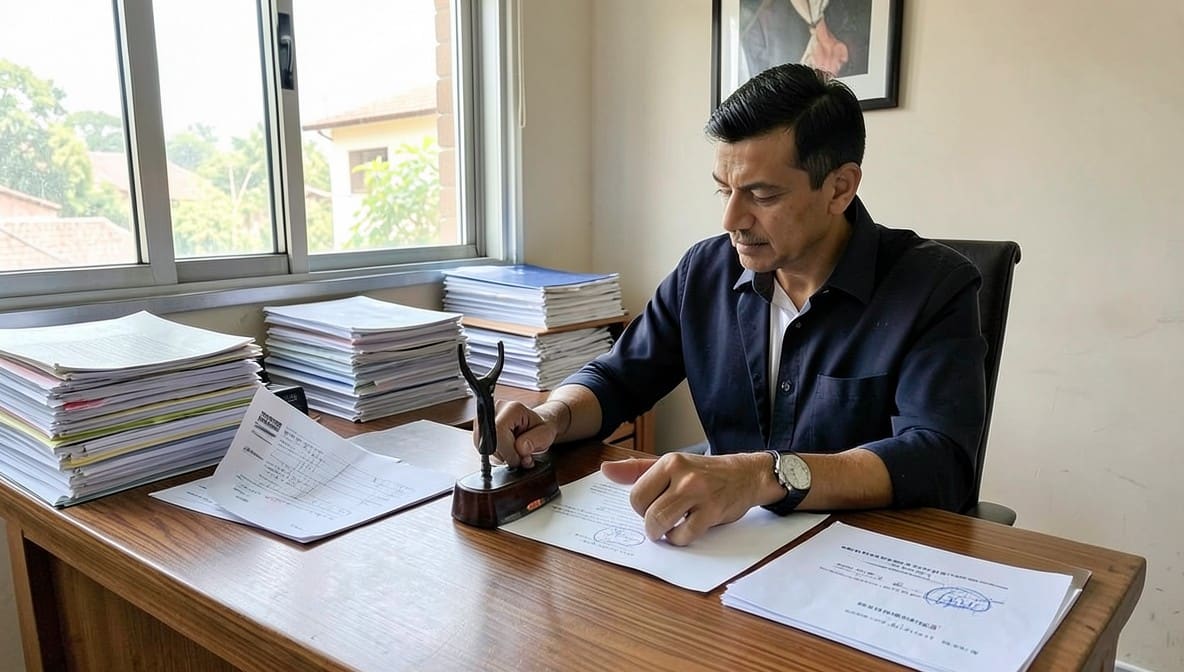
The Madhya Pradesh High Court has reaffirmed a foundational principle of administrative law: no public official may be removed from a position of responsibility without being afforded a fair opportunity to respond to allegations. This judgment in Dr. Vandana Tiwari v. State of Madhya Pradesh reinforces that procedural fairness is not a formality but a constitutional imperative, especially in public education administration.
Background & Facts
The Dispute
The petitioner, Dr. Vandana Tiwari, was serving as an Observer in an examination conducted by the State Education Department. Her duties included monitoring school functioning and reporting on administrative compliance. On 24.02.2026, she was assigned to observe a school, with her official duties continuing at her parent school until 07.03.2026. An inspection was conducted on 09.03.2026 by the District Education Officer, who found alleged irregularities in school management.
Key Facts
- Dr. Vandana Tiwari was appointed as Observer on 24.02.2026
- Her regular posting remained at her parent school until 07.03.2026
- Inspection report dated 09.03.2026 alleged lack of control over school staff and poor attendance
- The District Education Officer concluded that Dr. Tiwari was responsible for the irregularities
- On the same day, 09.03.2026, she was removed from charge and replaced by Teacher Vivek Soni
- No prior notice, inquiry, or opportunity to explain was provided to Dr. Tiwari
- The respondent did not produce any document establishing that Vivek Soni was junior to Dr. Tiwari
Procedural History
- 24.02.2026: Petitioner appointed as Observer for examination
- 07.03.2026: Completion of regular duties at parent school
- 09.03.2026: Inspection conducted; adverse findings recorded; petitioner removed from charge without notice
- 09.03.2026: Impugned order (Annexure P/4) passed removing petitioner and assigning charge to Vivek Soni
- 15.03.2026: Petitioner filed this writ petition under Article 226 of the Constitution
- 05.05.2026: Hearing before the High Court at Jabalpur
The Parties' Positions
Petitioner: Argued that removal from charge without a show cause notice violated the principles of natural justice, particularly the rule audi alteram partem. She contended that the allegations were serious and could impact her service record, and that the transfer to a junior officer was arbitrary.
Respondent: Submitted that irregularities were evident from the inspection report and immediate action was necessary for the sake of school administration. No documents were filed to substantiate the juniority of Vivek Soni.
Relief Sought
The petitioner sought quashing of the order dated 09.03.2026, restoration of her charge, and a direction to issue a show cause notice before any further action.
The Legal Issue
The central question was whether the principles of natural justice require a show cause notice and opportunity of hearing before removing a public servant from charge based on an inspection report, even if the action is temporary or administrative in nature.
Arguments Presented
For the Petitioner
The petitioner relied on the doctrine of audi alteram partem as an essential component of Article 14 and Article 21 of the Constitution. She cited State of U.P. v. Mohd. Noor and A.K. Kraipak v. Union of India to argue that even temporary administrative actions affecting reputation or service prospects require fair procedure. She emphasized that removal from charge, even if not a formal punishment, carries stigma and impacts career progression.
For the Respondent
The State contended that the action was taken in the public interest to ensure smooth functioning of the school. It argued that the inspection report revealed clear lapses and immediate replacement was justified. No legal obligation to issue a show cause notice was asserted, and no evidence was produced to substantiate the juniority claim.
The Court's Analysis
The Court examined the nature of the impugned order and its consequences. It noted that removal from charge, though not a formal dismissal, is a significant administrative action that affects the dignity and professional standing of the officer. The Court held that natural justice is not confined to punitive proceedings but extends to any decision that adversely affects rights or interests.
"Before removing petitioner from charge and handing over the same to his junior on basis of irregularities, petitioner ought to have been given a show cause notice and after receiving reply, respondents could have taken action, if they are not satisfied with reply."
The Court rejected the State’s argument that urgency justified bypassing procedural safeguards. It emphasized that administrative expediency cannot override constitutional norms. The fact that the successor was allegedly junior further heightened the arbitrariness of the action, especially in the absence of any documentation.
The Court distinguished this from purely operational transfers, noting that the allegations here were of negligence and mismanagement - matters that directly implicate personal responsibility and merit a fair hearing.
The Verdict
The impugned order dated 09.03.2026 is quashed. The State is directed to issue a show cause notice to Dr. Vandana Tiwari based on the inspection report dated 09.03.2026. After receiving her reply, the authorities may pass a fresh order after due consideration. The petitioner shall be restored to her charge pending such fresh order. No costs are awarded.
What This Means For Similar Cases
Show Cause Notice Is Non-Negotiable in Administrative Actions
- Practitioners must now argue that any adverse administrative action - even temporary removal from charge - requires prior notice and hearing
- This applies to teachers, inspectors, health officers, and other public functionaries
- The burden is on the authority to prove urgency justifies bypassing natural justice
Stigma and Reputation Are Protected Under Article 21
- Removal from charge is not merely procedural; it carries reputational consequences
- Courts will treat such actions as potential violations of right to reputation under Article 21
- Even if no formal punishment follows, the stigma alone triggers procedural safeguards
Documentation Must Support Allegations and Transfers
- Authorities must maintain and produce records to substantiate claims of seniority/juniority
- Unsubstantiated assertions in court will not be accepted
- Administrative decisions must be supported by documentary evidence, not oral submissions