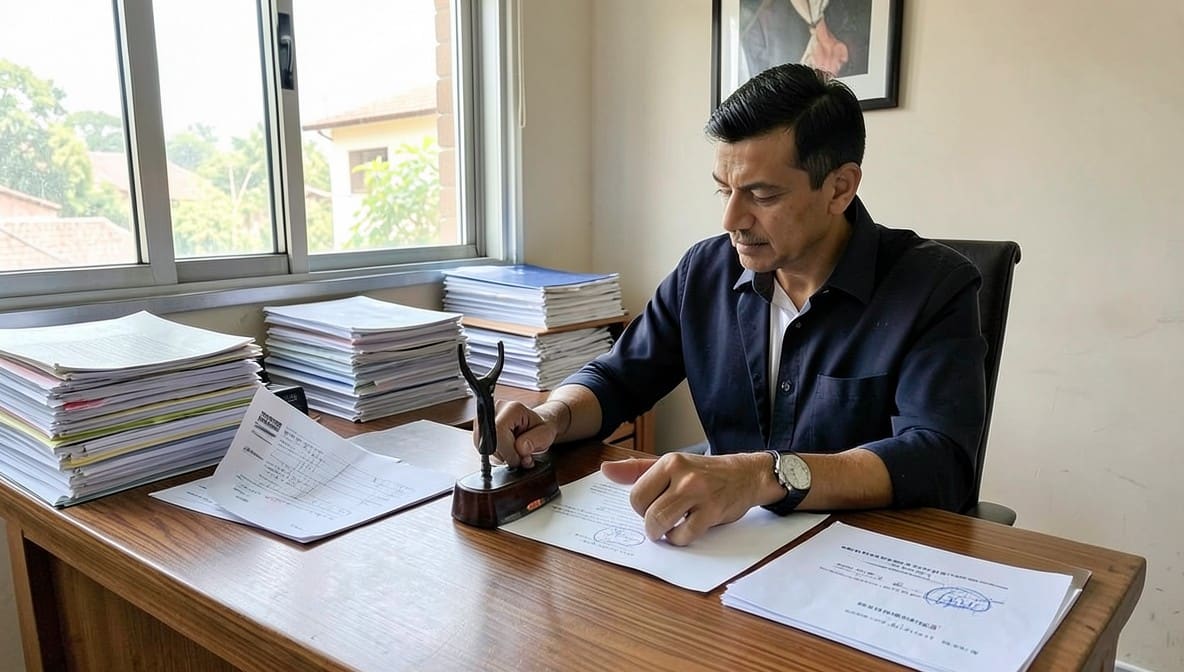
The Karnataka High Court has reaffirmed that a show cause notice issued under administrative discipline is not a final order but a procedural step to afford an opportunity of hearing. Dismissing a writ petition seeking to quash such a notice, the Court emphasized that premature interference undermines the foundational principle of natural justice.
Background & Facts
The Dispute
The petitioner, Nanda Kumara M.R., a Child Development Project Officer (CDPO) posted at Hangal, Udupi district, was issued a show cause notice dated 10.03.2026 (Annexure-A21) by the Department of Women and Child Development, alleging misappropriation of approximately 9,590 kilograms of milk powder. The notice was issued within 20 days of the petitioner assuming charge on 16.07.2024. The allegations were based on reports referenced in Annexures 1 to 4, which included media clippings and internal audit summaries. The petitioner challenged the notice before the Karnataka State Administrative Tribunal (KSAT), Belagavi, seeking stay. The Tribunal issued notice to the respondents but did not grant interim relief. The petitioner then filed this writ petition under Articles 226 and 227 of the Constitution.
Key Facts
- The petitioner assumed charge as CDPO, Hangal, on 16.07.2024
- Show cause notice dated 10.03.2026 was issued less than eight months after assuming charge
- Alleged misappropriation involved 9,590 kg of milk powder over a period of approximately 20 days
- Annexures to the notice included newspaper reports and internal documents, none of which were verified or cross-examined
- The notice granted 15 days to submit a written response
- No departmental inquiry had been initiated at the time of filing the writ petition
- The petitioner had not yet filed any reply to the show cause notice
Procedural History
- 16.07.2024: Petitioner assumed charge as CDPO, Hangal
- 10.03.2026: Show cause notice (No. MA.MA.E.154 SJD 2025(BHA-1)) issued by the First Respondent
- 15.03.2026: Petitioner filed Application No.10498/2026 before KSAT, Belagavi, seeking stay of the show cause notice
- 27.04.2026: KSAT issued notice to respondents but declined interim stay
- 15.05.2026: Writ Petition No.104393/2026 filed before Karnataka High Court, Dharwad Bench
- 26.05.2026: Hearing before Division Bench of Justices Anant Ramanath Hegde and Geetha K.B.
The Parties' Positions
For the Petitioner
- Argued that the show cause notice was mala fide and pre-judged guilt, citing the implausibility of misappropriating nearly 10,000 kg of milk powder in 20 days
- Contended that the notice was based solely on unverified newspaper reports without any independent inquiry
- Relied on Oryx Fisheries Private Limited v. Union of India (2010) 13 SCC 427 to argue that the notice was so defective that it warranted quashing even at the preliminary stage
- Sought immediate stay of the notice and direction to drop proceedings
For the Respondents
- Maintained that the notice was a preliminary step under service rules to invite explanation
- Stated that no final order had been passed and no inquiry had commenced
- Emphasized that the petitioner retained full rights to respond, present evidence, and challenge allegations in subsequent proceedings
- Argued that judicial intervention at this stage would stifle administrative discipline
Relief Sought
The petitioner sought:
- Quashing of the show cause notice dated 10.03.2026
- Stay of all proceedings arising therefrom
- Direction to the authorities to drop the allegations
- Costs of litigation
The Legal Issue
Can a show cause notice issued under service discipline, prior to any inquiry or final order, be quashed on the grounds that the authority has pre-judged the case or acted on insufficient evidence?
Arguments Presented
For the Petitioner
The petitioner’s counsel contended that the show cause notice was not merely procedural but a prejudicial act that violated the principles of natural justice. He argued that the allegations were absurd on their face - misappropriating nearly 10,000 kg of milk powder in 20 days was logistically impossible. He further submitted that the notice relied exclusively on media reports, indicating a lack of application of mind. He cited Oryx Fisheries, where the Supreme Court quashed a show cause notice and subsequent inquiry because the notice was based on unverified allegations and demonstrated a predetermined outcome. He urged that the same logic applied here.
For the Respondent
The Additional Government Advocate countered that a show cause notice is not a final order but a procedural mechanism to afford the employee an opportunity to explain. He emphasized that no inquiry had been initiated, no charges were framed, and no penalty had been imposed. He argued that the petitioner had not even filed a reply, making any judicial intervention premature. He relied on settled law that courts must not interfere in administrative proceedings at the preliminary stage unless the notice is patently illegal or mala fide.
The Court's Analysis
The Court undertook a careful examination of the nature and purpose of a show cause notice in administrative proceedings. It observed that such notices are not adjudicatory instruments but procedural safeguards designed to ensure fairness. The Court noted that the notice granted the petitioner 15 days to respond and explicitly invited objections.
"The show cause notice is only an invitation to explain; the petitioner is at liberty to respond to the said show cause notice by explaining his position as well as his defence."
The Court distinguished Oryx Fisheries on critical grounds. In that case, the Supreme Court quashed a show cause notice and subsequent inquiry because the notice was issued after a full investigation, the allegations were found to be baseless, and the inquiry process itself was tainted by bias. In contrast, in the present case, no inquiry had been initiated, no evidence had been recorded, and no final order had been passed. The Court held that the petitioner’s reliance on Oryx Fisheries was misplaced because the factual matrix was entirely different.
The Court further observed that the petitioner’s argument regarding the implausibility of the allegations, while potentially relevant at a later stage, could not be grounds for quashing the notice at this preliminary juncture. The Court emphasized that the merits of the allegations must be tested through a proper opportunity to respond, not through judicial speculation.
"In case the petitioner’s explanation is satisfactory, it is for the authority to take further course of action, i.e., to drop the proceedings. In case the explanation is not satisfactory, the authority will have to proceed in accordance with law and the petitioner should be given an opportunity of defending himself by placing all materials at his disposal."
The Court concluded that the Tribunal had correctly declined interim relief and that the writ petition was not maintainable at this stage.
The Verdict
The writ petition was dismissed. The Court held that the show cause notice dated 10.03.2026 shall not be quashed. The petitioner is granted 15 days from the date of this order to file a written response to the notice. The authority shall objectively assess the response and proceed in accordance with law. No opinion is expressed on the merits of the allegations. All contentions are kept open for adjudication in subsequent proceedings.
What This Means For Similar Cases
Show Cause Notices Are Not Final Orders
- Practitioners must not seek quashing of show cause notices merely on grounds of implausibility or media reports
- Courts will not interfere at the pre-inquiry stage unless the notice is facially illegal, mala fide, or violates statutory procedure
- The mere fact that allegations appear improbable does not render the notice void ab initio
Natural Justice Requires Opportunity, Not Prejudgment
- The right to be heard applies at the stage of response, not at the stage of issuance
- Authorities are entitled to initiate proceedings based on prima facie information
- The burden shifts to the employee to rebut allegations through documented evidence and reasoned explanation
Strategic Implications for Service Lawyers
- Always file a detailed, evidence-backed reply to show cause notices within the stipulated time
- Do not rely on judicial intervention to avoid procedural compliance
- Preserve all records of communication, inventory logs, and official orders to substantiate defense
- If the notice is procedurally defective (e.g., no specification of charges, no time to respond), challenge it on those grounds - not on the merits of the allegation