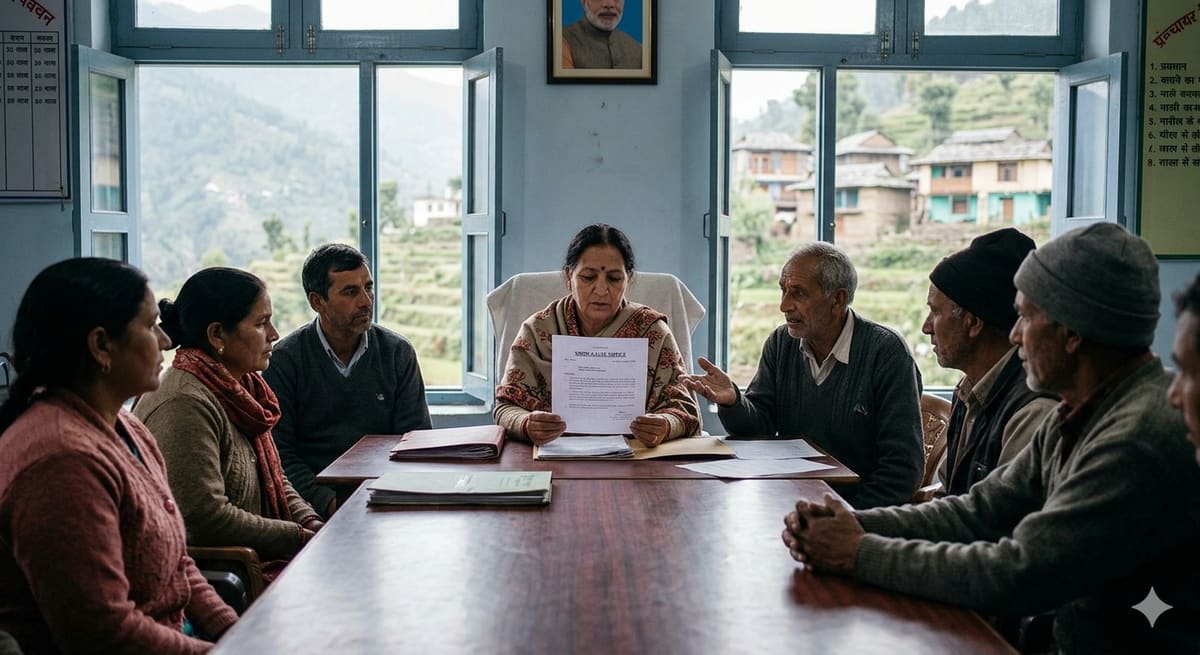
The Himachal Pradesh High Court has reaffirmed that administrative recovery actions against public functionaries must strictly comply with the principles of natural justice. In a decisive ruling, the Court set aside recovery notices issued to a petitioner seeking to contest Panchayat elections, holding that no financial liability can be imposed without prior notice, opportunity to be heard, or fair inquiry.
Background & Facts
The Dispute
The petitioner, Rakesh Kumar, a resident of District Hamirpur, sought to contest upcoming elections to the Panchayati Raj Institutions under the Himachal Pradesh Panchayati Raj Act, 1994. However, he was served with two recovery notices dated 28.04.2026 and 30.04.2026 (Annexures P-2 and P-1 respectively), demanding payment of Rs.1,88,858/- and Rs.5,11,717/- respectively within 15 days. These notices were issued by respondent No.6, the Block Development Officer, Bamsan (Tauni Devi). The petitioner contended that these notices rendered him disqualified under Section 122 of the Himachal Pradesh Panchayati Raj Act, 1994, which bars individuals with outstanding government dues from contesting elections.
Key Facts
The petitioner was not served with any show cause notice prior to issuance of the recovery notices.
No inquiry proceedings were conducted, and the petitioner was not given any opportunity to present his case or submit documents.
The recovery notices were only delivered to the petitioner on 04.05.2026, just days before the Court hearing.
The petitioner had no prior knowledge of any pending dues, audit findings, or departmental proceedings against him.
The recovery amounts were not supported by any order, sanction, or adjudication document.
Procedural History
28.04.2026: Recovery notice issued by Block Development Officer demanding Rs.1,88,858/-
30.04.2026: Second recovery notice issued demanding Rs.5,11,717/-
04.05.2026: Petitioner received both notices and became aware of the financial liability
05.05.2026: Writ Petition (CWP No. 6966/2026) filed before the High Court of Himachal Pradesh
07.05.2026: Court heard the matter in two sessions - morning and afternoon
The Parties' Positions
Petitioner: Argued that the recovery notices were issued in complete violation of the principles of natural justice, particularly audi alteram partem. He emphasized that no prior notice, inquiry, or opportunity to explain was afforded, rendering the notices void ab initio.
Respondents: Initially defended the notices. However, after being directed by the Court to obtain instructions, the Assistant Advocate General conceded that the petitioner’s allegations were correct - no show cause notice had been issued, and no inquiry had been conducted.
Relief Sought
The petitioner sought quashing of the two recovery notices dated 28.04.2026 and 30.04.2026, and a direction to the respondents to refrain from using these notices to disqualify him under Section 122 of the Himachal Pradesh Panchayati Raj Act, 1994.
The Legal Issue
The central question was whether administrative authorities can issue recovery notices imposing financial liability on a public official without issuing a show cause notice or providing an opportunity to be heard, and whether such action violates the principles of natural justice.
Arguments Presented
For the Petitioner
The petitioner’s counsel relied on the foundational doctrine of audi alteram partem and cited State of U.P. v. Mohammad Noor and A.K. Kraipak v. Union of India to argue that even in administrative proceedings, the right to a fair hearing is non-negotiable. He emphasized that the recovery notices were not merely procedural but had direct consequences - disqualification from contesting elections - thereby triggering the application of natural justice. He further contended that the absence of any adjudicatory order or audit report rendered the notices arbitrary and mala fide.
For the Respondent
The respondents initially defended the notices as routine administrative actions. However, upon instruction from respondent No.6, the Assistant Advocate General conceded that the petitioner had not been given any opportunity to respond, no show cause notice had been issued, and no inquiry had been conducted. This concession was pivotal and formed the basis of the Court’s finding.
The Court's Analysis
The Court observed that the issuance of recovery notices carrying the consequence of electoral disqualification is not a mere administrative formality but a quasi-judicial action with serious ramifications. The Court emphasized that the principles of natural justice are not confined to judicial proceedings but extend to any action that affects rights, interests, or privileges of an individual.
"The petitioner was not given any opportunity to explain his position, nor was he associated in any inquiry proceedings. The impugned notices were issued without any prior notice or hearing. This is a clear violation of the principles of natural justice."
The Court noted that the respondents’ concession was not merely an admission of procedural lapse but an acknowledgment of a fundamental breach of constitutional fairness. The Court held that even if the underlying claim of dues were substantively valid, the manner of enforcement - without notice or hearing - rendered the notices legally unsustainable. The Court distinguished between the validity of the claim and the legality of the procedure, holding that the latter cannot be compromised.
The Court further observed that the timing of the notices - issued just days before the petitioner’s intended election filing - raised concerns of mala fide intent to disqualify him politically. While the Court did not explicitly find mala fides, it underscored that procedural fairness must be scrupulously observed, especially when fundamental rights to contest elections are at stake.
The Verdict
The petitioner succeeded. The Court quashed and set aside the recovery notices dated 28.04.2026 and 30.04.2026. The respondents are directed not to rely on these notices for any purpose, including disqualification under Section 122 of the Himachal Pradesh Panchayati Raj Act, 1994. The respondents are at liberty to initiate fresh proceedings in accordance with law, provided they issue a show cause notice, afford a reasonable opportunity of hearing, and conduct a fair inquiry before any recovery is enforced. All pending miscellaneous applications are disposed of.
What This Means For Similar Cases
Procedural Fairness Trumps Administrative Convenience
Practitioners must challenge any recovery notice issued under Panchayati Raj or municipal laws that lacks a show cause notice or hearing opportunity
The burden is on the authority to prove compliance with natural justice - silence or non-response from the affected party does not waive this right
Electoral disqualification under Section 122 cannot be triggered by procedurally defective notices
Recovery Notices Are Not Routine - They Are Quasi-Judicial
Recovery notices that carry consequences like disqualification, suspension, or denial of benefits must follow full procedural safeguards
Authorities cannot rely on internal audit reports or administrative orders alone - the affected person must be heard before enforcement
This judgment applies equally to recovery actions under the HP Municipal Act, HP Cooperative Societies Act, and other local bodies’ statutes
Political Disqualification Must Be Based on Lawful Process
Any attempt to use financial recovery notices as a tool to bar political participation will be struck down if procedural norms are violated
Courts will scrutinize timing, intent, and lack of due process when recovery notices coincide with election timelines
Petitioners in similar cases may now invoke this judgment to seek immediate stay or quashing of notices issued without notice