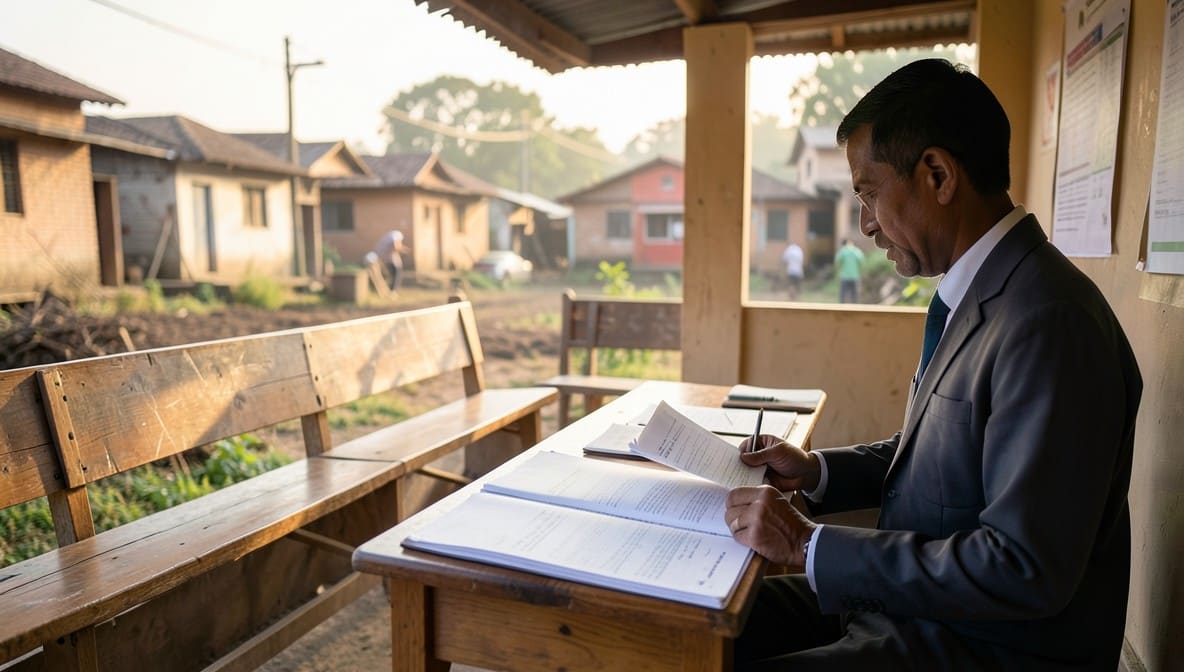
The Rajasthan High Court has reaffirmed that the principle of natural justice is inviolable in panchayat-level land disputes, quashing orders passed without affording parties a meaningful opportunity to be heard. This judgment reinforces procedural fairness as a constitutional imperative, not a technicality, in administrative adjudication under the Panchayati Raj Act.
Background & Facts
The Dispute
The petitioners, Virendra Godara and Sunil Godara, brothers and residents of Village Palasani, Tehsil Luni, District Jodhpur, held pattas (land records) issued in their favor by the Gram Panchayat for agricultural land. The respondents, including the Additional District Collector (I), Jodhpur, and a third-party claimant Narayan Lal Chopra, challenged the validity of these pattas before the revisional authority under Section 97 of the Rajasthan Panchayati Raj Act. The revision petitions were filed by the respondents seeking cancellation of the pattas on grounds of alleged irregularities in grant.
Key Facts
- The petitioners were issued pattas by the Gram Panchayat on an unspecified date prior to 2025
- Revision petitions (Nos. 157/2025 and 158/2025) were filed by the respondents in 2025
- The petitioners appeared before the Additional District Collector (I), Jodhpur, on multiple hearing dates between January and August 2025
- On several occasions, hearings were adjourned due to non-availability of records or absence of the respondent (Narayan Lal Chopra)
- The petitioners were not present on 28.08.2025, the date of final hearing, due to a bona fide misunderstanding of the hearing schedule
- The revisional court proceeded ex parte and passed orders on 28.08.2025 setting aside the petitioners’ pattas
- Review applications (Nos. 26/2025 and 27/2025) filed by the petitioners were dismissed on 24.02.2026 without substantive reasoning
Procedural History
- 2025 (exact date unspecified): Pattas issued in favor of petitioners by Gram Panchayat
- Early 2025: Revision petitions filed by respondents before Additional District Collector (I), Jodhpur
- January 2025 to August 2025: Multiple hearings held; petitioners present on all dates except 28.08.2025
- 28.08.2025: Revision petitions decided ex parte; pattas set aside
- 01.12.2025: Review applications filed by petitioners
- 24.02.2026: Review applications dismissed summarily
- 15.03.2026: Writ Petition No. 7192/2026 filed by Virendra Godara
- 16.03.2026: Writ Petition No. 7201/2026 filed by Sunil Godara
- 01.04.2026: Judgment delivered by High Court of Judicature for Rajasthan at Jodhpur
The Parties' Positions
Petitioners: Argued they were present at all prior hearings, the absence on 28.08.2025 was inadvertent and not due to negligence, and the revisional court failed to apply the doctrine of audi alteram partem. They contended that adjournments were caused by the court’s own administrative delays.
Respondents: Contended that the petitioners’ absence on the final hearing date justified ex parte adjudication, and the revisional court’s decision was based on documentary evidence and legal merit.
Relief Sought
The petitioners sought quashing of the orders dated 28.08.2025 and 24.02.2026, restoration of their pattas, and direction to the revisional court to re-hear the matters afresh with proper opportunity to be heard.
The Legal Issue
The central question was whether an administrative revisional court may lawfully pass an adverse order under Section 97 of the Rajasthan Panchayati Raj Act without affording the affected party a fair opportunity to be heard, even where the party’s absence on the final date was not due to deliberate neglect but arose from procedural confusion and prior adjournments caused by the court.
Arguments Presented
For the Petitioner
Learned counsel for the petitioners relied on the foundational principle of audi alteram partem and cited State of U.P. v. Mohammad Noor to argue that administrative justice must conform to the minimum standards of fairness. He emphasized that the petitioners had attended every hearing prior to 28.08.2025, and the court’s own delays in producing records had contributed to the procedural uncertainty. He further submitted that the dismissal of the review applications was mechanical and violated the duty to give reasoned orders.
For the Respondent
Learned counsel for the respondents contended that the petitioners’ failure to appear on the final hearing date, regardless of cause, amounted to abandonment of their claim. They relied on K. S. Puttaswamy v. Union of India to argue that procedural lapses by parties cannot override the finality of administrative decisions, and that the revisional court acted within its jurisdiction in deciding on merits based on available records.
The Court's Analysis
The Court undertook a rigorous examination of the hearing record and found that the petitioners had demonstrated consistent engagement with the revisional proceedings. The court noted that adjournments were frequently caused by the non-availability of records or absence of the respondent, not by any dilatory conduct of the petitioners.
"The petitioners cannot be held responsible for the adjournments which were occasioned by the non-availability of records or absence of the opposite party. To penalize them by passing an ex parte order on the final date, without any inquiry into the cause of their absence, would be a violation of the cardinal principle of natural justice."
The Court held that the doctrine of audi alteram partem is not a mere formality but a constitutional safeguard under Article 14 and Article 21 of the Constitution. It rejected the notion that absence on a single date, particularly when the party has been consistently present, justifies denial of hearing. The Court further criticized the review order dated 24.02.2026 as being devoid of reasoning, thereby violating the requirement of reasoned decisions in administrative adjudication.
The Court emphasized that revisional authorities under the Panchayati Raj Act function as quasi-judicial bodies and are bound by the same standards of fairness as civil courts. The failure to afford a hearing, even in the absence of a formal application for adjournment, renders the order void ab initio.
The Verdict
The writ petitions succeeded. The Court quashed and set aside the orders dated 28.08.2025 and 24.02.2026 passed by the Additional District Collector (I), Jodhpur. The revision petitions Nos. 157/2025 and 158/2025 were restored to their original numbers. The Additional District Collector (I), Jodhpur, is directed to re-hear the matters on merits as expeditiously as possible, preferably within four months from the date of receipt of a certified copy of this order. All pending applications are disposed of.
What This Means For Similar Cases
Procedural Fairness Overrides Technical Absence
- Practitioners must argue that absence on a final hearing date does not automatically waive the right to be heard if the party has been consistently present and the delay was not attributable to them
- Courts must examine the cause of absence and the history of proceedings before deciding to proceed ex parte
- Administrative bodies cannot treat procedural lapses as grounds for summary dismissal without assessing fairness
Review Orders Must Be Reasoned
- Review applications under the Panchayati Raj Act are not mere formalities; they are part of the right to remedy
- A review order that merely states "dismissed as without merit" without addressing submissions violates the duty to reason
- Practitioners should challenge summary review orders on grounds of non-application of mind and violation of natural justice
Quasi-Judicial Bodies Are Bound by Constitutional Norms
- Revisional authorities under the Panchayati Raj Act are quasi-judicial and must follow principles of natural justice
- The doctrine of audi alteram partem applies even in rural land disputes where parties may lack legal representation
- Courts will intervene where administrative decisions are rendered without a fair hearing, regardless of the forum or subject matter