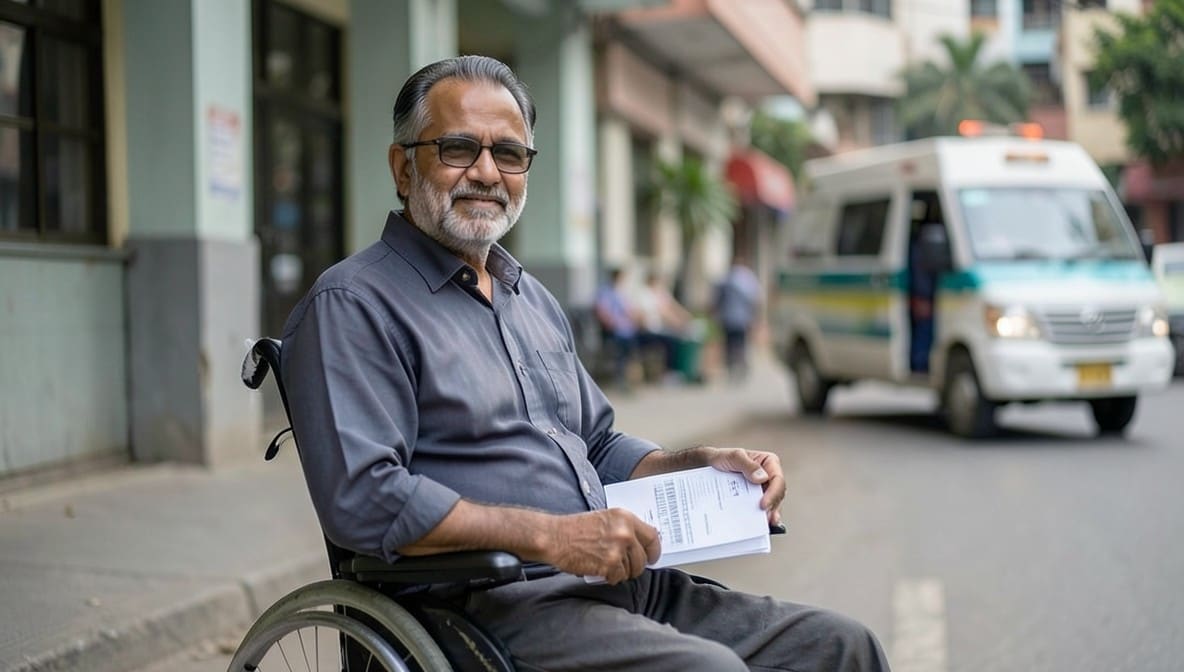
The Karnataka High Court recently delivered a significant judgment in a motor accident compensation case, emphasizing the need to assess functional disability based on the victim's occupation rather than mechanical application of physical disability percentages. The Court enhanced compensation for a manual worker who lost his left forearm, holding that his functional disability should be pegged at 60% and applying a notional income of Rs.14,500 per month as per Lok Adalat guidelines. This ruling clarifies the principles for calculating compensation under Section 173 of the Motor Vehicles Act, 1988 for manual workers with permanent disabilities.
Background & Facts
The Dispute
The appellant, Sri Ramesh S, a 48-year-old agricultural coolie from Tumakuru district, sustained grievous injuries in a road accident on 10.11.2020. While walking as a pedestrian near Dandi Maramma Temple on Thovinakere-Kabbigere Road, he was hit from behind by a motorcycle (Reg. No. KA 06 EN 5051) driven rashly and negligently by the first respondent. The accident resulted in the amputation of his left forearm below the ankle, rendering him unable to perform manual work as before. The appellant claimed compensation from the rider (Respondent No.1) and the insurer (Respondent No.2, United India Insurance Company Ltd.).
Key Facts
- Accident Date: 10.11.2020 at 06:15 p.m. near Dandi Maramma Temple, Surenahalli
- Injuries: Amputation of left forearm below ankle; grievous injuries requiring hospitalization at Hemavathi Hospital, Tumakuru
- Occupation: Agricultural coolie earning Rs.20,000 per month (claimed)
- Vehicle Involved: Motorcycle bearing registration No. KA 06 EN 5051
- Insurer: United India Insurance Company Ltd. (Respondent No.2)
- Disability Certificate: PW.2 (Doctor) assessed physical disability at 70%
Procedural History
- 10.11.2020: Accident occurred
- 15.11.2020: Appellant discharged from hospital after surgery
- 12.06.2021: Claim petition (MVC No.134/2021) filed before IV Additional District Judge and MACT, Tumakuru
- 19.02.2022: Tribunal awarded compensation of Rs.4,49,000 with 6% interest from the date of petition
- 23.05.2023: Notice to Respondent No.1 dispensed with
- 03.06.2026: Present Miscellaneous First Appeal (MFA No. 2884 of 2023) filed before Karnataka High Court
The Parties' Positions
Appellant's Contentions
- The Tribunal erred in assessing functional disability at 20% instead of 60%, given the amputation of the left forearm
- Notional income should have been taken at Rs.14,500 (Lok Adalat guidelines for 2020) instead of Rs.10,000
- Compensation for laid-up period should be for six months, not one month
- Compensation for pain and suffering (Rs.10,000) and future medical expenses (Rs.15,000) was inadequate
- Relied on Raj Kumar v. Ajay Kumar (2011 (1) SCC 343) and Nagarajappa v. Divisional Manager, Oriental Insurance Company Limited (2011 (13) SCC 323) to argue for higher functional disability assessment
Respondent's Contentions
- The Tribunal's assessment of 20% disability was just and proper
- Compensation awarded under all heads was adequate
- Sought dismissal of the appeal
Relief Sought
The appellant sought enhancement of compensation, specifically:
- Functional disability to be assessed at 60%
- Notional income to be taken at Rs.14,500 per month
- Compensation for laid-up period for six months
- Enhanced compensation for pain and suffering (Rs.1,00,000) and future medical expenses (Rs.60,000 for artificial prosthesis)
- Total enhanced compensation of Rs.15,81,263 with 6% interest from the date of petition
The Legal Issue
The appeal raised three critical questions:
- Whether the Tribunal erred in taking the appellant's notional income at Rs.10,000 instead of Rs.14,500 as per Lok Adalat guidelines for 2020?
- Whether the Tribunal erred in assessing functional disability at 20% despite amputation of the left forearm, which severely impacts a manual worker's earning capacity?
- Whether the Tribunal failed to adequately compensate for future medical expenses, pain and suffering, and loss of income during the laid-up period?
Arguments Presented
For the Appellant
The appellant's counsel argued that:
- The appellant, being an agricultural coolie, relied heavily on both hands for his livelihood. The amputation of his left forearm should have been assessed at 60% functional disability, not 20%
- The notional income for 2020, as per Lok Adalat guidelines, was Rs.14,500, which should have been applied instead of Rs.10,000
- The compensation for the laid-up period should cover six months, not one month, given the severity of the injury
- The compensation for pain and suffering (Rs.10,000) and future medical expenses (Rs.15,000) was grossly inadequate, especially considering the need for an artificial prosthesis costing at least Rs.60,000
- Cited Raj Kumar v. Ajay Kumar (2011 (1) SCC 343) to emphasize that functional disability must be assessed based on the impact on earning capacity, not just physical disability
For the Respondent (Insurer)
The insurer's counsel contended that:
- The Tribunal's assessment of 20% disability was correct
- The compensation awarded under all heads was just and proper
- The appeal should be dismissed
The Court's Analysis
The Court undertook a detailed analysis of the legal principles governing compensation for permanent disabilities, particularly for manual workers. The key aspects of the Court's reasoning are as follows:
Notional Income Assessment
The Court observed that the appellant had claimed an income of Rs.20,000 per month but failed to produce evidence to substantiate this claim. However, the Tribunal erred in taking the notional income at Rs.10,000 instead of Rs.14,500, which was the amount fixed by the Legal Services Authority for settlement of disputes in Lok Adalat for the year 2020. The Court held:
"The notional income fixed by the Legal Services Authority for settlement of disputes in Lok Adalath is Rs.14,500/- p.m. for the year 2020. Considering the said aspect, the Tribunal ought to have taken the notional income at Rs.14,500/- p.m. Therefore, notional income of the claimant is to be taken at Rs.14,500/- p.m."
Functional Disability Assessment
The Court critically examined the Tribunal's assessment of 20% functional disability despite the amputation of the appellant's left forearm. The Court relied on medical evidence (Ex.P.12 and PW.2's testimony) which clearly indicated the amputation and assessed physical disability at 70%. The Court distinguished the insurer's argument that the disability was related to the leg, noting that PW.2 had specifically mentioned a crush injury to the left forearm.
The Court placed heavy reliance on the Supreme Court's decision in Raj Kumar v. Ajay Kumar (2011 (1) SCC 343), which laid down the principles for assessing compensation for permanent disabilities:
"Where the claimant suffers a permanent disability as a result of injuries, the assessment of compensation under the head of loss of future earnings would depend upon the effect and impact of such permanent disability on his earning capacity. The Tribunal should not mechanically apply the percentage of permanent disability as the percentage of economic loss or loss of earning capacity."
The Court emphasized that the percentage of economic loss may differ from the percentage of physical disability, depending on the claimant's occupation. For instance, a driver or carpenter with a left-hand amputation would suffer near-total loss of earning capacity, whereas a clerk might continue working with minimal impact. The Court quoted:
"For example, if the left hand of a claimant is amputated, the permanent physical or functional disablement may be assessed around 60%. If the claimant was a driver or a carpenter, the actual loss of earning capacity may virtually be hundred per cent, if he is neither able to drive or do carpentry. On the other hand, if the claimant was a clerk in government service, the loss of his left hand may not result in loss of employment and he may still be continued as a clerk as he could perform his clerical functions; and in that event the loss of earning capacity will not be 100% as in the case of a driver or carpenter, nor 60% which is the actual physical disability, but far less."
Applying these principles, the Court held that since the appellant was an agricultural labourer requiring the use of both hands, the functional disability should be assessed at 60%. The Court also relied on Nagarajappa v. Divisional Manager, Oriental Insurance Company Limited (2011 (13) SCC 323), where the Supreme Court had assessed functional disability at 68% for a manual worker with upper limb disabilities.
Compensation Calculation
The Court recalculated the compensation under various heads:
-
Loss of Future Income: The Court applied the formula:
- Notional income: Rs.14,500 per month
- Multiplier: 13 (based on the appellant's age of 48 years)
- Functional disability: 60%
- Calculation: Rs.14,500 x 12 x 13 x 60% = Rs.13,57,200
-
Future Prospects: The Court applied 25% future prospects as per National Insurance Company v. Pranay Sethi (AIR 2017 SC 5157), given the appellant's age (40-50 years). This added Rs.3,39,300 to the loss of future income, bringing the total to Rs.16,96,500.
-
Loss of Income During Laid-Up Period: The Tribunal had awarded compensation for only one month. The Court enhanced this to six months, calculating Rs.14,500 x 6 = Rs.87,000.
-
Pain and Suffering: Enhanced from Rs.10,000 to Rs.1,00,000.
-
Future Medical Expenses: Enhanced from Rs.15,000 to Rs.60,000 for an artificial prosthesis, as advised by PW.2.
The Court upheld the Tribunal's awards for medical expenses (Rs.76,763), food/nourishment/conveyance/attendant charges (Rs.10,000), and did not award separate compensation for loss of amenities since future prospects were already accounted for.
The Verdict
The Karnataka High Court partly allowed the appeal and enhanced the compensation as follows:
- Total Enhanced Compensation: Rs.20,30,263 (including Tribunal's award of Rs.4,49,000)
- Additional Compensation Awarded: Rs.15,81,263
- Interest: 6% per annum from the date of petition till realization
- Compliance Deadline: The insurer must deposit the enhanced compensation within six weeks, failing which interest will increase to 9% per annum from the date of judgment till payment
- Operative Directions: The appellant is entitled to the entire enhanced amount, and the award is to be drawn accordingly
What This Means For Similar Cases
Functional Disability Must Reflect Occupation
This judgment reinforces that functional disability must be assessed based on the victim's occupation and the impact of the injury on their earning capacity, not merely the percentage of physical disability. Practitioners should:
- Argue for higher functional disability percentages for manual workers with limb amputations or severe injuries
- Rely on Raj Kumar v. Ajay Kumar to distinguish between physical and economic disability
- Highlight the victim's inability to perform their specific job functions post-injury
Notional Income Guidelines Are Binding
The Court's reliance on Lok Adalat's notional income guidelines (Rs.14,500 for 2020) sets a precedent for tribunals to follow these benchmarks when claimants fail to produce income proof. Practitioners should:
- Cite Lok Adalat guidelines in cases where income evidence is lacking
- Argue for the application of the latest notional income figures as per the year of the accident
Enhanced Compensation for Laid-Up Period and Future Medical Expenses
The Court's enhancement of compensation for the laid-up period (from one month to six months) and future medical expenses (from Rs.15,000 to Rs.60,000) signals that tribunals must consider:
- The severity of the injury and the recovery period required
- The actual cost of medical aids (e.g., artificial limbs) rather than arbitrary sums
- The long-term medical needs of the victim, especially for permanent disabilities
Future Prospects for Middle-Aged Victims
The Court's application of 25% future prospects for a victim aged 40-50 years, as per Pranay Sethi, underscores that tribunals must account for career growth potential even for manual workers. Practitioners should:
- Argue for future prospects in all cases involving victims in the 40-50 age bracket
- Use the multiplier method to calculate loss of future income, factoring in both disability and future prospects