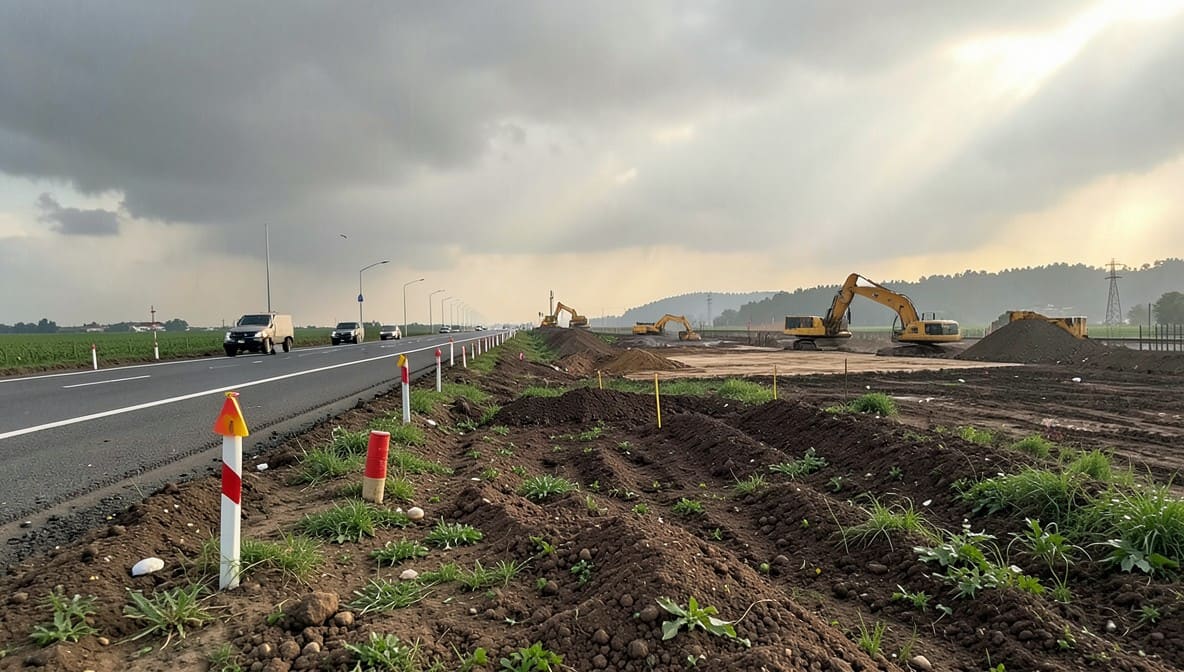
The batch of appeals before the Madhya Pradesh High Court challenged the enhanced compensation awards passed by the Reference Court under the Right to Fair Compensation and Transparency in Land Acquisition, Rehabilitation and Resettlement Act, 2013. The appeals were filed by the State of Madhya Pradesh and Rail Vikas Nigam Limited against the awards granted to land losers in three villages - Talpura, Mana, and Bansapur - for the acquisition of land for the construction of the third railway line between Barkheda and Budhani in Sehore district. The High Court, after a detailed examination of the factual matrix and legal principles, dismissed all appeals and cross-objections, affirming the Reference Court's valuation methodology and the enhanced compensation awarded.
Background & Facts
The Genesis of the Acquisition
The acquisition pertains to land required for the construction of the third railway line between Barkheda and Budhani in Sehore district, Madhya Pradesh. The acquisition was initiated by the State of Madhya Pradesh and executed by Rail Vikas Nigam Limited (RVNL), the beneficiary agency. The lands were acquired in three villages: Talpura, Mana, and Bansapur. The acquisition process involved the issuance of a notification under Section 11 of the Right to Fair Compensation and Transparency in Land Acquisition, Rehabilitation and Resettlement Act, 2013 (hereinafter referred to as the Act of 2013) on 19.01.2018 for lands in Talpura and 18.07.2019 for lands in Mana.
Key Facts
- Village Talpura: The lands were primarily agricultural, and the Collector assessed compensation at Rs. 42.35 lakh per hectare. The Reference Court enhanced the compensation to Rs. 65.18 lakh per hectare for some lands and Rs. 74.08 lakh per hectare for others, based on exemplar sale deeds.
- Village Mana: The lands were situated within the municipal limits of Budhni Municipal Council. The Collector assessed compensation at Rs. 42.35 lakh per hectare for agricultural land, while the Reference Court enhanced it to Rs. 2.81 crore per hectare, relying on two exemplar sale deeds (Exhibit P-7 and P-8) dated 08.03.2016 and 17.06.2015, respectively.
- Village Bansapur: The lands were diverted for industrial use and situated adjacent to the National Highway. The Reference Court assessed compensation at Rs. 3.09 crore per hectare, including a 10% increment for diverted industrial land.
Procedural History
- Date of Notification under Section 11: 19.01.2018 (Talpura), 18.07.2019 (Mana).
- Date of Award by Collector: 24.09.2019.
- Reference Applications filed by Land Losers: Between 2019 and 2020.
- Reference Court's Awards: Passed in 2022, enhancing compensation significantly.
- Appeals filed by State and RVNL: Between 2022 and 2023, challenging the Reference Court's awards.
- Present Appeals: First Appeals Nos. 634-638, 811, 822, 824, 830, 831, 834-836, 838-840, 842, 844, 851, 855, 857-858, 1286-1287, 1289, 1292-1294, 1305-1306, 1330-1333 of 2022, and 1286-1287, 1289, 1292-1294, 1330-1333 of 2022.
- Judgment Pronounced: 23.07.2026.
The Parties' Positions
- Appellants (State and RVNL): Argued that the Reference Court erred in relying on exemplar sale deeds situated 3-5 kilometers away from the acquired lands, which were not comparable in location, situation, or proximity to highways. They contended that the Reference Court's enhancement was arbitrary and disproportionate, ranging from 3 to 7 times the Collector's assessment.
- Respondents (Land Losers): Argued that the Reference Court correctly relied on exemplar sale deeds within the same Gram Panchayat or nearest vicinity, and that the lands in Mana and Bansapur were situated within the municipal limits of Budhni, entitling them to higher compensation reflective of urban potential.
Relief Sought
The appellants sought setting aside of the Reference Court's awards, arguing that the compensation was enhanced exorbitantly and without legal justification. The land losers, in cross-objections, sought further enhancement of compensation, particularly for lands in Mana, where they claimed the Reference Court's valuation was still inadequate.
The Legal Issue
The central question was whether the Reference Court correctly applied the methodology for determining market value under Section 26 of the Act of 2013, particularly the reliance on exemplar sale deeds situated in the nearest village or vicinity, and whether the enhanced compensation awarded was justified in light of the factual circumstances of the acquired lands.
Arguments Presented
For the Appellant/State and RVNL
The appellants argued that the Reference Court erred in relying on exemplar sale deeds that were not situated in the nearest village or vicinity, and that the lands were not comparable in terms of location, proximity to highways, or urban potential. They relied on the following precedents:
- Gafar and others vs. Moradabad Development Authority (2007), which held that exemplar lands must be in the vicinity and that guesswork cannot be the basis for valuation.
- Bhule Ram vs Union of India (AIR 2014 SC 1957), which emphasized that claimants must provide evidence to support their valuations and that geographical location and proximity to highways are critical factors.
- Union of India vs. Mangat (AIR 2000 SC 3527), which held that land adjacent to major roads holds greater value than land farther away.
- Rajashekar Sankappa Taradandi and others vs. Assistant Commissioner & Land Acquisition Officer (AIR 1996 SC 3222), which held that potential future use should not influence compensation.
- Kanwar Singh and others vs. Union of India (AIR 1999 SC 317), which cautioned against relying on valuation of adjacent villages due to absurd consequences.
- Sumitraben Singabhai Gamit vs. State of Gujarat (Civil Appeal No.5095 of 2025), which held that valuation must be determined as of the date of notification under Section 11.
- M.P. Road Development Corporation vs. Vincent Daniel (Civil Appeal No.3998 of 2024), which held that if no exemplars are available in the vicinity, Section 26(a) must be applied.
The appellants also argued that the maps filed by RVNL were not certified and lacked a scale, making them unreliable for determining distances between exemplar lands and acquired lands.
For the Respondent/Land Losers
The respondents argued that the Reference Court correctly relied on exemplar sale deeds within the same Gram Panchayat or nearest vicinity, and that the lands in Mana and Bansapur were situated within the municipal limits of Budhni, entitling them to higher compensation. They contended that the lands in Talpura were adjacent to the Pradhan Mantri Rural Road, and that the exemplar sale deeds relied upon were valid and comparable. They also argued that the maps filed by RVNL were unreliable and did not reflect the true location of the exemplar lands.
The Court's Analysis
The Court examined the methodology for determining market value under Section 26 of the Act of 2013, which provides three modalities:
- Section 26(a): Valuation as per the Indian Stamp Act for the area where the land is situated.
- Section 26(b): Average sale price for similar land situated in the nearest village or nearest vicinity area.
- Section 26(c): Consented amount of compensation in cases of acquisition for private companies or public-private partnership projects.
The Court held that the highest of the values determined under these modalities must be adopted as the market value. It emphasized that the Reference Court must consider all relevant factors, including the theory of deduction, the principle of belting, and the advantages or disadvantages of the acquired land compared to exemplar lands.
"The values computed in terms of Clauses (a), (b) and (c) of Section 26(1) of the Acquisition Act, 2013 are not to be averaged. The highest of the values as determined by Clauses (a), (b) and (c), is to be treated as the market value under Section 26(1) of the Acquisition Act, 2013."
The Court also addressed the issue of the multiplier factor under Section 26(2) and Section 30(2) of the Act of 2013. It held that since the acquisition was for the purpose of the Union (Railways), the Central Government's notification prescribing a multiplier of 2.0 for rural areas applied, not the State Government's notification prescribing a multiplier of 1.0.
The Court examined the exemplar sale deeds relied upon by the Reference Court and found that they were valid and comparable in terms of location, proximity to highways, and urban potential. It rejected the appellants' contention that the exemplar lands were situated too far away, noting that the lands in Talpura and Khapakhurd were within the same Gram Panchayat, and that the lands in Mana were situated within the municipal limits of Budhni, entitling them to higher compensation.
The Court also rejected the appellants' argument that the maps filed by RVNL were unreliable, noting that the maps lacked a scale and did not reflect the true location of the exemplar lands. It held that the Reference Court had correctly appreciated the evidence and arrived at a conclusion that was in accordance with law.
The Verdict
The High Court dismissed all the appeals filed by the State of Madhya Pradesh and RVNL, as well as the cross-objections filed by the land losers. The Court affirmed the Reference Court's awards, holding that the Reference Court had correctly applied the methodology for determining market value under Section 26 of the Act of 2013 and that the enhanced compensation awarded was justified in light of the factual circumstances of the acquired lands. The Court held that the multiplier of 2.0 prescribed by the Central Government's notification applied, not the multiplier of 1.0 prescribed by the State Government's notification.
The Court directed that the compensation awarded by the Reference Court, including the multiplier of 2.0, be paid to the land losers within 8 weeks from the date of the judgment.
What This Means For Similar Cases
Exemplar Sale Deeds Must Be Comparable in Location and Circumstances
- The judgment reaffirms that exemplar sale deeds relied upon for determining market value under Section 26(b) must be situated in the nearest village or nearest vicinity area and must be comparable in terms of location, proximity to highways, and urban potential.
- Courts must reject exemplar sale deeds that are situated too far away or are not comparable in terms of location or circumstances.
Urban Potential Must Be Considered for Lands Within Municipal Limits
- Lands situated within municipal limits, even if not formally diverted for non-agricultural use, must be valued at rates reflective of their urban potential.
- The judgment clarifies that lands within municipal limits are entitled to higher compensation, as their potential is not limited to agricultural use.
Multiplier Factor Depends on the Appropriate Government
- The multiplier factor under Section 26(2) and Section 30(2) depends on the "appropriate Government" as defined under Section 3(e) of the Act of 2013.
- If the acquisition is for the purpose of the Union (e.g., Railways), the Central Government's notification prescribing a multiplier of 2.0 for rural areas applies, not the State Government's notification prescribing a multiplier of 1.0.
Maps Must Be Reliable and Scaled
- Maps filed to challenge the location of exemplar lands must be certified, scaled, and reflect the true location of the lands.
- Uncertified maps lacking a scale are unreliable and cannot be relied upon to challenge the Reference Court's valuation methodology.