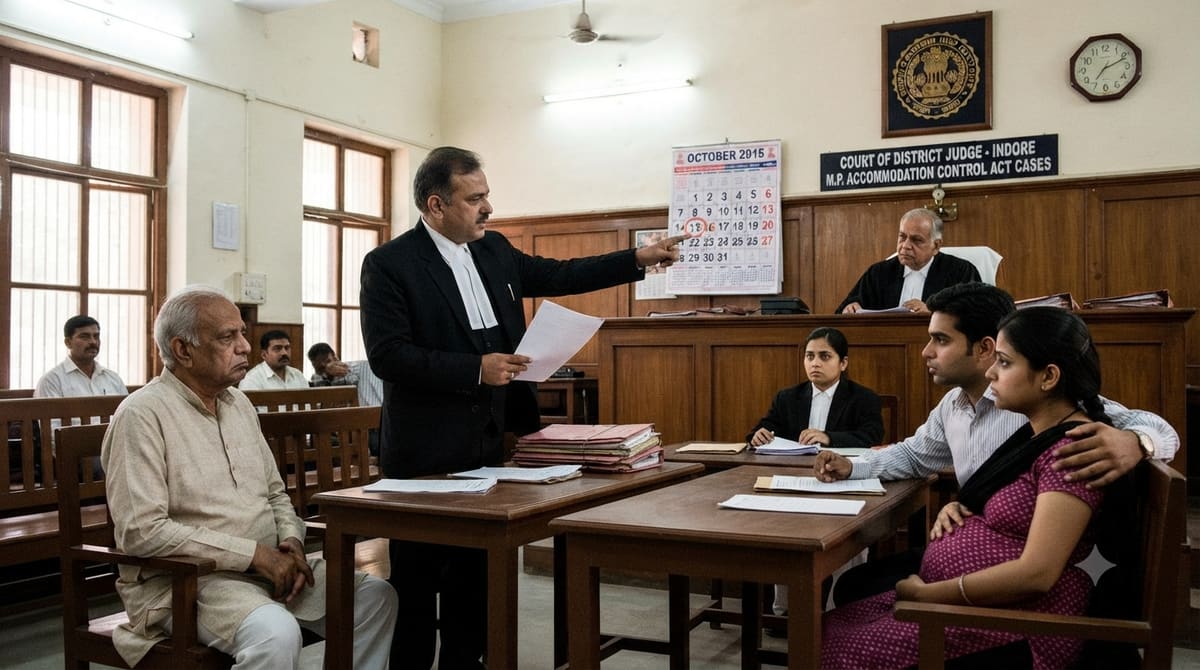
The Madhya Pradesh High Court has reaffirmed a foundational principle in tenancy law: the bonafide need of a landlord for eviction must be assessed as of the date the suit is filed, not at any later stage, even if circumstances change. This ruling resolves a recurring point of litigation in rent control cases and provides clarity for landlords and tenants alike.
Background & Facts
The Dispute
The plaintiff, Rajesh Laad, filed a suit for eviction and recovery of arrears of rent against the defendants, legal representatives of the deceased Kanhaiyalal, who had been occupying a shop measuring 198.56 sq.ft. at House No. 89A, M.G. Road, Indore. The tenancy was oral, originally granted to Babulal, Kanhaiyalal’s predecessor-in-interest, at a monthly rent of Rs. 600. The plaintiff claimed that rent had not been paid since 1.7.2012 and that the premises were required bonafide for his daughter, Priyal Laad, to start a boutique business.
Key Facts
The tenancy commenced in the 1980s with Babulal as tenant
After Babulal’s death, rent was paid by Kanhaiyalal, who became the primary tenant
Rent was revised to Rs. 128 per month effective 1.1.2005, and later to Rs. 600 per month
The plaintiff served a notice dated 16.8.2013 terminating the tenancy with effect from 16.10.2013
The suit was filed on 16.10.2013 (Regular Civil Suit No. 5000085/2013)
The plaintiff alleged subletting to Rajkumar Jain and structural alterations
The defendants admitted non-payment of rent since 1.7.2012 but claimed deposits were made
On 11.2.2014, defendants deposited Rs. 1,200 in court as rent arrears
Priyal Laad, the plaintiff’s daughter, got married in 2020
The plaintiff produced Ex.P/11 (purchase of dress material) and Ex.P/14 (certificate of fashion designer qualification) to substantiate bonafide need
Procedural History
16.10.2013: Suit filed before the Civil Judge (Senior Division), Indore
25.1.2025: Trial Court decreed the suit for eviction under Section 12(1)(a) and 12(1)(f) of the M.P. Accommodation Control Act, 1961
21.1.2026: First Appellate Court (Regular Civil Appeal No. 38/2025) affirmed the trial court’s findings
15.12.2025: Defendants filed application under Order 41 Rule 27 CPC seeking to add evidence of rent receipts and marriage certificate of Priyal Laad
21.1.2026: First Appellate Court rejected the application under Order 41 Rule 27 CPC
9.7.2026: Second Appeal No. 854/2026 filed before the Madhya Pradesh High Court
Relief Sought
The appellants sought reversal of the eviction decree on two grounds: (1) that rent was regularly paid and the trial court erred in rejecting evidence of payment under Order 41 Rule 27 CPC; and (2) that the bonafide need of the plaintiff’s daughter ceased upon her marriage in 2020, rendering the decree unsustainable.
The Legal Issue
The central question was whether the bonafide need of a landlord for eviction under Section 12(1)(f) of the M.P. Accommodation Control Act, 1961 must be assessed as of the date of filing the suit, or whether subsequent events such as the marriage of the intended beneficiary can invalidate the claim.
Arguments Presented
For the Appellant
Learned counsel argued that the First Appellate Court erred in rejecting the application under Order 41 Rule 27 CPC, which sought to introduce rent receipts and the marriage certificate of Priyal Laad. He contended that these documents were material to the issue of payment and bonafide need, and their exclusion prejudiced the defendants. He further submitted that since the daughter was married by 2020, the need for the premises for her boutique business no longer existed, and the decree could not be sustained on that ground.
For the Respondent
The respondent’s counsel argued that the trial court had already evaluated the evidence of bonafide need, including the daughter’s professional qualifications and purchase of business materials. He emphasized that the suit was filed in 2013, and the law requires the bonafide need to be judged as of that date. He further submitted that the rent receipts were available during trial and could have been produced then; their belated production under Order 41 Rule 27 CPC was not justified.
The Court's Analysis
The Court undertook a two-pronged analysis: first, on the admissibility of evidence under Order 41 Rule 27 CPC; and second, on the legal standard for establishing bonafide need.
On the issue of evidence, the Court held that the documents sought to be introduced - rent receipts and the marriage certificate - were not newly discovered. The receipts were in the possession of the defendants since the filing of the written statement, and the marriage certificate was a public record available well before the appeal. The Court relied on settled law that Order 41 Rule 27 CPC permits additional evidence only if the party can show due diligence and that the evidence could not have been produced despite reasonable care. No such explanation was offered. The Court observed:
"No explanation has been given that why the same were not filed during the course of trial."
On the issue of bonafide need, the Court turned to binding precedent. It cited Surajmal v. Radheshyam (AIR 1988 SC 1345), which established that the relevant date for determining bonafide need is the date of filing of the suit. It further relied on the Supreme Court’s recent order in Maria Martins v. Noel Zuzarte (SLP(C) No. 11349/2025, dated 16.4.2026), which reaffirmed this principle. The Court emphasized:
"As such, this Court has to consider whether on the date of filing of civil suit daughter of the plaintiff Priyal Laad, for whose bonafide need decree was sought, was married or not. As per the evidence... the marriage of Priyal Laad happened in the year 2020 [while] the suit was filed in the year 2013... this cannot be a ground for denial for a decree of bonafide need."
The Court also noted that the trial and appellate courts had meticulously evaluated the evidence - including the daughter’s professional certification, purchase of fabric, and testimony of witnesses - and found no perversity in their findings. The second appeal, therefore, did not raise any substantial question of law.
The Verdict
The Second Appeal was dismissed. The Court upheld the eviction decree under Section 12(1)(a) and Section 12(1)(f) of the M.P. Accommodation Control Act, 1961. The defendants were directed to vacate the premises within 8 weeks from the date of this judgment. No order as to costs was made. The Court confirmed that the bonafide need of the plaintiff’s daughter was validly established as of the suit filing date in 2013, and her subsequent marriage in 2020 did not affect the decree.
What This Means For Similar Cases
Bonafide Need Is Fixed at Suit Filing Date
Practitioners must now treat the date of filing the eviction suit as the decisive benchmark for assessing bonafide need under Section 12(1)(f)
Subsequent events - marriage, relocation, change of business plans - cannot be invoked to defeat a valid claim
Landlords should ensure all evidence supporting bonafide need (professional credentials, business plans, purchase receipts) is documented and filed at the earliest stage
Evidence Under Order 41 Rule 27 CPC Is Not a Backdoor for Late Submissions
Documents available during trial cannot be introduced at appellate stage without a compelling explanation for non-production
Courts will strictly apply the test of due diligence and reasonable care
Failure to produce rent receipts or payment proof during trial will not be cured by belated applications
Subletting and Structural Alterations Require Specific Evidence
Claims of subletting or structural changes must be supported by independent evidence, not mere allegations
The trial court’s rejection of these claims in this case underscores the need for concrete proof
Practitioners should prepare witness statements and photographic or documentary evidence early in litigation