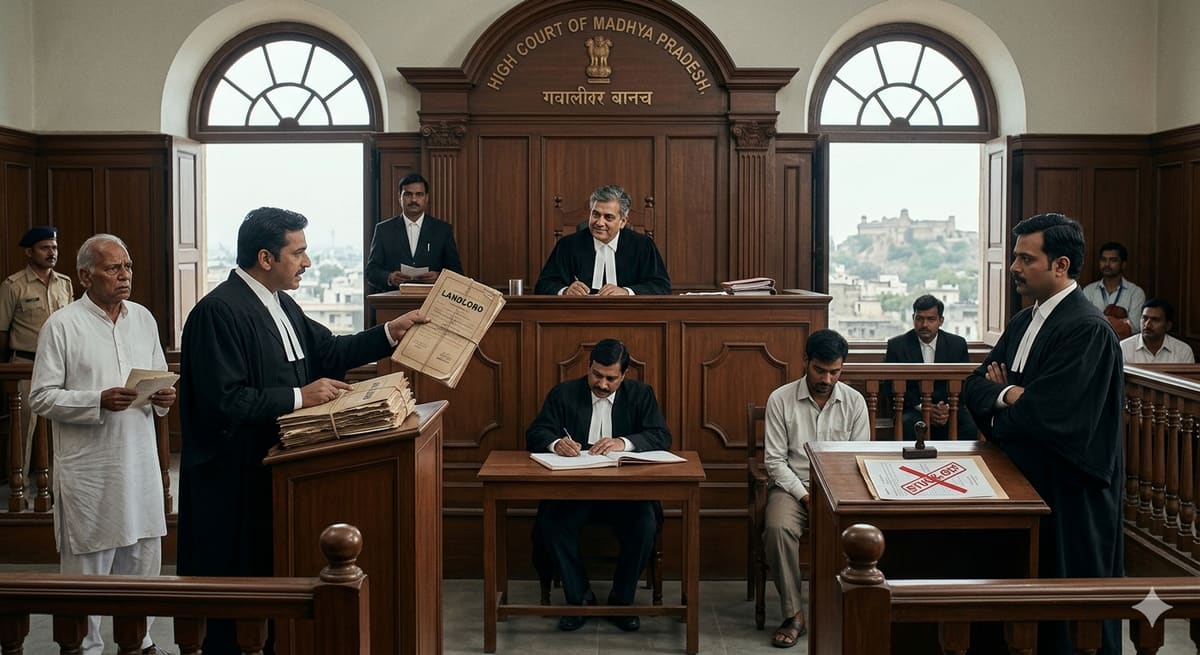
The Madhya Pradesh High Court has clarified a critical procedural threshold in landlord-tenant disputes under the MP Accommodation Control Act, holding that a tenant’s own admission of rent in pleadings cannot be later treated as disputed to avoid the mandatory consequence of defence striking under Section 13(6). This ruling reinforces the principle that judicial discretion under the Act must be grounded in the pleadings, not speculative disputes.
Background & Facts
The Dispute
The petitioner, Rajesh Pal, is the landlord of a 0.90 acre property in Bhopal, which was let out to the respondent, Deepak Kumar Rajak, for operating a marriage garden. The tenancy commenced on 10.12.2021 under a five-year agreement with an annual rent of Rs. 7.00 lakhs, equivalent to Rs. 58,300 per month. The tenant filed a suit for permanent injunction on the assertion that the landlord was attempting to evict him unlawfully. In response, the landlord filed a written statement and a counterclaim seeking eviction on grounds including non-payment of rent.
Key Facts
- The tenant’s plaint dated 10.12.2021 explicitly stated the rent as Rs. 7.00 lakh per annum (Rs. 58,300 per month)
- The tenant admitted this rate in his own pleadings as the basis for seeking protection against eviction
- No formal dispute regarding this rent amount was raised by the tenant in his written statement or during initial hearings
- The landlord filed a counterclaim for eviction on 15.01.2025, citing non-payment of rent since 01.07.2024
Procedural History
- 10.12.2021: Tenancy commenced under oral agreement with annual rent of Rs. 7.00 lakhs
- 15.01.2025: Landlord files counterclaim for eviction in the tenant’s suit
- 13.12.2024: Trial court passes order under Section 13(1) directing tenant to pay Rs. 58,300 per month as rent, based on tenant’s own admission in plaint
- 01.07.2025: Tenant fails to make payments for three consecutive months (April, May, June 2025)
- 07.01.2026: Trial court rejects landlord’s application under Section 13(6) to strike out tenant’s defence, claiming rent amount remains disputed
- 21.04.2026: Petition filed before Madhya Pradesh High Court challenging the trial court’s order
Relief Sought
The petitioner seeks setting aside of the trial court’s order dated 07.01.2026, striking off the tenant’s defence under Section 13(6), and proceeding with the eviction suit.
The Legal Issue
The central question was whether a tenant’s explicit admission of rent in his plaint can be disregarded by the trial court to claim a dispute exists, thereby avoiding the mandatory consequence of defence striking under Section 13(6) of the MP Accommodation Control Act.
Arguments Presented
For the Petitioner
The petitioner’s counsel argued that the tenant’s plaint constituted a judicial admission under Section 58 of the Indian Evidence Act, binding the tenant to the rent figure of Rs. 58,300 per month. The trial court’s refusal to strike the defence was contrary to Section 13(6), which mandates striking of defence upon failure to pay the admitted rent. Reliance was placed on the plain language of Section 13(1) and (6), which do not permit evasion of payment obligations by raising frivolous disputes after admission.
For the Respondent
The respondent’s counsel contended that the rent amount remained subject to negotiation and that the trial court had discretion to assess whether a genuine dispute existed. He argued that the landlord’s claim for higher rent in the counterclaim created ambiguity, and therefore, the tenant’s defence should not be struck without a formal determination under Section 13(2).
The Court's Analysis
The High Court observed that Section 13(1) requires the tenant to pay rent at the rate at which it was paid, and Section 13(6) mandates the striking of defence if such payment is not made. Crucially, the court emphasized that Section 13(2) only applies where a dispute over rent is genuinely raised at the earliest opportunity - not after the tenant has already admitted the amount in pleadings.
"The tenant himself has admitted the rent to be Rs. 58,300/- per month in his plaint wherein he has sought permanent injunction against the landlord seeking protection against apprehended dispossession."
The court held that once a party admits a fact in pleadings, it cannot later be allowed to deny it to frustrate statutory obligations. The trial court’s reasoning that the rent remained disputed was legally unsustainable because the dispute, if any, was only about a higher rent - not the admitted Rs. 58,300. The court further noted that the trial judge had failed to examine the pleadings, rendering the order perverse and contrary to the Act’s intent.
The court reiterated that Section 13(6) is a mandatory provision designed to prevent tenants from delaying eviction proceedings by non-payment while simultaneously claiming protection. Allowing a tenant to rely on his own admission to claim dispute would render the provision nugatory.
The Verdict
The petition is allowed. The trial court’s order dated 07.01.2026 is set aside. The defence of the tenant is struck off under Section 13(6) of the MP Accommodation Control Act. The suit shall proceed to hearing on the merits of eviction without further delay. The tenant shall be liable for costs of Rs. 15,000 to be paid within four weeks.
What This Means For Similar Cases
Admission in Pleadings Is Binding
- Practitioners must treat any rent figure admitted in a tenant’s plaint as conclusive for the purpose of Section 13(6)
- Applications under Section 13(6) must be filed immediately upon non-payment of the admitted amount, without waiting for a Section 13(2) determination
No Room for Strategic Disputes
- Tenants cannot create artificial disputes over rent after admitting it in pleadings to avoid eviction
- Courts must reject applications under Section 13(2) if the dispute is raised solely to delay proceedings after admission
Procedural Compliance Is Non-Negotiable
- Failure to pay admitted rent triggers automatic consequence under Section 13(6) - no discretion remains
- Judges must review pleadings before rejecting Section 13(6) applications; failure to do so renders orders liable to be set aside