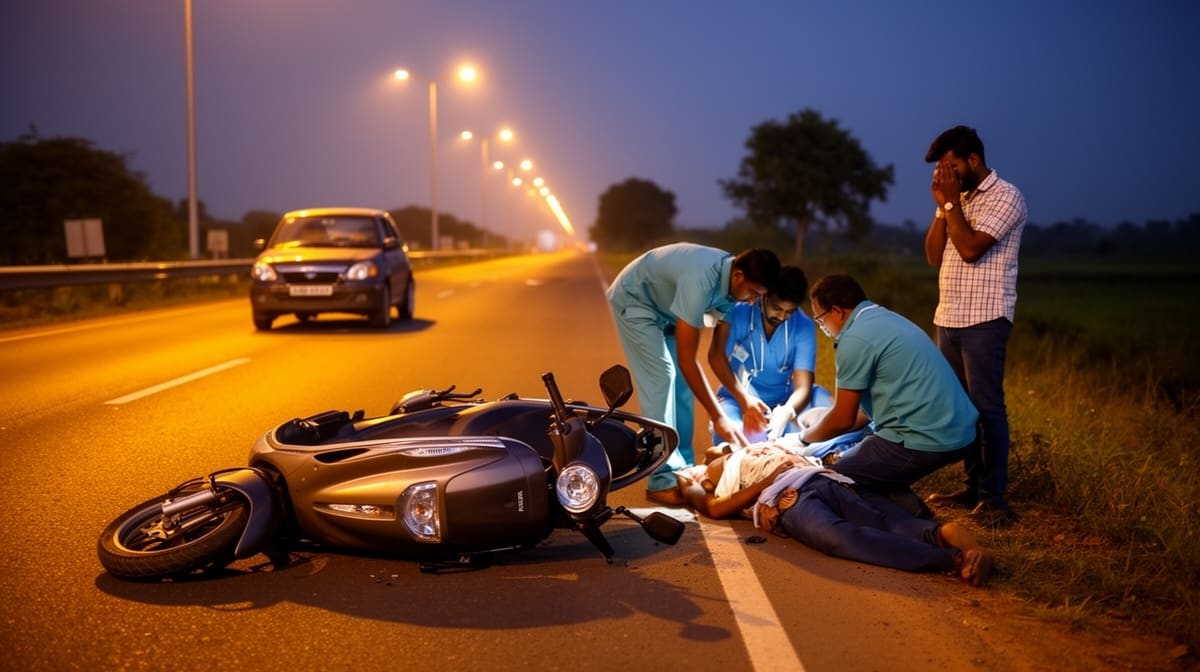
The Andhra Pradesh High Court has reaffirmed that delay in lodging an FIR cannot be a ground to reject motor accident compensation claims if the accident is proven through evidence. The judgment establishes key principles on negligence, burden of proof, and quantum of compensation, emphasizing the social welfare nature of the Motor Vehicles Act and the need for a holistic approach in adjudicating such claims.
Background & Facts
The Dispute
The appellant, S. Venkata Reddy, sustained injuries on 21.11.2006 when his motorcycle was dashed by an auto bearing No. AP 28 W 1176 (offending vehicle) near SP Bungalow, Kurnool. He suffered multiple injuries, including a fracture to his right wrist and grievous injury to his knee joint. He was treated at Government Hospital, Kurnool, Viswabharati Super Specialty Hospital, Kurnool, and Apollo Hospital, Hyderabad, incurring medical expenses of Rs. 30,000. The appellant, aged 39 years and earning Rs. 3,000 per month, claimed compensation for his disabilities.
Key Facts
- Date of Accident: 21.11.2006
- Offending Vehicle: Auto bearing No. AP 28 W 1176
- Injuries: Fracture to right wrist, grievous injury to knee joint, and three simple injuries
- Medical Expenses: Rs. 30,000 (Rs. 24,432 at Viswabharati Hospital, Rs. 2,000 for tests, Rs. 25,000 at Apollo Hospital)
- FIR Lodged: 01.04.2007 (delayed due to hospitalization)
- Charge Sheet: Filed on 01.04.2007 (Ex.A3)
- Lok Adalat Settlement: Offence compounded under Section 320(8) CrPC (Ex.A4)
- Respondents:
- 1st Respondent: Owner of the offending vehicle (remained ex-parte)
- 2nd Respondent: Policyholder (remained ex-parte)
- 3rd Respondent: Bajaj Allianz General Insurance Company Limited (contested the claim)
Procedural History
- 15.02.2007: Claim petition (M.V.O.P.No. 437/2007) filed before the Motor Accidents Claims Tribunal (MACT), Kurnool
- 15.02.2012: MACT dismissed the claim, holding that delay in lodging FIR and lack of evidence on negligence defeated the claim
- 2012: Appellant filed M.A.C.M.A.No. 1406/2012 before the High Court
- 01.07.2026: High Court allowed the appeal, setting aside the MACT order
The Parties' Positions
Appellant/Petitioner
- The accident occurred due to the rash and negligent driving of the offending vehicle
- Delay in lodging FIR was due to hospitalization and treatment
- Official records (FIR, charge sheet, Lok Adalat settlement) prove the accident and negligence
- The Insurance Company failed to examine the driver or owner of the offending vehicle
Respondent/Insurance Company
- No negligence on the part of the driver of the offending vehicle
- Appellant failed to prove the accident, negligence, injuries, and expenditure
- Delay in lodging FIR was fatal to the claim
- Alleged collusion between the appellant and the owner of the offending vehicle
- No fitness certificate for the offending vehicle, violating policy conditions
Relief Sought
The appellant sought compensation for:
- Medical expenses (Rs. 30,000)
- Loss of earning capacity during treatment
- Pain and suffering
- Attendant charges
- Transportation costs
- Future treatment and loss of amenities of life
The Legal Issue
The appeal raised the following questions:
- Whether the accident dated 21.11.2006 occurred due to the rash and negligent driving of the offending vehicle, and whether the appellant sustained injuries in the said accident?
- Whether the appellant is entitled to compensation, and if so, the quantum and against which respondents?
- Whether the dismissal of the claim by the MACT under its order dated 15.02.2012 was proper?
- What is the result of the appeal?
Arguments Presented
For the Appellant/Petitioner
- Delay in lodging FIR cannot be a ground to reject the claim, especially when the appellant was hospitalized
- The MACT failed to appreciate the evidence, including the charge sheet and Lok Adalat settlement, which proved the accident and negligence
- The Insurance Company did not take steps to examine the driver or owner of the offending vehicle, weakening its defence
For the Insurance Company/3rd Respondent
- The appellant failed to prove the accident, negligence, and injuries
- Delay in lodging FIR was fatal to the claim
- Alleged collusion between the appellant and the owner of the offending vehicle
- No fitness certificate for the offending vehicle, violating policy conditions and absolving the Insurance Company of liability
The Court's Analysis
The Court examined the statutory and precedential guidance on motor accident claims, emphasizing the social welfare nature of the Motor Vehicles Act and the need for a holistic approach in adjudicating such claims. Key observations include:
Standard of Proof in Motor Accident Claims
"The principle of standard of proof, beyond reasonable doubt, cannot be applied while considering a claim seeking compensation for the death or the injury on account of road accident. The touchstone of the case, the claimants shall have to establish is preponderance of probability only."
The Court relied on Bimla Devi v. Himachal Road Transport Corporation (2009 (13) SCC 530), which held that proceedings before the MACT are summary in nature, and it is sufficient to establish the case on the touchstone of preponderance of probability. The strict standard of proof beyond reasonable doubt is not applicable.
Delay in Lodging FIR
The Court rejected the Insurance Company’s argument that delay in lodging FIR was fatal to the claim. It relied on Ravi v. Badrinarayan (2011 (4) SCC 693), which held:
"Delay in lodging the FIR cannot be the ground to deny justice to the victim. Under such circumstances, they are not expected to act mechanically with promptitude in lodging the FIR with the police. Delay in lodging the FIR thus, cannot be the main ground for rejecting the claim petition."
The Court also referred to Tamil Nadu State Transport Corporation v. P. Shanthi (2017 SCC OnLine Mad 38431), which reiterated that proceedings before the MACT are summary in nature, and the standard of proof is preponderance of probability, not beyond reasonable doubt.
Negligence and Involvement of the Offending Vehicle
The Court held that the involvement of the offending vehicle was established through:
- The evidence of PW1 (appellant), an injured eyewitness
- Ex.A1 (FIR), Ex.A2 (Wound Certificate), Ex.A3 (Charge Sheet), and Ex.A4 (Lok Adalat settlement)
- The fact that the owner and policyholder remained ex-parte, and the Insurance Company failed to examine the driver or owner
The Court observed:
"The core accusation, whether the vehicle is involved in the accident or not, much stress is there from the Insurance Company that the vehicle bearing No. AP 28 W 1176 referred as offending vehicle, did not involve in the accident. However, no steps are taken by the Insurance Company to summon either the driver or the owner of the offending vehicle."
The Court concluded that the negligence of the driver of the offending vehicle was proven, and the Insurance Company’s defence of collusion was not substantiated by evidence.
Quantum of Compensation
The Court criticized the MACT for failing to quantify compensation despite sufficient evidence being available. It emphasized that Tribunals should quantify compensation even if they ultimately dismiss the claim on other grounds, to avoid unnecessary delays and financial burdens on claimants.
The Court relied on several precedents to quantify compensation under various heads:
- Pain and Suffering: Rs. 25,000 for grievous injury, Rs. 10,000 for simple injuries
- Extra Nourishment and Nervous Shock: Rs. 5,000
- Medical Expenditure: Rs. 50,000
- Attendant Charges: Rs. 10,000
- Transportation: Rs. 10,000
- Loss of Earning Capacity: Rs. 20,000 (calculated at Rs. 5,000 per month for 4 months)
The total compensation awarded was Rs. 1,50,000 with 7.5% interest per annum from the date of the petition till realization.
Liability of the Insurance Company
The Court held that the Insurance Company was liable to pay compensation as:
- The policy (Ex.B1) was in force
- No violations of policy conditions (e.g., absence of driving license or fitness certificate) were proven
- The defence of collusion was not substantiated by evidence
The Court observed:
"Fraud, collusion etc., among the owner of the vehicle and the claimant is not shown with any evidence. Hence, the excuse of the Insurance Company is not acceptable."
The Verdict
The appeal was allowed, and the following directions were issued:
- The order and decree dated 15.02.2012 passed by the MACT in M.V.O.P.No. 437/2007 was set aside.
- The appellant was awarded compensation of Rs. 1,50,000 with 7.5% interest per annum from the date of the petition till the date of deposit/realization.
- Respondents 1 to 3 were held jointly and severally liable, with the 3rd respondent (Insurance Company) primarily liable under the insurance policy.
- The Insurance Company was directed to deposit the compensation amount within two months as follows:
- If the appellant furnished his bank account details within 15 days, the amount was to be deposited directly into his account.
- If the appellant failed to comply, the Insurance Company was to deposit the amount before the MACT, and the appellant was entitled to withdraw it immediately.
- No order as to costs was passed in the appeal.
What This Means For Similar Cases
Delay in Lodging FIR Is Not Fatal
- Practitioners should argue that delay in lodging FIR cannot defeat a motor accident claim if the accident is proven through other evidence, such as medical records, charge sheets, or Lok Adalat settlements.
- Courts are required to adopt a holistic approach and consider the social welfare nature of the Motor Vehicles Act, rather than applying strict standards of proof.
- Delay due to hospitalization or treatment is a valid explanation and should not be used to reject claims.
Preponderance of Probability Is the Standard of Proof
- The standard of proof in motor accident claims is preponderance of probability, not beyond reasonable doubt.
- Tribunals must rely on official records (FIR, charge sheet, medical certificates) and eyewitness testimony to establish negligence and involvement of the offending vehicle.
- Insurance Companies cannot absolve themselves of liability merely by alleging collusion or delay without substantiating such claims with evidence.
Tribunals Must Quantify Compensation Even If Claim Is Dismissed
- Tribunals should quantify compensation in every case where evidence is available, even if they ultimately dismiss the claim on other grounds (e.g., negligence not proven).
- This practice avoids unnecessary delays and financial burdens on claimants, as appellate courts may reverse findings on negligence but still need a basis for awarding compensation.
- Practitioners should ensure that Tribunals address all issues, including quantum of compensation, to prevent remands and further delays.
Insurance Company Liability Is Presumed Unless Violations Are Proven
- The Insurance Company is liable under the policy unless it proves violations (e.g., absence of driving license, fitness certificate, or fundamental breach of policy conditions).
- Allegations of fraud or collusion must be substantiated with evidence; mere assertions are insufficient to absolve the Insurance Company of liability.
- The burden of proof lies on the Insurance Company to establish violations or collusion, failing which it remains liable to pay compensation.