The Punjab and Haryana High Court has affirmed that victims of motor accidents are entitled to statutory no-fault compensation under Section 164 of the Motor Vehicles Act, even when negligence cannot be established due to delayed reporting and weak evidence. This ruling reinforces the welfare-oriented purpose of the Act and clarifies that procedural deficiencies do not defeat statutory relief.
Background & Facts
The Dispute
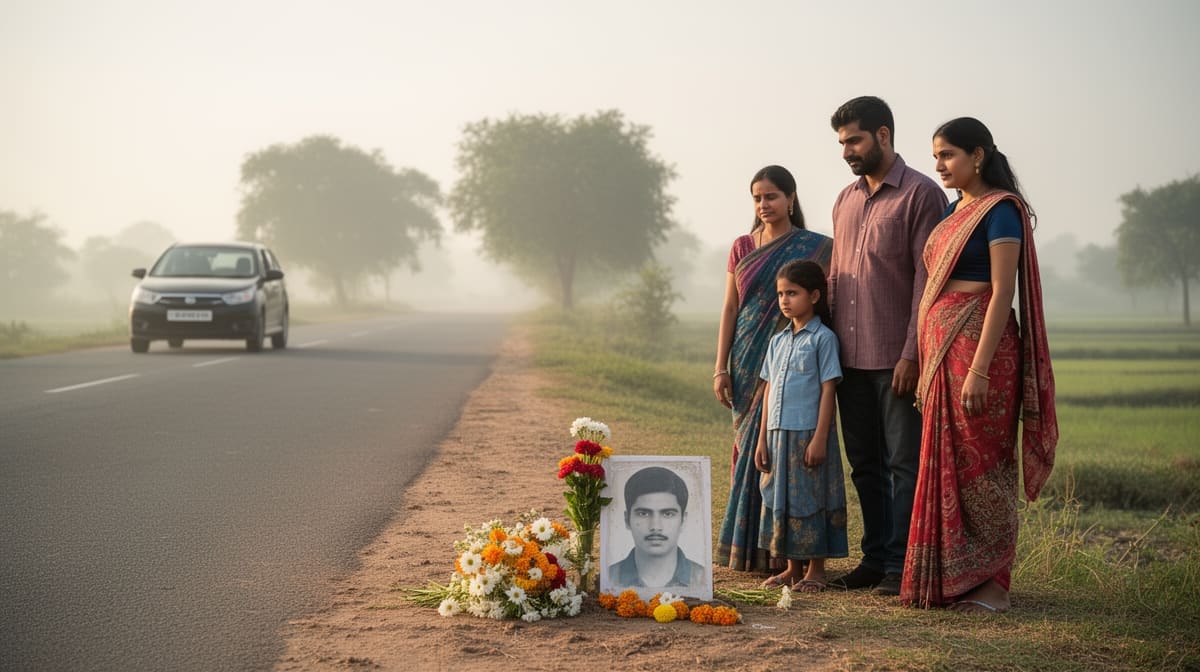
On 01.02.2000, Bhagwan Dass, aged 26, died when the trolley attached to a Mahindra tractor (registration HR-05C-2140), driven by Jeet Singh and owned by respondent No.2, overturned near Dera of Ved Park. He fell beneath the tractor and was killed. The accident occurred without any immediate formal police report.
Key Facts
- The deceased was employed and earning Rs.4,000 per month at the time of death
- Zile Singh, the deceased’s father and first responder, lodged a DDR (Mark-B) on the same day but did not mention rash or negligent driving
- No FIR was registered until approximately 11 months after the accident, and 9 months after the claim petition was filed
- The claim petition was filed on 05.02.2003 by the deceased’s widow, Ratti, and mother, Nita Devi
- The post-mortem report (Ex.PA) confirmed death due to trauma from the accident
- An alleged eyewitness, Malkiat Singh, was not mentioned in the DDR or in Zile Singh’s initial statement (Mark-A)
- The driver, Jeet Singh, admitted in cross-examination that the trolley’s hook detached, causing it to overturn, but denied any rash or negligent driving
- No site plan, mechanical inspection report, seizure memo, or independent public witness corroborated the claim of negligent driving
- The tractor was uninsured at the time of the accident
Procedural History
- 01.02.2000: Accident occurred
- 01.02.2000: DDR (Mark-B) lodged by Zile Singh
- 05.02.2003: Claim petition filed under Section 166 of the Motor Vehicles Act before Motor Accident Claims Tribunal, Panipat
- 02.04.2003: Tribunal dismissed claim for fault-based compensation under Section 166, awarded Rs.50,000 under Section 140 (no-fault liability)
- 2003 - 2023: Appeal pending before High Court
- 01.04.2022: Section 140 repealed and replaced by Section 164 via Motor Vehicles (Amendment) Act, 2019
- 13.03.2026: Appeal heard and reserved
- 18.03.2026: Judgment pronounced
The Parties' Positions
Appellants (widow and mother of deceased): Argued that despite delayed FIR and absence of police allegations, circumstantial and oral evidence - including the post-mortem report, driver’s admission, and eyewitness testimony - established negligence. They sought enhanced compensation under Section 166.
Respondents (driver and owner): Contended that the absence of negligence in the initial DDR, the belated FIR, and the uncorroborated testimony of Malkiat Singh rendered the negligence claim unreliable. They supported the Tribunal’s award of Rs.50,000 under Section 140.
Relief Sought
The appellants sought enhancement of compensation to reflect actual loss and dependency, including interest, under Section 166. In the alternative, they sought application of the amended Section 164 for higher no-fault compensation.
The Legal Issue
Can a claimant entitled to fixed no-fault compensation under Section 164 of the Motor Vehicles Act, even if the claim petition was filed under Section 166 and negligence could not be established due to delayed FIR and lack of corroborative evidence?
Arguments Presented
For the Appellant
Counsel argued that the Motor Vehicles Act is a social welfare statute requiring liberal interpretation. Even if negligence was not proven, the death resulted from a motor vehicle accident, which triggers no-fault liability under Section 164. The delay in FIR and absence of police allegations do not negate the statutory right to compensation. Reliance was placed on Ram Murti & Ors. v. Punjab State Electricity Board and New India Assurance Co. Ltd. v. Urmila Halder, where the Supreme Court extended Section 164 benefits to pending cases.
For the Respondent
Counsel contended that Section 164 cannot be invoked retrospectively or in cases where the claim was never pleaded under that provision. The claim petition was filed under Section 166, and the Tribunal rightly dismissed it due to lack of proof. The amendment to Section 164, they argued, cannot override the procedural and evidentiary deficiencies that led to dismissal under Section 166.
The Court's Analysis
The Court examined the evidentiary record and found that the claimants failed to discharge the burden of proving rash and negligent driving under Section 166. The initial DDR, prepared contemporaneously with the incident, contained no allegation of negligence. The FIR, registered 11 months after the accident and 9 months after the claim petition, was deemed an afterthought. The eyewitness Malkiat Singh was not mentioned in any early statement, rendering his testimony unreliable. The driver’s admission that the trolley hook detached did not amount to an admission of negligence.
"The initial document, prepared contemporaneously with the incident, is the most natural and reliable piece of evidence. Its silence about negligent driving completely demolishes the case of the appellants on this score."
The Court reaffirmed that while the standard of proof in motor accident claims is preponderance of probabilities, some cogent material must still be presented to establish negligence under Section 166. The Tribunal’s dismissal of the claim on this ground was upheld.
However, the Court turned to Section 164, which replaced Section 140 with effect from 01.04.2022. Section 164(2) explicitly states that the claimant need not prove wrongful act, neglect, or default. The Court held that the Motor Vehicles Act is a beneficial statute, and its amendments enhancing compensation must be applied to pending cases to fulfill its social welfare objective.
"Statutory amendments enhancing the measure of relief, particularly in no-fault liability provisions, can be applied to pending proceedings where they do not impair any vested rights but only advance the cause of justice."
The Court relied on Ram Murti and New India Assurance, where the Supreme Court granted Section 164 benefits even when the accident occurred before the amendment and negligence was unproven. The Court concluded that denying compensation under Section 164 in this case would defeat the very purpose of the Act.
The Verdict
The appeal is partly allowed. The dismissal of the claim under Section 166 is upheld. However, the appellants are entitled to a fixed compensation of ₹5,00,000 under Section 164 of the Motor Vehicles Act on a no-fault basis. This amount shall carry interest at 7% per annum from 01.04.2022 until realization. Since the vehicle was uninsured, the owner is liable to pay the compensation and interest. The Tribunal’s award of Rs.50,000 under Section 140 is set aside.
What This Means For Similar Cases
No-Fault Compensation Is Automatic Upon Proof of Accident
- Practitioners must now argue that if a motor vehicle accident results in death or grievous hurt, Section 164 applies regardless of whether negligence was pleaded or proven
- The burden shifts from proving fault to proving the accident involved a motor vehicle and resulted in death or grievous hurt
- Delayed FIRs, uncorroborated testimony, or absence of police allegations are irrelevant under Section 164
Amendments to Welfare Statutes Apply to Pending Cases
- Beneficial amendments to social legislation like the Motor Vehicles Act must be applied retroactively to pending appeals
- Courts cannot deny enhanced compensation on grounds of procedural non-compliance or timing of filing
- Claimants should always pray for alternative relief under Section 164 even if the petition is framed under Section 166
Insurance Liability Is Not a Barrier to Recovery
- When the offending vehicle is uninsured, the owner becomes personally liable for Section 164 compensation
- The absence of insurance does not extinguish the statutory right to no-fault compensation
- Practitioners must now routinely include the owner as the primary respondent for payment, even if insurance was not in force