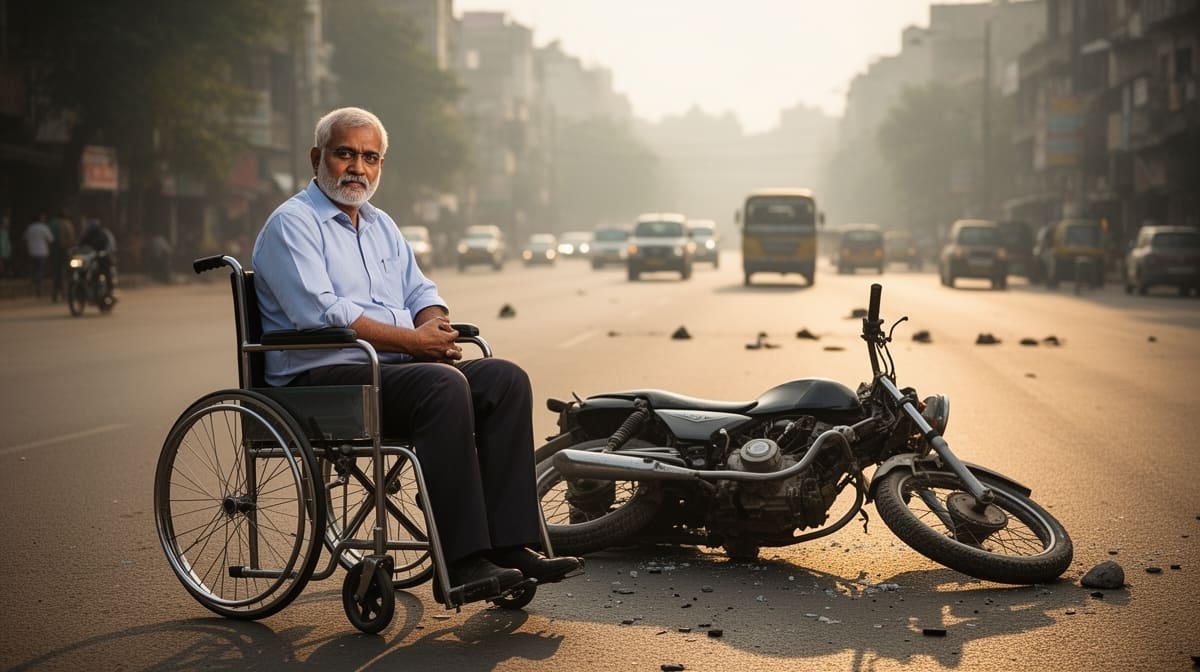
The Bombay High Court has clarified key principles in motor accident compensation claims by substantially enhancing the award to reflect realistic loss of future income, proper application of multiplier, and recognition of non-monetary damages. This judgment reinforces the need for courts to move beyond mechanical calculations and adopt a holistic, claimant-centric approach under the Motor Vehicles Act.
Background & Facts
The Dispute
The respondent, Rama Bhola Vishwakarma, sustained serious bodily and head injuries on 30 October 2005 when his motorcycle collided with a bus operated by the Brihan Mumbai Electricity Supply & Transport Undertaking (BEST). The accident resulted in prolonged incapacity and permanent disability, prompting the claimant to file a claim petition before the Motor Accident Claims Tribunal, Thane.
Key Facts
- The claimant was engaged in the business of furniture retail at the time of the accident
- He produced his Income Tax Return for the relevant year, showing a returned income of Rs. 1,05,252/-
- Two medical certificates were submitted: Dr. Bansal assessed 20% disability (bone injury), Dr. Joshi assessed 43.75% disability (head injury)
- The Tribunal adopted a 40% disability rating, consistent with the average of both reports
- The claimant was out of action for over six months, with medical evidence indicating continued incapacity for approximately 15 months
- The Tribunal awarded Rs. 5,78,000/- under six heads: pain and suffering, hospital bills, chemist bills, loss of business, special diet and conveyance, and loss of future income
Procedural History
- 30 October 2005: Accident occurred
- 2006: Claim petition filed before Motor Accident Claims Tribunal, Thane
- 31 July 2010: Tribunal delivered award of Rs. 5,78,000/-
- 16 February 2012: BEST filed First Appeal No. 160 of 2012 before the Bombay High Court
- 29 June 2026: Judgment delivered by Justice Jitendra Jain
Relief Sought
The respondent, through counsel, sought enhancement of the award. The appellant (BEST) challenged the Tribunal’s findings on negligence, disability percentage, and loss of business calculation.
The Legal Issue
The central questions were: (1) Whether the Tribunal erred in adopting a 40% disability rating despite conflicting medical certificates; (2) Whether the multiplier of 12 was correctly applied under Sarla Verma; (3) Whether loss of business should be calculated for six or twelve months; and (4) Whether loss of amenity should be awarded separately.
Arguments Presented
For the Appellant (BEST)
Ms. Heena Shaikh contended that the driver was not negligent, citing absence of police report. She argued that the loss of business was unproven due to non-production of business license. She challenged the 40% disability as arbitrary given two divergent medical opinions and urged application of a lower multiplier.
For the Respondent (Claimant)
Mrs. Rina Kundu argued that BEST’s internal departmental enquiry had found the driver guilty and imposed a seven-day suspension, establishing negligence. She relied on the Income Tax Return to substantiate business income and contended that the Tribunal’s six-month calculation for loss of business was inconsistent with its own finding of 15-month incapacity. She sought enhancement under the principle that claimants need not appeal to seek higher compensation.
The Court's Analysis
The Court rejected BEST’s argument on negligence, holding that the internal disciplinary finding against the driver constituted sufficient evidence of fault. The Court observed: > "The BEST undertaking in their own internal departmental enquiry have found the driver to be guilty and awarded seven days of suspension. Therefore, to that extent, the submission of the learned counsel cannot be accepted."
Regarding loss of business, the Court noted the Tribunal’s own observation that the claimant was incapacitated for more than six months, yet had awarded compensation for only six months. The Court held: > "In the interest of justice, the loss of business should be considered by taking twelve months and not six months."
On disability, the Court distinguished the two medical certificates: Dr. Bansal’s assessment pertained to bone injury, while Dr. Joshi’s addressed head trauma. The Court affirmed the Tribunal’s adoption of 40% as a reasonable midpoint, stating: > "No fault can be found in the Tribunal's reasoning in adopting 40% disability."
The Court then applied the Sarla Verma guidelines, holding that the multiplier for a claimant aged 40-45 with permanent disability must be 13, not 12. It further held that a 25% future prospects addition is mandatory for self-employed persons with documented income, raising the monthly income from Rs. 6,000/- to Rs. 7,500/-. The Court also awarded Rs. 10,000/- for loss of amenity, a head not previously considered by the Tribunal.
The Verdict
The appeal was disposed of with enhancement. The Court increased the compensation from Rs. 5,78,000/- to Rs. 7,69,500/-. The enhanced amount of Rs. 1,91,500/- is to be paid by BEST within 12 weeks from the date of judgment, along with interest from the date of the original application (31 July 2010) until realization. The Tribunal is directed to adjust any amounts already deposited or withdrawn.
What This Means For Similar Cases
Multiplier Must Reflect Age and Life Expectancy
- Practitioners must apply the Sarla Verma multiplier table strictly: 13 for claimants aged 40-45, not default to 12
- Failure to apply correct multiplier constitutes reversible error
Future Prospects Are Mandatory for Self-Employed
- For self-employed claimants with IT returns, a 25% addition to actual income is now mandatory under Pranay Sethi
- This applies even if the claimant is not salaried or lacks formal salary slips
Loss of Amenity Is a Separate Head of Compensation
- Loss of amenity is distinct from pain and suffering and must be quantified independently
- Courts must now explicitly consider and award this head where permanent disability affects daily living
Medical Certificates Must Be Interpreted by Specialization
- Conflicting medical opinions should not be dismissed as inconsistent if they address different anatomical or pathological aspects
- Tribunals may adopt a reasonable average if each certificate is grounded in professional expertise
Documentation Trumps Formalities
- Income Tax Returns are sufficient proof of business income; production of business license is not mandatory
- Internal disciplinary findings by employers can establish negligence in accident claims