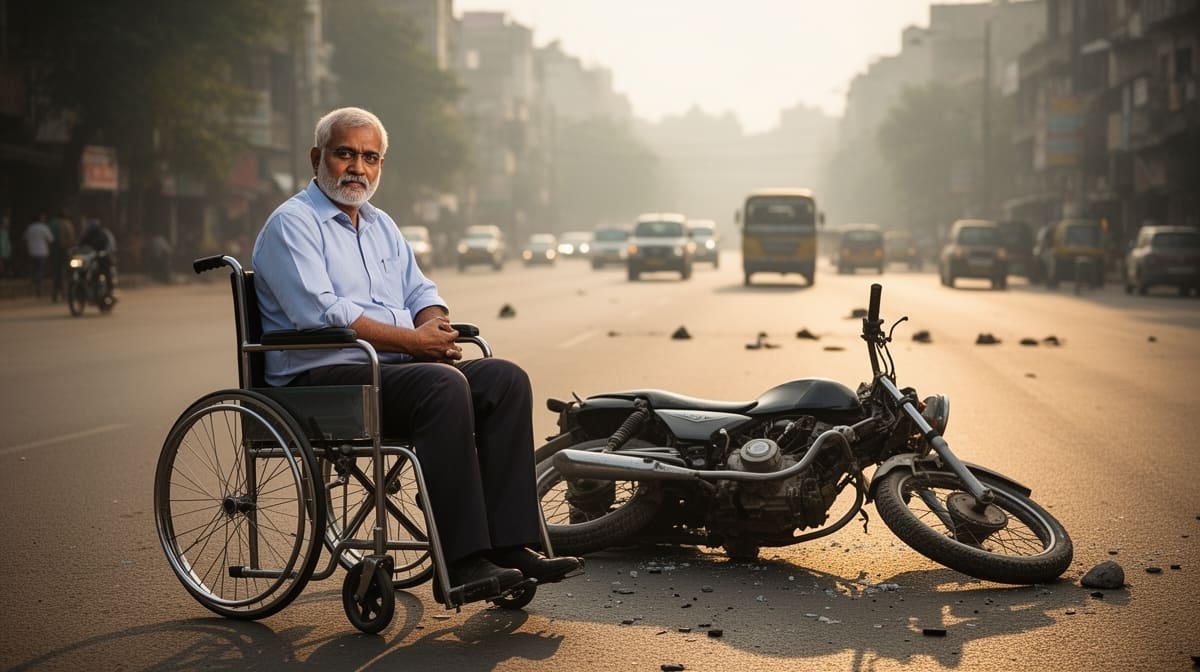
The Madhya Pradesh High Court has affirmed a Motor Accident Claims Tribunal award of over Rs.10.9 lakh, reinforcing the correct methodology for calculating loss of future earnings in personal injury claims. The judgment clarifies how income, future prospects, and disability percentages must be assessed under established precedents, offering critical guidance for practitioners handling motor accident claims.
Background & Facts
The Dispute
The claim arose from a motor accident involving a tractor and a motorcycle on or about 17.02.2017, in which the claimant, Shubham Singh, then aged 21 years, sustained severe injuries resulting in the amputation of his left leg below the knee. The claimant filed a claim petition before the Motor Accident Claims Tribunal, Sidhi, on 17.02.2017, seeking compensation for permanent disability, loss of future earnings, medical expenses, and other damages.
Key Facts
- The claimant was a semi-skilled labourer engaged in manual work at the time of the accident.
- He suffered permanent physical disability assessed at 80% by the Medical Board, as per Disability Certificate Ex.P-76.
- The Tribunal accepted the claimant’s monthly income at Rs.5,000, but the High Court found this undervalued.
- The appellant, National Insurance Company Limited, challenged the award on grounds of alleged collusion, delayed FIR, and incorrect disability assessment.
- The owner of the tractor denied involvement, but the FIR, charge-sheet, and MLC report were admitted as evidence.
- The claimant’s left leg was amputated below the knee, with stump length exceeding 8.89 cm but not exceeding 12.70 cm.
Procedural History
- 17.02.2017: Claim petition filed before Motor Accident Claims Tribunal, Sidhi (Claim Case No.28/2017)
- 21.12.2017: Tribunal awarded compensation of Rs.10,90,200/- with 7% interest from the date of filing (17.02.2017)
- 22.06.2018: Appeal filed before the High Court of Madhya Pradesh at Jabalpur (Misc. Appeal No.1843 of 2018)
- 22.06.2026: Hearing concluded before Justice Ratnesh Chandra Singh Bisen
Relief Sought
The appellant sought to set aside the Tribunal’s award on the grounds that:
- The FIR was inordinately delayed and the tractor owner denied involvement, suggesting collusion
- The MLC report indicated the claimant fell from a motorcycle, not from a tractor collision
- The functional disability of 60% was excessive and inconsistent with Schedule I of the Employees’ Compensation Act, 1923
- The income assessment of Rs.5,000/month was too low, but the multiplier and disability percentage were incorrectly applied
The Parties' Positions
Appellant (Insurance Company): Argued that the claim was collusive, the disability percentage should be capped at 50% under Schedule I of the Employees’ Compensation Act, and the Tribunal erred in not applying contributory negligence.
Respondent (Claimant): Contended that the FIR, charge-sheet, and medical evidence conclusively established the tractor’s involvement and the claimant’s permanent disability. The Tribunal’s award was fair and aligned with Pranay Sethi guidelines.
The Legal Issue
The central question was whether the Motor Accident Claims Tribunal correctly assessed the claimant’s monthly income, applied the appropriate multiplier, and determined the loss of future earning capacity based on a 60% functional disability, despite the statutory disability percentage under the Employees’ Compensation Act, 1923.
Arguments Presented
For the Appellant
The appellant’s counsel argued that the Tribunal erred in accepting a 60% functional disability, contending that Schedule I of the Employees’ Compensation Act, 1923, prescribes only 50% for amputation below the knee with stump length between 8.89 cm and 12.70 cm. It was further submitted that the delay in lodging the FIR (over 24 hours) and the tractor owner’s denial of involvement rendered the claim suspect. The appellant also contended that the Tribunal failed to consider contributory negligence, as the claimant was riding a motorcycle without a helmet or license. The counsel urged the Court to reduce the compensation by applying the statutory 50% disability rate and reducing the multiplier.
For the Respondent
The respondent’s counsel submitted that the Tribunal’s findings were based on credible documentary evidence: the FIR, charge-sheet, MLC report, and the Medical Board’s disability certificate (Ex.P-76) which assessed permanent disability at 80%. The counsel emphasized that the Employees’ Compensation Act is not applicable to motor accident claims, which are governed by the Motor Vehicles Act, 1988, and the principles laid down in National Insurance Co. Ltd. v. Pranay Sethi. The claimant’s income as a semi-skilled labourer was reasonably assessed, and the multiplier of 18 was correctly applied.
The Court's Analysis
The Court undertook a detailed review of the Tribunal’s methodology in calculating compensation. It noted that while the Tribunal had assessed the claimant’s monthly income at Rs.5,000, this was inconsistent with the Collector’s Guidelines applicable at the time, which fixed the monthly wage for semi-skilled labourers at Rs.7,707. The Court held that the claimant, aged 21 and engaged in manual labour, was reasonably classified as a semi-skilled worker.
"Considering the age of the injured, namely 21 years, and the nature of his avocation, this Court is of the view that his income could reasonably be assessed at Rs.7,707/- per month, treating him as a semi-skilled labourer."
The Court then applied the Pranay Sethi precedent to add 40% towards future prospects, resulting in an annual income of Rs.1,29,477. Even if the functional disability were reduced to 50% (as urged by the appellant), the loss of future earning would be Rs.64,738 per annum. Multiplying this by the standard multiplier of 18 (for a 21-year-old claimant), the total loss of future earnings amounted to Rs.11,65,284, which exceeds the Tribunal’s award of Rs.10,90,200.
The Court explicitly rejected the appellant’s reliance on the Employees’ Compensation Act, 1923, noting that the Act governs employer-employee liability and is inapplicable to third-party motor accident claims. The Tribunal was entitled to rely on the Medical Board’s assessment of 80% disability and apply its discretion in determining functional disability for compensation purposes.
The Court also dismissed the allegations of collusion, finding that the FIR and charge-sheet were duly recorded and corroborated by medical evidence. No evidence of fabrication was established.
The Verdict
The appellant’s appeal was dismissed. The High Court affirmed the Motor Accident Claims Tribunal’s award of Rs.10,90,200 with interest at 7% per annum from 17.02.2017 until realization. The Court held that the compensation was just, fair, and reasonable, and that the Tribunal correctly applied the principles of Pranay Sethi. No modification to the award was warranted.
What This Means For Similar Cases
Income Assessment Must Reflect Market Realities, Not Arbitrary Figures
- Practitioners must cite Collector’s Guidelines or wage data from official sources to challenge undervalued income assessments
- For claimants under 25, semi-skilled labourer rates (Rs.7,707/month) are often the appropriate benchmark, not Rs.5,000
- Courts will not accept low income figures without justification, especially for young, able-bodied claimants
Employees’ Compensation Act Does Not Bind Motor Accident Claims
- Disability percentages under Schedule I of the Employees’ Compensation Act are irrelevant for motor accident compensation
- Tribunals must rely on medical board assessments and apply functional disability percentages based on the claimant’s actual loss of earning capacity
- The Motor Vehicles Act operates independently, and compensation must be calculated under Pranay Sethi and related precedents
Delay in FIR Alone Cannot Invalidate a Claim
- A delay in lodging an FIR, even beyond 24 hours, does not automatically render a claim collusive
- The burden lies on the insurer to prove fabrication; mere denial by the vehicle owner is insufficient
- Corroborative evidence such as charge-sheet, MLC, and medical reports must be weighed holistically