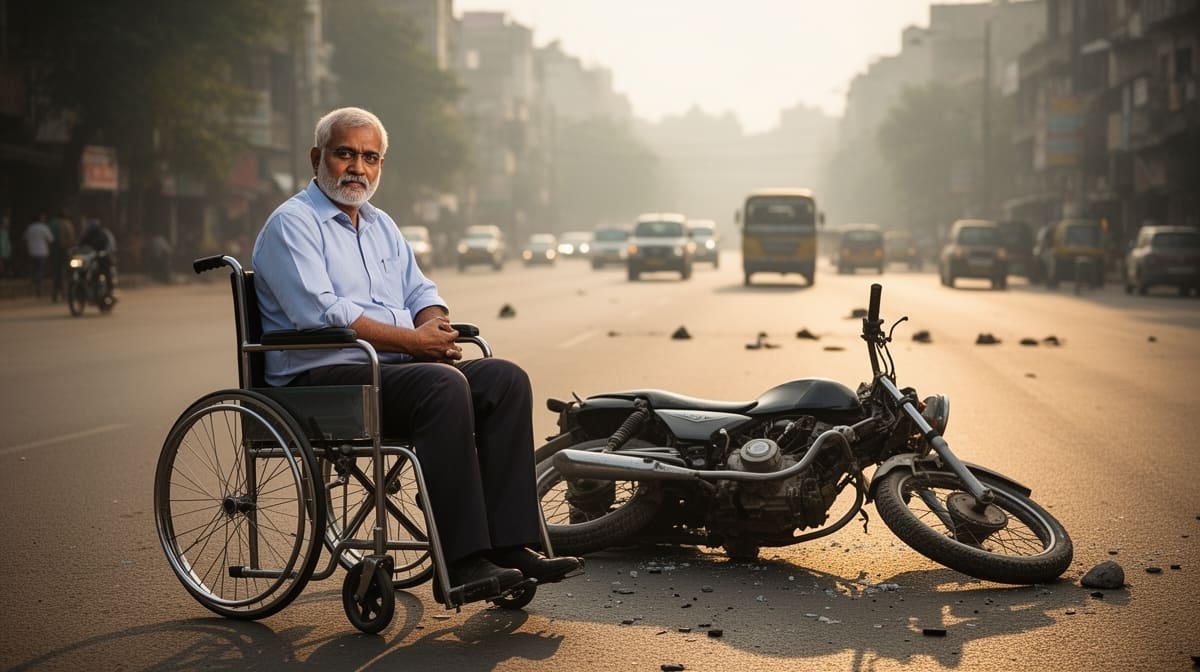
The Andhra Pradesh High Court has significantly clarified the methodology for calculating compensation in motor accident cases involving permanent disability, emphasizing that tribunals must apply the multiplier method with liberal inclusion of future prospects, even when the claimant’s income is not formally documented. This judgment reinforces the principle that compensation must restore the victim to their pre-accident economic position, not merely reimburse documented losses.
Background & Facts
The Dispute
The appellant, Karrothu Satyam, a 32-year-old daily wage laborer engaged in machine contract work, was involved in a motor vehicle accident on 26.03.2009 near Gurla Police Station, Vizianagaram District. The 1st respondent, Bonga Kannappadora Kanakaraju, was driving a truck bearing registration number AP 15 X 3767, which collided with the appellant’s motorcycle. The accident resulted in multiple fractures to both legs and severe physical disability.
Key Facts
- The appellant was riding his motorcycle on the left side of the road at approximately 18:00 hours on 26.03.2009.
- The truck driver, 1st respondent, allegedly drove rashly and negligently, causing the collision.
- The appellant sustained grievous injuries: fracture of right femur, tibia, and fibula; and fracture of left tibia and fibula.
- He was initially treated at Government Hospital, Vizianagaram, and later transferred to Kala Hospital, Visakhapatnam, for specialized orthopedic care.
- He underwent two surgical procedures: first on 31.03.2009 for fixation of implants, and second on 04.06.2009 for removal of nails and implants.
- He was discharged on 08.04.2009 after the first surgery and again on 05.07.2009 after the second.
- The appellant was earning Rs. 300 per day at the time of the accident.
- A case under Sections 337 and 338 IPC was registered as Crime No. 22 of 2019 against the driver.
- The District Medical Board, Vizianagaram, issued a Disability Certificate (Ex.A7) assessing his permanent disability at 45%.
- Medical expenses amounted to Rs. 99,967/- as per Ex.A5.
- Treatment was availed under the Rajiv Aarogyasri Scheme, but the appellant affirmed he had personally paid the bills.
Procedural History
- 26.03.2009: Date of accident.
- 26.03.2009: FIR filed (Ex.A1) by Gurla Police Station.
- 05.04.2009: Wound certificate issued (Ex.A2).
- 15.06.2009: M.V.I. report prepared (Ex.A3).
- 10.07.2009: Charge sheet filed against driver (Ex.A4).
- 10.08.2009: Disability Certificate issued by District Medical Board (Ex.A7).
- 2009: Motor Vehicle Accident Claim Petition (MVOP No. 833 of 2009) filed before the Motor Accidents Claims Tribunal (MACT), Vizianagaram.
- 31.12.2011: MACT awarded compensation of Rs. 2,23,000/-.
- 01.07.2013: Appeal filed before the High Court under Order 41 CPC.
- 01.07.2026: Judgment pronounced by the Andhra Pradesh High Court.
The Parties' Positions
Appellant (Claimant): Argued that the compensation awarded was inadequate. Contended that the MACT erred in undervaluing loss of future earnings and failing to apply the multiplier method correctly. Asserted that 30% future prospects should have been added to his income, and that the lump sum of Rs. 45,000/- for 45% disability was irrational.
Respondents: Did not adduce any oral evidence. The insurer (3rd respondent) challenged the claimant’s income proof and argued that the compensation was excessive. The driver and owner adopted the insurer’s counter.
Relief Sought
The appellant sought enhancement of compensation to reflect the true loss of earning capacity, including:
- Proper calculation of loss of future earnings using the multiplier method
- Addition of 30% future prospects to monthly income
- Adequate compensation for pain, suffering, medical expenses, and attendant charges
- Interest at a reasonable rate from the date of petition
The Legal Issue
The central question was whether the Motor Accidents Claims Tribunal and the High Court on appeal must apply the multiplier method to calculate loss of future earnings for a permanently disabled claimant, and whether a 30% addition for future prospects is permissible even when the claimant’s income is not formally documented.
Arguments Presented
For the Appellant/Petitioner
The appellant relied on Rajkumar v. Ajay Kumar and Sidram v. United India Insurance Co. Ltd. to argue that the percentage of permanent disability does not automatically equate to loss of earning capacity, and that tribunals must assess earning capacity based on occupation, age, education, and nature of work. He contended that his daily wage of Rs. 300 justified a monthly income of Rs. 9,000, and that a 30% addition for future prospects was standard under Kajal v. Jagadish Chand. He further cited Sarla Verma v. Delhi Transport Corporation to support the use of a multiplier of 16 for a 32-year-old claimant. He emphasized that compensation must be liberal and not constrained by rigid formulas.
For the Respondent/State
The respondents did not present any oral evidence. The insurer challenged the claimant’s income proof, arguing that Rs. 300 per day was speculative and that no salary slips or tax records were produced. They contended that the MACT’s award of Rs. 100 per day was conservative and adequate, and that the lump sum of Rs. 45,000/- for disability was reasonable. They also argued that the claimant had received treatment under a government scheme, implying no out-of-pocket expenses.
The Court's Analysis
The Court undertook a detailed review of precedents from the Supreme Court to establish a principled framework for quantifying compensation in permanent disability cases. It emphasized that compensation under the Motor Vehicles Act is not merely damages for loss, but a mechanism to restore the victim to their pre-accident economic status.
"The expression compensation may include a claim for damage but compensation is more comprehensive. Normally damages are given for an injury which is suffered, whereas compensation stands on a slightly higher footing. It is given for the atonement of injury caused and the intention behind grant of compensation is to put back the injured party as far as possible in the same position, as if the injury has not taken place, by way of grant of pecuniary relief."
The Court rejected the MACT’s lump sum award of Rs. 45,000/- for 45% disability as arbitrary and unsupported by any rational calculation. It held that the percentage of disability must be converted into a percentage of loss of earning capacity, which then must be multiplied by the claimant’s annual income and the appropriate multiplier.
The Court accepted the appellant’s income of Rs. 300 per day as credible, noting that daily wage earners in rural India rarely maintain formal records. It added 30% future prospects as mandated by Kajal v. Jagadish Chand, resulting in a monthly income of Rs. 3,900/- (Rs. 3,000 + 30%). Applying 45% loss of earning capacity, the monthly loss was Rs. 1,755/-. Multiplying this by the applicable multiplier of 16 (for age 32 under Sarla Verma), the Court calculated the loss of future earnings at Rs. 3,36,960/-. The Court also enhanced other heads: transportation from Rs. 1,000 to Rs. 25,000; medical and attendant charges from Rs. 1,09,000 to Rs. 1,00,000; and pain and suffering from Rs. 60,000 to Rs. 50,000, while adjusting for reasonableness.
The Court further affirmed that there is no legal bar to awarding compensation exceeding the claim amount, citing Nagappa v. Gurudayal Singh and Ramla v. National Insurance Co. Ltd. The insurer was held jointly and severally liable with the owner, as per the insurance policy.
The Verdict
The appeal was allowed. The High Court set aside the MACT’s award of Rs. 2,23,000/- and enhanced the compensation to Rs. 5,45,960/-. The claimant is entitled to interest at 7.5% per annum from the date of the petition until realization. Respondents 2 and 3 are jointly and severally liable, with the insurer (Respondent 3) primarily responsible. The insurer must deposit the amount within two months. If the claimant furnishes his bank account number within 15 days, payment shall be made directly; otherwise, the amount shall be deposited with the MACT for withdrawal. There shall be no order as to costs.
What This Means For Similar Cases
Loss of Earning Capacity Must Be Calculated, Not Assumed
- Practitioners must now argue that disability percentage ≠ loss of earning capacity; tribunals must assess occupation, age, and work nature to determine actual earning loss.
- A 45% disability does not justify a flat Rs. 45,000/- award; it must be converted into a percentage of income loss and multiplied.
Future Prospects Are Mandatory Even for Informal Workers
- A 30% addition for future prospects is now a settled norm for claimants under 40, regardless of formal income proof.
- Daily wage earners’ earnings can be inferred from local norms and testimony; absence of salary slips is not fatal.
Multiplier Must Be Applied with Sarla Verma Guidelines
- The multiplier for a 32-year-old is 16; deviations require explicit justification.
- Courts must apply the multiplier to the adjusted annual income (income + 30% prospects), not to the disability lump sum.
Compensation Can Exceed Claimed Amount
- Claimants may be awarded more than claimed if the evidence supports a higher quantum.
- This removes a procedural barrier and aligns with the compensatory purpose of the Act.
Insurance Liability Is Absolute
- Insurers remain liable even if the owner/driver is not present or contesting.
- Payment timelines and direct deposit mechanisms must be strictly followed.