The Allahabad High Court has significantly clarified the methodology for calculating just compensation in motor accident claims, particularly regarding future prospects, prosthetic limb replacement costs, and income assessment for homemakers. The judgment reinforces that compensation must reflect realistic economic loss and long-term medical needs, not merely static figures.
Background & Facts
The Dispute
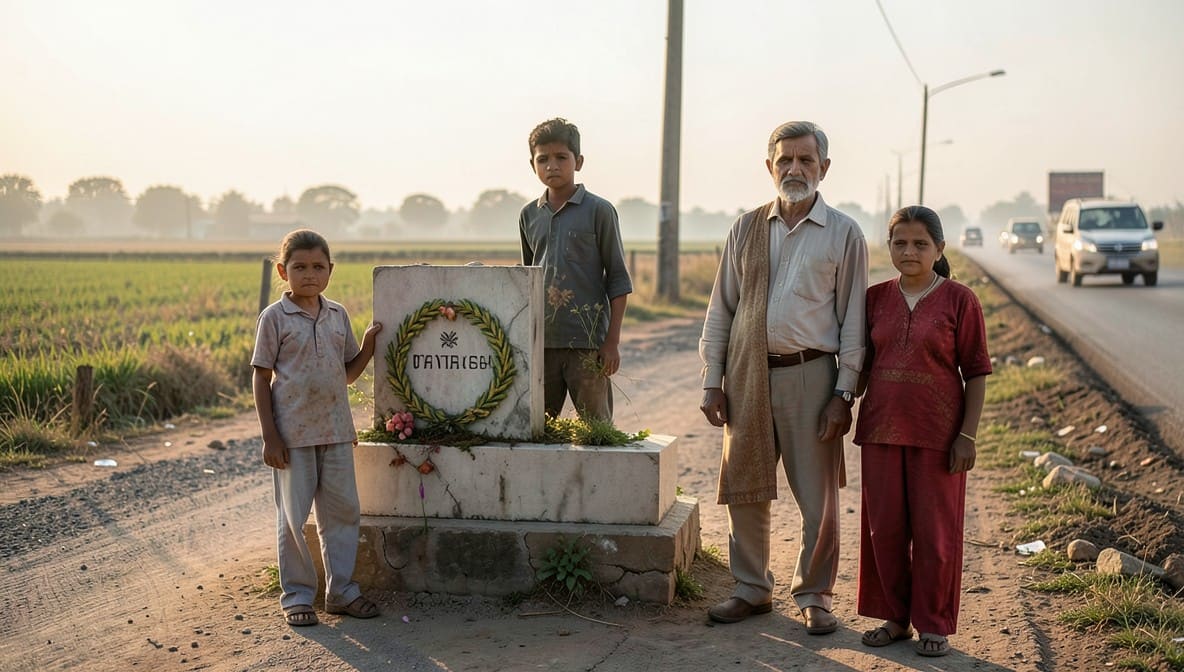
On 07.11.2008, a motorcycle carrying Jagat Dev Singh and his relative Malti Devi collided with a TATA 407 truck (UP 86-9684) driven negligently. Jagat Dev Singh sustained severe injuries requiring leg amputation and an artificial limb. Malti Devi, aged 52, died at the scene. Two claim petitions were filed before the Motor Accident Claims Tribunal: one by Jagat Dev Singh for permanent disability, and another by Malti Devi’s legal heirs for wrongful death.
Key Facts
- Jagat Dev Singh: Male, aged 30 at the time of accident. Claimed monthly income of Rs.6,000/- (Rs.4,000/- from oil company job, Rs.2,000/- from property dealing).
- Malti Devi: Female, aged 52, housewife. No formal employment. Survived by three legal heirs.
- Injuries: Jagat Dev Singh underwent leg amputation; procured artificial limb at a cost of Rs.2,82,996/-. Expected to require replacement every five years.
- Evidence: Jagat Dev Singh testified that the truck was driven in a zigzag manner. No contrary evidence was presented by the insurer or owner to establish contributory negligence.
- Tribunal Award: Awarded Rs.11,99,520/- for disability (based on Rs.6,000/- monthly income with multiplier 17) and Rs.2,82,996/- for prosthetic limb. Awarded Rs.6,66,500/- to Malti Devi’s heirs (based on Rs.3,000/- monthly income with 1/3 deduction).
Procedural History
- 07.11.2008: Accident occurred.
- 2009: Claim petitions filed before Motor Accident Claims Tribunal.
- 2010: Tribunal delivered award.
- 2011: First Appeal From Order No. 860 of 2011 (Jagat Dev Singh) and First Appeal From Order No. 791 of 2011 (Malti Devi’s heirs) filed before High Court.
- 13.05.2026: Judgment delivered by Hon’ble Justice Pankaj Bhatia.
- 03.02.2026: Substitution application filed in Appeal No. 791 of 2011 due to death of respondent no.1; condoned by court.
The Parties' Positions
For the Appellant (The New India Assurance Co. Ltd.)
- Argued contributory negligence due to head-on collision.
- Contended that Jagat Dev Singh’s income of Rs.6,000/- was not substantiated: Filling station certificate was denied by its owner; no proof of Rs.2,000/- from property business.
- Argued that Rs.3,000/- monthly income for Malti Devi (housewife) was appropriate and 1/3 deduction was correct.
- Claimed compensation amounts were excessive and unsupported by evidence.
For the Respondents (Claimants)
- Relied on Magma General Insurance Co. Ltd. v. Nanu Ram and National Insurance Co. Ltd. v. Pranay Sethi to argue for just compensation under Section 168 of the Motor Vehicles Act.
- Asserted that income evidence was corroborated: Annexure No.6 confirmed Rs.2,000/- from property business; filling station testimony confirmed Rs.4,200/-.
- Argued that future prospects must be added: 40% for employed persons, 10% for housewives.
- Cited Prahlad Sahai v. Haryana Roadways for prosthetic limb replacement every five years.
- Cited Lata Wadhwa v. State of Bihar for housewife income norms.
Relief Sought
- Jagat Dev Singh: Increase compensation for disability and prosthetic limb costs.
- Malti Devi’s heirs: Increase compensation by revising income assessment and removing arbitrary 1/3 deduction.
- Both: Interest from date of filing claim petition until realization.
The Legal Issue
The central questions were: (1) Whether contributory negligence can be inferred from a head-on collision absent evidence; (2) Whether future prospects must be added to income for calculating compensation under Section 168 of the Motor Vehicles Act; (3) Whether the cost of a prosthetic limb must be recalculated based on life expectancy and replacement cycles; and (4) Whether the income of a housewife should be assessed at Rs.3,000/- or at a higher rate reflecting inflation and evolving norms.
Arguments Presented
For the Appellant
The insurer contended that the Tribunal erred in accepting unverified income documents. The filling station certificate was contradicted by its owner, and no bank statements or tax returns supported the Rs.2,000/- income from property dealing. The insurer argued that the Tribunal’s reliance on oral testimony without documentary corroboration violated evidentiary standards. Regarding Malti Devi, the insurer maintained that Lata Wadhwa set a binding precedent of Rs.3,000/- monthly income for housewives, and the 1/3 deduction for personal expenses was standard. The insurer further argued that the multiplier of 17 for a 30-year-old was excessive and that the prosthetic cost of Rs.2.83 lakh was adequate.
For the Respondent
The claimants relied on Pranay Sethi to assert that future prospects are mandatory: 40% for employed persons and 10% for homemakers. They cited Prahlad Sahai to argue that prosthetic limbs must be costed for replacement every five years, making the Tribunal’s one-time award inadequate. For Malti Devi, they argued that Rs.3,000/- was outdated and that Rs.5,000/- per month (semi-skilled worker rate) was appropriate in 2008. They emphasized that Section 168 mandates just compensation regardless of cross-appeal, and that the Tribunal’s findings on negligence were supported by unchallenged testimony.
The Court's Analysis
The Court conducted a meticulous review of the evidence and applicable precedents. It rejected the insurer’s argument on contributory negligence, noting that the claimant’s testimony about the truck’s zigzag driving was uncontradicted in cross-examination. The Court held that a head-on collision alone cannot establish negligence on the part of the motorcyclist without affirmative evidence.
"The cross examination of the said witness does not discredit the said testimony rather reinforces it. Apart from the same, no evidence was adduced at the instance of the owner and the Insurance Company to establish the contributory negligence."
On income assessment, the Court upheld the Tribunal’s finding of Rs.6,000/- monthly income for Jagat Dev Singh. Annexure No.6 and the filling station testimony were deemed credible and unimpeached. However, the Court found the Tribunal erred in omitting future prospects. Citing Pranay Sethi, it held that 40% must be added to the assessed income for employed persons under 40. This raised the monthly income to Rs.8,400/-.
For prosthetic limb costs, the Court relied on Prahlad Sahai, which mandates that compensation must account for replacement every five years. Given Jagat Dev Singh’s age of 30, the Court estimated 10-12 replacements over his life expectancy. It awarded Rs.10,00,000/- as a lump sum for future limb replacements, replacing the Tribunal’s one-time cost.
Regarding Malti Devi, the Court held that Lata Wadhwa’s Rs.3,000/- figure was from 2001 and outdated. In 2008, a housewife’s income should be assessed at Rs.5,000/- per month as a semi-skilled worker. The 1/3 deduction for personal expenses was retained, but the multiplier of 11 was correctly applied. The Court also upheld the conventional heads: loss of estate (Rs.18,500/-), funeral expenses (Rs.18,500/-), and loss of consortium (Rs.48,500/- per heir).
The Court emphasized that Section 168 permits enhancement even without a cross-appeal, as the claimant may plead for just compensation. The interest rate was fixed at 7% per annum from the date of filing, and payment must be made via RTGS to verified family accounts, per Parminder Singh v. Honey Goyal and Suo Motu Writ Petition No.7 of 2024.
The Verdict
The appeals were allowed. The compensation for Jagat Dev Singh was revised to Rs.21,99,520/- (Rs.11,99,520/- for loss of earnings + Rs.10,00,000/- for prosthetic limbs). The compensation for Malti Devi’s heirs was revised to Rs.6,66,500/-. Both amounts shall bear interest at 7% per annum from the date of filing the claim petitions until actual payment. The total compensation shall be paid within three months via RTGS to bank accounts held solely or jointly by family members. Any prior payments shall be adjusted from the final amount.
What This Means For Similar Cases
Future Prospects Are Mandatory, Not Discretionary
- Practitioners must now routinely claim 40% future prospects for claimants under 40 and 10% for housewives, citing Pranay Sethi.
- Tribunals must explicitly state whether future prospects were considered and, if not, the reasons for omission.
- Failure to include future prospects renders the award legally defective and subject to appellate revision.
Prosthetic Limb Costs Must Reflect Life Expectancy
- Compensation for artificial limbs must be calculated based on replacement every five years, per Prahlad Sahai.
- Advocates must submit medical reports estimating life expectancy and replacement cycles.
- One-time awards for prosthetics are no longer sustainable; courts must award lump sums covering anticipated replacements.
Housewife Income Must Reflect Contemporary Norms
- The Rs.3,000/- benchmark from Lata Wadhwa is obsolete. Current assessments should use Rs.5,000/- per month as a baseline for housewives in 2008 - 2015.
- Income for homemakers should be assessed as semi-skilled workers, adjusted for inflation and regional wage norms.
- Arbitrary deductions beyond 1/3 for personal expenses are not permitted unless substantiated by evidence.